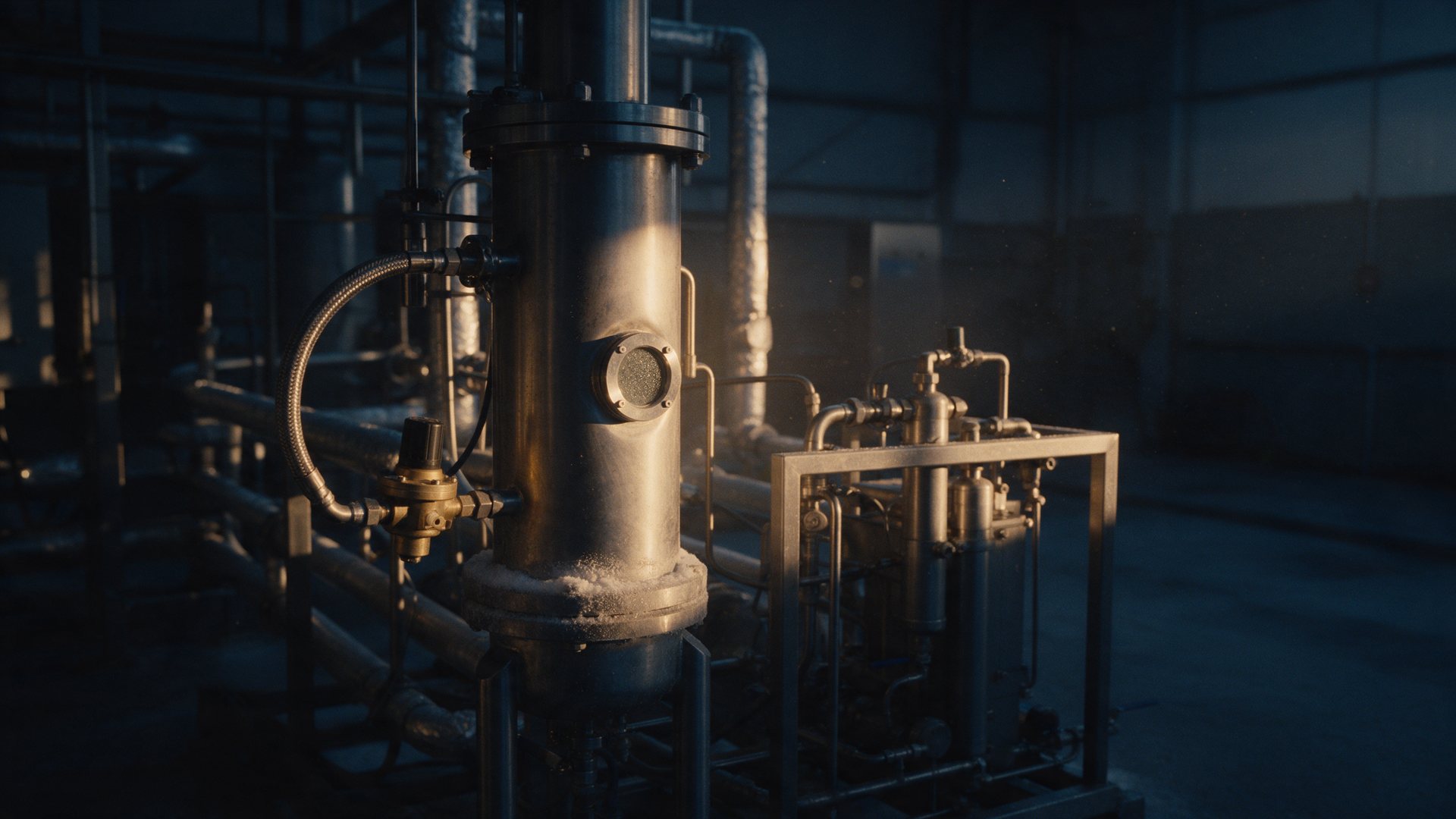
The reaction was never the problem
4H2 + CO2 -> CH4 + 2H2O, with a Gibbs free energy of -131 kJ per mole. Hydrogenotrophic methanogens have run that reaction on this planet for billions of years, and the strains that matter commercially are well characterised: Methanothermobacter thermautotrophicus grows at 55 to 70 degrees Celsius and doubles every two to four hours, and Methanocaldococcus jannaschii tolerates 80 to 85 degrees and pressures up to 50 bar.
A biological route that works in a 5-litre fermenter is a solved problem. The reason it has taken fifteen years to reach commercial scale is not biology. It is gas-liquid mass transfer.
Mass transfer is the engineering
Hydrogen dissolves badly. At 55 degrees and one bar, the solubility is 1.4 milligrams per litre, which is why the volumetric mass transfer coefficient, kLa, sits between 10 and 300 per hour across every design in the field and is the binding constraint on throughput.
The reactor types people solve it with are known: continuously stirred tanks, trickle beds, bubble columns, membrane biofilm reactors, solid-state supports. Performance separates sharply. A trickle bed reaches 1 to 15.4 normal cubic metres of methane per cubic metre of reactor per day at 95 to 99 per cent purity. A stirred tank runs 0.4 to 5 at 85 to 99 per cent. Raising pressure from one bar to five roughly doubles the production rate. Specific energy demand lands between 0.3 and 0.8 kilowatt hours per normal cubic metre of methane.
Read those ranges as the honest state of the art. Nothing in them is theoretical, and nothing in them is a step change.
Commercial scale already arrived
Europe ran 35 operational e-methane plants in 2023, producing 449 gigawatt hours a year, against a projection of 3,000 gigawatt hours a year by 2027. The wider biomethane base is larger: 1,678 European plants as of June 2025 and roughly 3.5 billion cubic metres of production in 2023. EU policy asks for 35 billion cubic metres by 2030, and the European Commission puts the investment needed to reach it between EUR 37 billion and EUR 83 billion.
The reference installations are specific. BioCat in Copenhagen has run a 1 megawatt power-to-gas unit at 200 normal cubic metres per hour since 2016. Allendorf in Germany commissioned a 300 kilowatt electrolysis line in 2015. Harjavalta in Finland pairs 20 megawatts of electrolysis with a solid-state reactor. Sonderborg in Denmark produces 33 gigawatt hours a year of e-methane.
One input price decides the outcome
Electrolysis hydrogen costs EUR 4 to 8 per kilogram today and is projected at EUR 2 to 3 by 2030. It is more than 75 per cent of the total cost of the process, which means the business case is a hydrogen-price case with biology attached.
The rest of the stack is knowable. Biocatalyst capital cost runs EUR 20 to 200 per megawatt hour and operating cost around EUR 13 per megawatt hour. Levelised e-methane lands between EUR 170 and EUR 680 per megawatt hour, against natural gas at EUR 30 to 50 per megawatt hour on the TTF benchmark. The EU emissions trading price of EUR 64 per tonne of CO2 adds only about EUR 10 to 15 per megawatt hour of advantage.
That arithmetic is why the field consolidates rather than proliferates.
The intellectual property is concentrated
Across more than 24 patent families, one company holds eight or more. Electrochaea's filings span the European Patent Office, the United States, Japan, China, Brazil, Mexico, Singapore, Australia, Canada, South Africa, Israel and Taiwan. Its foundation patent on the strain, EP2661511B1 and US8932849B2, was filed with a 2011 priority and runs to 2032.
Around it sit specific positions rather than broad ones. Q Power claims a solid-state reactor needing no pressure and no agitation, US11512272B2. The Technical University of Denmark claims a membrane biofilm reactor, EP3555258B1. Matthias Brunner claims a reactor with gas throughput up to 500:1, US10329588B2. In the last three years Kanadevia Inova acquired MicrobEnergy and Cycle0 acquired Biogasclean.
Where the white space actually sits
Hyperthermophilic strains above 80 degrees have one published paper and no patents. High-pressure integrated systems have few filings. Machine-learning control of a methanation reactor has a single pending application. Underground in-situ methanation is filed in one jurisdiction only.
A filing strategy that goes where the incumbents did not is cheaper than one that argues with them.
The probability that a biological route wins on the strength of its chemistry alone is close to zero. The chemistry is public. What decides the outcome is whether the input price curve and the policy value converge before the runway ends.
We have built 200 wood-gasification machines across the UK and Europe, restructured a EUR 75 million industrial group, and built companies across twelve countries. The diligence question is never whether the reaction works. It is what the hydrogen costs in the year the plant has to be paid for.
For advisory, board seats and media appearances, write to media@exventure.co.