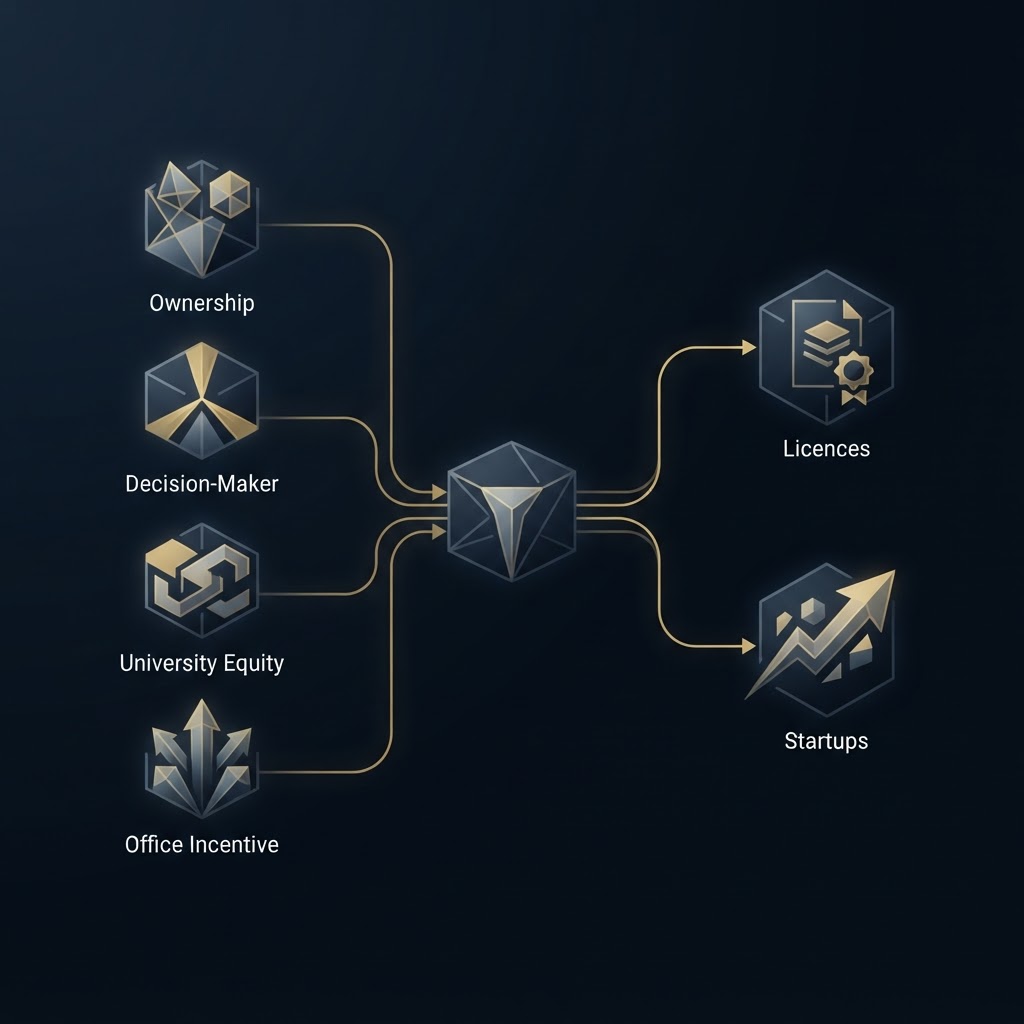
University research commercialization is usually discussed as if it were a talent problem. Smarter founders, braver scientists, better pitch decks. The data says something less flattering and more useful: the number of companies a university system produces is set mostly by its rules. Who owns the invention. Who gets to decide what happens to it. How much the institution takes. What the transfer office is paid to maximise.
Change those four settings and the output changes, even when the science stays the same. This piece compares the systems that exist today, the US, the UK and the Nordic variants, and pulls out what the productive ones share. If you want the practical version for a single invention, read the three routes out of a university first. This is the view from one level up.
The scoreboard: how much research becomes a company
Start with the biggest system and its own numbers. In FY2024, US universities and research institutions reported 26,196 invention disclosures, 9,507 licences and options, 775 new products and 941 startups formed, on USD 109.7 billion of research expenditure. The year before it was 903 startups and 714 products on USD 104.9 billion.
Do the division and two ratios fall out:
- Roughly 28 disclosures per startup. Most inventions leave as a licence, or not at all.
- Roughly USD 117 million of research spend per startup, stable across both years.
FY2025 pushed in the right direction, with research spend above USD 112 billion, more than 28,000 disclosures and new startups up 15 percent. The same update shows foreign patent filings down 40 percent, which matters more than it sounds for anything that has to be deployed outside the home market. For what each step costs once a disclosure is filed, see the route from research to commercialization, priced.
The honest reading: the machine works, slowly and expensively, and the ratio barely moves year to year. That stability is the clue. When output tracks spend that closely, the bottleneck is structural. We walked through the five structural bottlenecks in why so much academic research stalls. Here the question is which rules create them.
Rule one: who owns the invention and who decides
Bayh-Dole: the office decides
Since the Bayh-Dole Act of 1980, US universities own inventions made with federal money and their technology transfer offices decide what to do with them. The inventor gets a share of income, not the steering wheel.
That choice of decision-maker has consequences. An office judged on licensing revenue picks the counterparty most likely to pay, which is usually an established company. A model comparing the US and Swedish systems notes that startup licences represent under 10 percent of US licences executed, and finds the US system is less conducive to entrepreneurship whenever incumbents hold any advantage, because the inventor who would have pushed for a startup is not the one choosing.
The revenue logic does not even pay off for most institutions. In one AUTM-based study of 144 US universities, only 65 of 2,821 licences issued in 2011 generated more than USD 1 million. A handful of blockbusters carry the whole system.
Professor's privilege: the inventor decides
Sweden runs the opposite rule. Under the professor's privilege, the academic owns the invention. When Denmark and Norway moved to university ownership, their offices increased their use of licensing, while Swedish universities kept a spin-off strategy. Same region, similar science, different owner, different output mix.
The pattern is simple enough to state as a rule of thumb: put the decision with the inventor and you get more companies; put it with the office and you get more licences. Neither is wrong. They optimise for different things, and most systems never state which one they want.
Rule two: what the university takes
The second rule is the price of leaving. If the university's equity stake and terms scare off the first investor, the company dies at incorporation, whatever the science.
The UK confronted this directly. Its 2023 Independent Review of University Spin-out Companies recommended 10 to 25 percent university equity as the norm for life sciences spinouts, and 10 percent or less for software, with hardware and engineering sitting in between. It also asked for something that costs nothing: approvals delegated to named individuals instead of committees that meet a few times a year, and a template term sheet modelled on the US University Startup Basic Outlicensing Template, US-BOLT.
The government accepted every recommendation, and pointed to the momentum it wanted to protect: UK spinout investment grew from GBP 1.1 billion in 2014 to GBP 5.3 billion in 2021.
Here is the twist. A later study of 15 major UK spinout universities found founding equity trending down, but only a weak and context-dependent link between equity levels and investment success. Support structures, team strength and investor access mattered more. So equity is a gate, not an engine. A greedy stake can kill a deal. A generous one does not create a company. We cover the negotiation itself in how founders and universities split spinout equity.
Rule three: what the office is paid to maximise
If licensing income is the metric, it is worth knowing how small it is. A cross-country comparison put licence revenue at 2.9 percent of research expenditure for US universities, 1.1 percent in the UK and 1.2 percent across Europe. The same comparison found European public research produced more start-ups per research dollar than the US, and that about half of all licences involved no patent at all.
Read that twice. The system most famous for commercialization leads on income share, and loses on company formation. The authors suggest one reason: low royalties for European academic inventors push them to found firms instead. Incentives again, not talent.
What makes an office productive? A US and UK efficiency study found the number of transfer staff and legal spend drive output, while research income is not the critical input, with constant or decreasing returns to scale. Bigger offices do not get proportionally better. Experienced people with a budget to protect and negotiate do.
What the systems that work have in common
Comparisons of Stanford, MIT, Cambridge and Oxford describe the split plainly: the US offices run decentralised, entrepreneurship-driven models tied closely to venture capital, while Cambridge and Oxford centralise and prioritise long-term partnerships. Stanford files over 250 patent applications a year, MIT around 350, Oxford around 130. The US pair is faster. The UK pair is more patient and matures technology further before it leaves.
Across all the evidence above, the productive systems share five settings:
- A clear owner and a fast decision. Delegated sign-off, published timelines, no quarterly committee.
- Predictable terms. A template everyone starts from, so negotiation is about the deal, not the document.
- Inventor upside that competes with a salary. Where inventors earn little from licences, they found companies.
- An office staffed for deals, not compliance. Staff and legal budget beat raw research income.
- Capital and operators within reach. Every model that produces companies sits next to investors who can price deep tech and people who can run it.
The fifth is where most systems are weakest, and it is the one no university can legislate.
Where a venture builder fits in the system
A transfer office can protect an invention and sign a licence. It cannot hire the operator who will run the first plant, finance a pilot unit or file patents in the markets where the product will actually be sold. That is the gap between a signed deal and a deployed technology, and it is where a deep tech venture builder earns its place.
EX Venture works on exactly that half of the problem. We finance, patent and deploy deep tech across four continents, with a EUR 160M+ capital track record. Zero-X has put 200+ waste-to-energy units into operation across 11 countries. EX IX has filed 24 patent families with around 100 more validated in the pipeline. None of that replaces a university. It is the part of the system the university was never built to run.
If you sit on the university side, the implication is practical: design your terms so that a builder, an investor and an operator can all say yes in the same quarter. If you sit on the founder side, choose your institution's rules as carefully as your co-founder. For the vocabulary behind all of this, see what research commercialisation means.
FAQ
Which country is best at university research commercialization?
It depends on the metric. The US earns the most licence income relative to research spend, 2.9 percent against about 1 percent in the UK and Europe. Europe, in the same comparison, formed more start-ups per research dollar. Pick the metric that matches your goal before you pick the model.
What is the professor's privilege?
A rule under which the academic inventor, not the university, owns the invention. Sweden kept it, while Denmark and Norway moved to university ownership, and their transfer offices then leaned toward licensing rather than spin-offs.
Does licensing income fund university research?
Barely. Even in the US it is under 3 percent of research expenditure, and most of that comes from a few licences. Treat a transfer office as a route to impact, not a revenue line.
What is US-BOLT?
The US University Startup Basic Outlicensing Template, a shared starting point for startup licence terms. The UK spinout review recommended building a similar template term sheet so that negotiations start from a common document instead of a blank page.