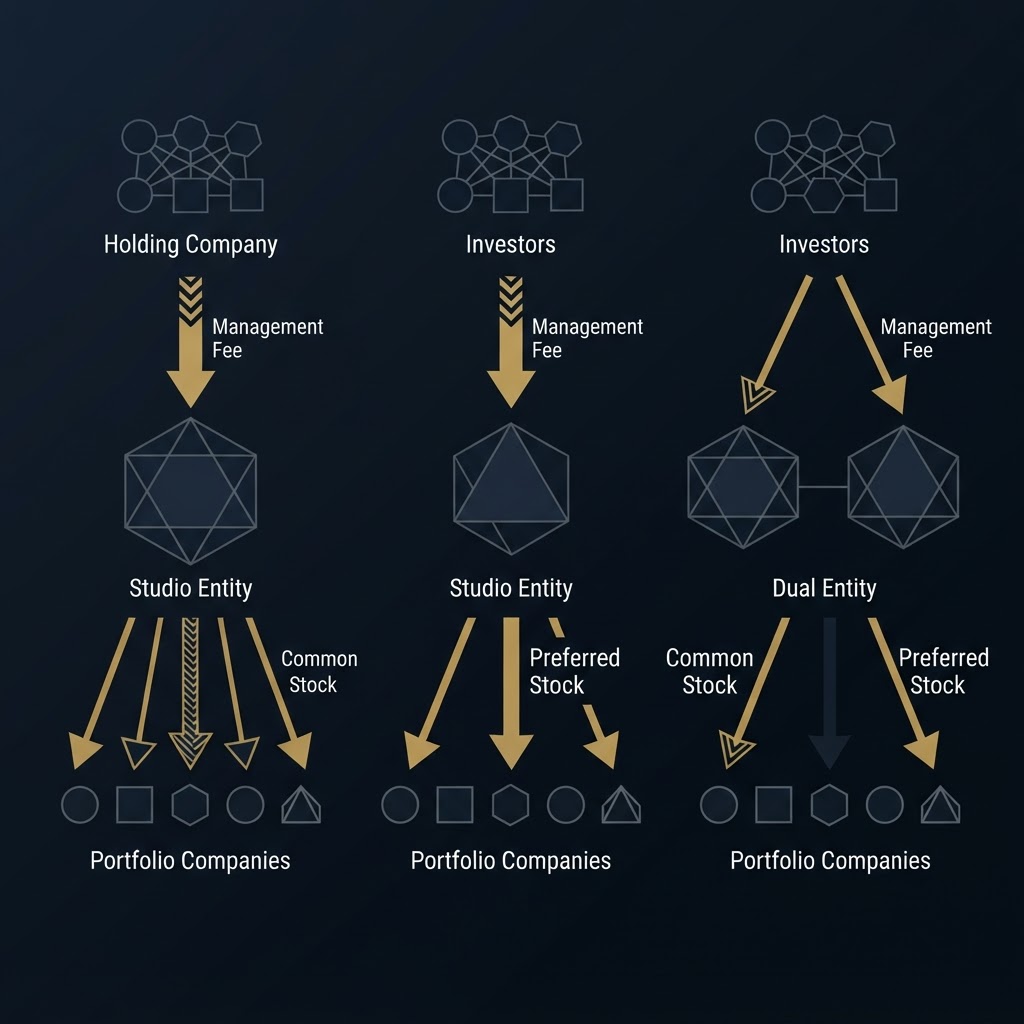
The venture studio business model has one load-bearing constraint, and every other decision follows from it. A studio does not just invest. It also invents the company and operates it, which means it carries a payroll of engineers, designers and operators long before there is a company to bill. Venture studios spend 40 to 60 percent of their total capital on operations, two to three times a traditional venture fund.
That cost is fixed. It does not change with the legal wrapper. What changes is who pays for it and how visibly. Get that question right and the structure explains itself. Get it wrong and you are reading a term sheet in a language nobody taught you.
What the model actually sells
A venture studio creates new companies in exchange for equity in them. That is the definition that separates it from its neighbours: an accelerator sells services to startups that already exist, and a VC is a relatively passive equity investor in them. One business can be all three at once, which is why the labels blur in marketing and matter in the documents.
The trade is straightforward. Studios reach funding milestones faster because they enter with a validated problem, an operating team and existing resources, in exchange for taking more equity and more control than a VC would. If you need the ground-level definition first, we cover what a venture studio is separately, and how venture studios work day to day walks the process from idea to spin-out.
This article is about the money.
The three structures behind every venture studio
Holding company: one entity, one balance sheet
Investors buy a fixed percentage of the studio itself, usually a C-corp or LLC. There is no management fee and no carried interest. Operations and new ventures are funded straight from cash on the balance sheet, and the team's ownership in the holdco is its carry.
Raises typically run USD 1M to 50M, with investor ownership of the studio between 25 and 50 percent, and a raise usually covering three years of operating expenses and 10 to 12 builds. Because the studio's spend buys equity rather than paying a fee, holdcos tend to hold more of what they build: initial portfolio ownership averages around 43 percent.
The cost is liquidity. An investor in a holdco is tied to the whole portfolio's exit timeline rather than a single company's.
Fund: the 2 and 20 route
The familiar vehicle. Limited partners commit to a fund with a 2 percent annual management fee and 20 percent carried interest, the fund owns the shares in the companies created, and the management fee resources the studio.
The arithmetic is the problem. A USD 100M fund produces about USD 2M a year in fees, which covers a lean VC partnership and not a studio full of in-house builders. Practitioners put the floor for the fund route at roughly USD 25M committed just to cover team salaries from fees. Below that scale the model quietly starves, which is why fund-structured studios either raise large or bolt on fee modifications: carry step-ups at performance hurdles, accelerated fee schedules, or a deal-by-deal waterfall.
What the fund buys is legibility. LPs know the vehicle, compliance is a well-trodden path, and successive funds give the studio clear start and end points and a succession plan.
Dual entity: the hybrid most studios are converging on
Two entities. A holding company houses the team and does the building. A fund provides capital and, usually, seeds the holdco so operations are covered before any fee arrives.
The elegance is in the share classes. The studio takes common stock as a founder, the fund takes preferred stock as an investor, and the two roles stop competing for the same line on the cap table. Ownership targets run 30 to 60 percent for the holdco and 10 to 20 percent for the fund. The holdco itself comes in two flavours, captive, funded exclusively by the fund, or independent, raising from its own separate investor base.
This is becoming the default, and it is where founders get most confused, because their equity now touches two vehicles at once. The same source gives the number worth asking for in any structure: the GP commit, the partners' own capital at risk, normally 1 to 5 percent of fund size.
Where the money goes
Taking one company from concept to external investment readiness costs USD 200k to 1M. At the studio level, the Global Startup Studio Network's 2022 data put the median annual studio budget at USD 1.36M and the average at USD 2.49M, with 79 percent of studios also writing starting capital into their own companies, averaging USD 476k each.
Set against a fund, the overhead ratio is stark. The same Venture Studio Forum cost analysis cited above documents a worked example where studio expenses run near 37 percent of investment capital, against roughly 10 percent in management fees for a traditional fund.
Read those figures as the honest version of the pitch. The operating cost is the product. A structure that hides it in layered fee arrangements has not removed it.
Where the money comes back
Studios earn on the way in, not just on the way out. La Boétie's studio versus fund comparison, linked above, puts equity at first cheque at 30 to 60 percent against the 10 to 20 percent a seed VC takes through capital alone, and the band widens to 20 to 40 percent when the studio cofounds a company meant to stand alone, or 50 to 80 percent when it keeps funding growth as near-sole investor. We break the negotiation itself down in how much equity venture studios take.
Exits are the headline line, but rarely the only one. A studio nine years into the model reports that management fees do not cover studio operations, so corporate partnership revenue offsets burn, and liquidity is managed actively through early secondaries and mid-sized exits rather than waiting a decade for every company to IPO. The full revenue stack is its own subject, covered in how venture studios make money.
The numbers the model has to beat
The industry benchmark comes from a Global Startup Studio Network survey of 14 studios and 258 studio startups: average IRR of 53 percent against 21.3 percent, TVPI of 5.8x against 1.6x, zero to Series A in 25 months against 56, 84 percent reaching an institutional seed round and 72 percent converting seed to Series A.
Treat those as directional, not as diligence. The aggregate covers studios that chose to report and excludes those that did not, so survivors are over-represented while the most secretive top performers are absent entirely. Single-studio figures like Hexa's 6 percent failure rate read as a top-quartile point rather than a field average. Ask any studio for its own realised numbers.
Which structure fits which studio
Holding company when the raise is small, when a parent absorbs operating cost, or when the ventures need patient capital past a fund's ten year clock. Simplest to run, hardest to exit from cleanly.
Fund when AUM is genuinely large enough that fees fund a payroll, and when LPs want a familiar vehicle with defined start and end points.
Dual entity when the studio wants founder common stock and preferred follow-on in the same company. The price is two raises, two sets of accounts and two governance conversations.
Cap table optics decide more than they should. One evolved structure, the Tulsa Model, splits the studio's two roles into separate equity line items, one for founder common shares and one for the investment stake, to avoid the dead capital problem that deters Series A investors, and uses a founder equity holding company with profits interests so staff share portfolio-wide upside. Downstream investors read cap tables as a story about incentives. Make sure yours tells the one you mean.
What changes when the ventures are deep tech
Almost all of the above assumes software. Hardware and science break three of its assumptions at once.
You cannot validate a gasifier with a landing page, so the cheap kill gates that make the funnel economic have to be replaced by pilots and physical testing. First revenue sits years further out, which means a ten year fund clock can expire before the asset matures, pushing deep-tech builders toward holdco and dual entity shapes with patient capital behind them. And two capital layers the studio literature barely mentions become central: non-dilutive public and EU grant money, sequenced against equity rounds so dilution stays sane across a decade, and patents held as balance-sheet assets rather than legal hygiene.
That last point changes what the studio owns. In software the asset is a cap table entry. In deep tech it is a patent family plus deployed units generating operating data, both of which hold value even when a single venture stalls.
This is the shape EX Venture runs: a capital track record above 160 million euros across four continents, 200 or more waste-to-energy units deployed in 11 countries, 24 patent families filed with roughly 100 more validated in the pipeline, and 250 or more operators trained into the portfolio. Operators, patents and installed hardware are what the operating budget converts into, which is the honest answer to where a studio's 40 to 60 percent goes. We go deeper on that distinction in a deep-tech venture builder.
FAQ
Is a venture studio a fund or a company? It can be either, and the distinction is the whole model. A holding company sells investors a stake in the studio itself, with no management fee and no carry. A fund raises under a 2 and 20 structure and pays the studio a management fee. A dual entity runs both, with the studio holding common stock and the fund holding preferred. Establish which one is on the other side of the table before you read the equity percentage, because the same number means different things in each.
Can a venture studio survive on management fees alone? Rarely. Studio operations cost more than fund management and most studios lack the assets under management to cover them from a 2 percent fee. That is why the fund route has a practical floor around USD 25M committed, and why studios layer in revenue offsets such as corporate partnerships, sidecar funds and billed services.
What is a venture studio GP commit and what is a normal one? It is the general partners' own capital committed into the studio's fund or holding company, typically 1 to 5 percent of fund size. Read it as an alignment signal rather than a footnote. Partners with meaningful personal capital at risk behave differently from partners living on fees.
How is a venture studio different from a holding company? A studio may be legally structured as a holding company, but the objective differs. Studios build high-growth ventures intended to take venture investment and exit, earning as investors. Classic holding companies keep profitable, self-sustaining businesses and earn as operators. Deep-tech builders often sit deliberately between the two, holding assets long enough for the science to mature.