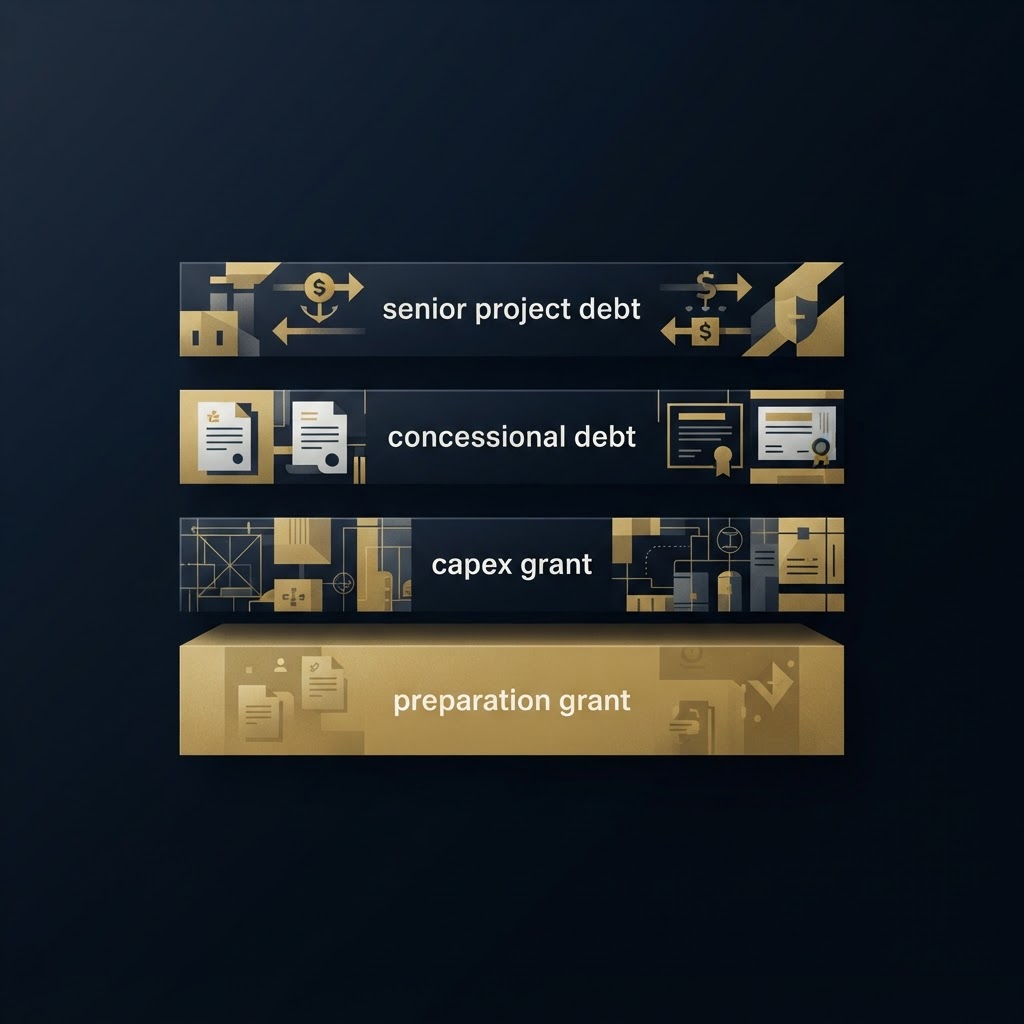
Waste to energy funding is not one question. It is four, asked in sequence, and each one is answered by a different kind of money with a different test attached.
That sequencing is what the search results miss. You will find grant programme pages and you will find press releases about deals that closed, and neither tells you the thing that decides whether your project joins them. Money for a waste to energy plant is stage-gated. A preparation grant buys documents. A deployment grant buys concrete. Concessional capital buys risk that the commercial market will not price. Senior debt buys nothing at all until a contract exists that a court would enforce.
The most common failure we see is not a bad plant. It is a developer asking the wrong layer for money at the wrong stage, then reading the rejection as a verdict on the technology.
Layer one: grants that pay for documents, not steel
The first money into a project does not build anything. It produces the paperwork that lets the later money say yes.
The African Development Bank's Sustainable Energy Fund for Africa is a clean example of the instrument. For a 10 MW municipal waste to energy plant in Kibera, Nairobi, SEFA approved a grant of USD 995,000 to fund a full environmental and social impact assessment, detailed engineering designs, legal advisory and financial and transaction advisory services. Not a boiler. A document set. Those are precisely the deliverables a lender's credit committee will later ask for and refuse to fund itself.
Early-stage facilities work the same way with more of the burden shifted onto you. EEP Africa offers grants and repayable grants between EUR 200,000 and 500,000, with minimum co-financing of 30 to 50 percent of the project budget depending on project phase and company maturity, covering feasibility studies, pilots, replication and scale-up. Read the co-financing line carefully. A EUR 500,000 grant on a 50 percent requirement is a EUR 1 million commitment, and the half you bring has to be real.
Other programmes invert the timing entirely and pay on delivery. India's Ministry of New and Renewable Energy structures its waste to energy programme as central financial assistance to project developers released in respect of successful commissioning of plants generating biogas, bio-CNG, power or syngas from urban, industrial and agricultural waste. That is not development capital. It is a rebate you can only bank once you have already spent the money, which means it belongs in your return model and not in your funding plan.
One distinction matters more than any of these amounts. The EIC Accelerator funds the company, not the plant: a lump sum grant below EUR 2.5 million for innovation activities at TRL 6 to 8 to be completed within 24 months, plus an investment component of EUR 1 to 10 million in direct equity or quasi-equity, with 2026 budgets of EUR 414 million for the Open call and EUR 220 million for the Challenges. If your technology needs proving, that is your instrument. If your site needs building, it is not.
Layer two: grants that do pay for concrete, and the queue for them
Capex grants exist, they are large, and they are brutally contested.
The EU Innovation Fund is the reference case. It covers up to 60 percent of a project's additional capital and operating costs, with individual awards in the latest round running from EUR 1.8 million to EUR 216 million, and its EUR 2.9 billion Net-Zero Technologies call closed in April 2026 with 358 applications requesting EUR 17.5 billion, six times the available budget, with results expected in October 2026 and grant agreements in the first quarter of 2027.
Two numbers there should change how you plan. The oversubscription means this is not a funding source you can build a base case on. And the timeline means an application submitted today is capital you do not control for roughly a year.
Eligibility runs on capital expenditure bands rather than technology categories, so the first question is which door you fit through. The call terms set small-scale projects at capex above EUR 2.5 million and up to EUR 20 million, medium-scale above EUR 20 million and up to EUR 100 million, large-scale above EUR 100 million, with the maximum grant capped at 60 percent of relevant costs and financial close required within four years of grant signature.
That last clause is the one people skim. A capex grant does not close your financing. It obliges you to close your financing, on a clock, and the other 40 percent plus everything outside the relevant-cost perimeter is still yours to find. The grant makes the rest of the stack possible. It does not replace it.
Layer three: blended and concessional finance, the layer nobody asks for
This is where the leverage actually is, and it is the layer most developers skip because they read development banks as slow rather than as structurally different.
Look at what a development finance ticket does mechanically. On the Bac Ninh waste to energy project in Vietnam, total project cost is around USD 74 million, with an IFC package of up to USD 30 million of which up to USD 15 million is a senior loan provided as blended concessional finance co-investment under the Finland Blended Finance Climate Program. IFC's own stated reason for being there is the useful part: long-term dollar financing was not readily available for waste to energy plants from domestic or international lenders, because the contractual framework was not bankable to international lenders and local banks could neither analyse the risk nor lend in dollars.
The ratio is even clearer on the largest recent deal in the sector. For 12 industrial waste to energy plants in Thailand, ADB signed aggregate loan agreements totalling 16.6 billion baht, about USD 511.9 million, of which ADB provided 3.0 billion baht or USD 91.9 million from its own ordinary capital resources while mobilising 13.6 billion baht or USD 420.0 million from six parallel lenders, also acting as environmental and social coordinator so that all borrowers met a single standard.
The concessional ticket was under a fifth of the money. Its product was the other four fifths.
For a project that is close but not clearing, the blend can do the whole job without touching the plant. Modelling of the stalled ITF Nambo facility in West Java, which failed to reach financial close on equity shortages and revenue uncertainty, found that concessional debt at 3 percent interest plus a credit guarantee reduced the weighted average cost of capital to 6.14 percent, lifted the IRR to 6.47 percent and produced a positive NPV even at a conservative refuse-derived fuel price of USD 40 per ton, with a debt service coverage ratio above 1.4x, in an optimised structure of 15 percent equity, 42.5 percent commercial debt and 42.5 percent concessional debt.
Same plant, same feedstock, same tariff. The project became fundable because the capital structure changed.
Layer four: senior debt, and what it is really secured against
Commercial project debt is the cheapest money in the stack and the last to arrive, because it is underwritten against contracts rather than against equipment.
Institutional lenders treat waste infrastructure as a contracted cash flow business, and the cornerstone is the tipping or gate fee agreement, tested on contract tenor, minimum guaranteed waste volumes, take-or-pay provisions, counterparty credit quality, inflation indexation and currency denomination, alongside a minimum debt service coverage ratio above 1.50x with strong projects exceeding 2.00x, sponsor equity of 20 to 40 percent funded before debt drawdown, and fixed-price date-certain EPC contracts carrying liquidated damages.
Notice which revenue line is missing from that list. The electricity tariff gets the modelling attention, but the enforceable line is the disposal fee, which is why US landfill economics matter to a lender: tipping fees averaged USD 62.28 per tonne in 2024, up 10 percent in a single year, and where the landfill alternative is cheap the gate fee cannot carry the debt. We have argued the full version of that case separately, in who actually pays in a waste to energy business model.
Where the country risk rather than the project risk is binding, guarantees substitute for balance sheet. On the Samarkand waste to energy project in Uzbekistan, a 50 MW facility processing 1,500 tons per day, MIGA is considering guarantees of up to USD 316.75 million against transfer restriction, expropriation, war and civil disturbance, and breach of contract, with tenors up to 20 years for equity-related investments and up to 14 years for debt. That instrument does not improve the project. It makes the project's jurisdiction lendable.
The gate that stops deep tech: your technology is too new to borrow against
Here is the part that is missing from every ranking page, and it is the part that matters most if you are commercialising something new.
Technical feasibility and bankability are separate tests, and a novel process can pass the first while failing the second for years. Senior debt providers expect at least three years of successful commercial operating history, multiple reference plants in operation, documented uptime and availability and proven emissions compliance, and projects proposing untested pyrolysis, gasification, plasma or chemical conversion routes frequently struggle to secure institutional debt unless fully wrapped by major industrial sponsors with substantial balance sheet support.
Private credit desks describe the same split from the other side: grate incineration is an established technology with decades of performance data, while emerging gasification and pyrolysis methods present a different risk profile altogether, pushing the focus onto the EPC contractor's performance bond and balance sheet, with lenders requiring the debt service coverage ratio to hold even where the plant operates at eighty percent of rated efficiency. If you are weighing those routes on their merits rather than their financeability, the mechanism is worth understanding first: how waste gasification actually works explains what the lenders are being asked to underwrite.
Draw the conclusion the programme pages never draw. For a genuinely novel process, layer four does not exist yet. There is no term sheet to win, at any DSCR, until operating hours exist. So the first units have to be funded with equity, grants and sponsor balance sheet, and their real output is not electricity. It is the operating record that opens the debt market for units five through fifty.
That is the phase we build in. EX Venture has designed, financed and installed waste-to-energy systems across 11 countries with more than 200 units deployed, alongside a EUR 160M capital track record across four continents, which is the same pattern that governs what a deep tech venture builder does in any capital-intensive sector: absorb the pre-bankable years on purpose, because they are the asset. Budget for that phase as a cost of capital rather than treating it as a delay, and the sequencing stops feeling like rejection.
Regulation is a funding event, and it moves before the capital does
The fastest way to change a project's funding prospects is often not financial engineering. It is a rule change upstream of it.
Indonesia demonstrated this at scale. Replacing a two-payer structure, Presidential Regulation 109/2025 set a single fixed electricity price of USD 0.20 per kWh for the 30-year life of the project, with the state utility PLN required to sign the power purchase agreement within 10 working days of pre-construction licences. The capital followed almost immediately: the resulting national programme covers 33 cities at approximately IDR 84 trillion or about USD 5 billion, with Phase One awards worth nearly USD 600 million and funding drawn partly from Patriot Bonds targeting up to IDR 50 trillion, about USD 3 billion.
Thailand's version was a tariff auction rather than a decree. Under the feed-in-tariff programme for 2022 to 2030, the regulator enabled competitive bidding for 200 MW of industrial waste fuelled capacity, of which 100 MW was approved in the first round, and all 12 of the ADB-financed plants were awarded in that round, selling under 20-year PPAs to the Provincial Electricity Authority with about 24 months of construction from the EPC notice to proceed.
Both cases say the same thing to a developer. The tariff instrument sits upstream of the finance. Read the regulation before you read the term sheet, because the regulation is what the term sheet is priced off.
A funding sequence that closes
- Secure the waste supply contract first. Tonnage commitment, tenor, counterparty credit, indexation. Every later layer is priced off this document, and no amount of capital structuring compensates for its absence.
- Use a preparation grant to produce the diligence pack. Impact assessment, detailed engineering, independent engineer's report, transaction advisory. These are cheap to grant-fund and expensive to self-fund.
- Match currency between revenue and debt before you shop the deal, or price the hedge explicitly. A devaluation that halves your local-currency revenue against dollar debt is a default, not a bad quarter.
- Pick the capex grant band deliberately and treat the award as a probability, not a line item.
- Bring a development finance institution in early enough to shape the structure, not late enough to rescue it. Their function is mobilisation, and mobilisation takes time to arrange.
- If the technology is novel, fund the operating-hours phase on purpose. Nobody will lend against it, and it is the only path to the layer that will.
FAQ
Can you get a grant to build a waste to energy plant, or only to study one? Both exist and they are separate instruments with separate applications. Preparation grants pay for studies, engineering and advisory work, typically a few hundred thousand to a million dollars, and they never touch construction. Capex grants such as the EU Innovation Fund do pay toward the build, at up to 60 percent of relevant costs on projects above EUR 2.5 million of capital expenditure, with awards in the latest round ranging from EUR 1.8 million to EUR 216 million. The practical difference is competition and timing: preparation money is comparatively obtainable, capex money is oversubscribed several times over and takes about a year to resolve.
How much equity does a sponsor have to put in? Institutional lenders generally expect 20 to 40 percent sponsor equity, funded before debt drawdown, plus demonstrated capacity to absorb cost overruns. A blended structure can compress that materially: the optimised Nambo model reduced equity to 15 percent by pairing commercial debt with concessional debt and a credit guarantee. Equity is also where schedule risk lands, so budget above the minimum rather than at it.
Does a development bank loan replace commercial lenders or bring them in? Usually the latter, and the ratio is the reason to bother. On the Thai financing, ADB lent about USD 91.9 million from its own resources and mobilised about USD 420.0 million from six parallel lenders. Approach a development finance institution as an anchor and a standard-setter rather than as a source of cheap money and the conversation goes differently.
Do small distributed units qualify for project finance at all? Rarely, and that is a scale problem rather than a technology problem. Project finance is built for large single assets with a contracted municipal or utility counterparty, and the diligence cost does not shrink with the plant. Small on-site systems are usually funded as equipment, corporate balance sheet or lease structures, where the credit being assessed is the host's ability to pay rather than the plant's cash flow.