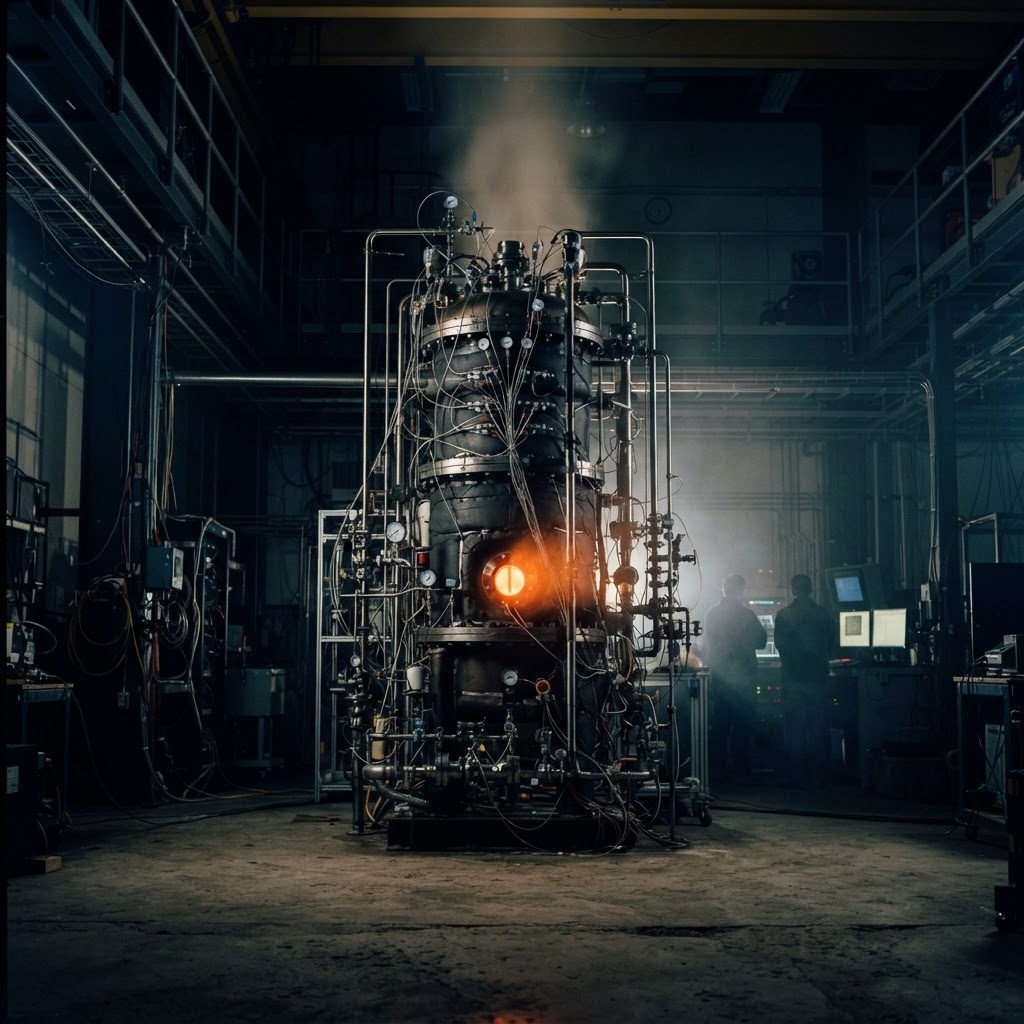
The EQL-150 prototype gasifier — built by Zero-X, the EX Venture portfolio company advancing thermochemical conversion and distributed energy — has completed a 120-hour uninterrupted steady-state campaign, with syngas lower heating value variance held below 3% across the entire run. The duration deliberately exceeded the 72-hour mark where a previous performance decay had appeared. The decay did not return. The run validates a new condition-based ash extraction logic and produces the program's anchor reference dataset for model validation and scale-up design.
Why now
Short campaigns flatter a gasifier. Most published fixed-bed operation data covers runs measured in hours, and the failure modes that decide commercial viability — ash accumulation, bed channeling, gradual gas-quality decay — only appear when the machine runs for days. The EQL-150 prototype exhibited exactly this pattern: in extended operation, syngas lower heating value decayed progressively after 72 continuous hours, despite apparently steady operating conditions.
The team treated the decay as research content, not an embarrassment. Every subsequent hour of engineering went into understanding and eliminating it, because the commercial case for gasification depends on sustained performance. Engine OEMs, offtake partners, and project financiers do not buy peak numbers. They buy the guarantee that the machine holds specification on day five the way it did on day one.
What we built
The EQL-150 prototype is a downdraft gasification platform converting waste-derived fuels into syngas, designed as the intermediate step between laboratory proof of concept and full commercial deployment. Over the reporting period, the program executed seven work packages — readiness assessment, phased start-up, thermal profiling, fuel variability testing, syngas quality assessment, interim performance review, and kinetics validation. Every conclusion traced to instrumented measurement: thermocouple arrays for thermal findings, gas analysis for composition, differential pressure for bed condition, auger torque for fuel state.
The fuel variability campaign mapped the machine's tolerance for real-world feedstock. Moisture ranged from 15% to 35%, bulk density varied by up to 40%, a non-linear air pre-heating demand appeared above 28% moisture, and bed channeling in low-density fuels was resolved through mechanical agitation setpoints and a feed-forward air control loop tied to auger torque.
The interim performance review found the root cause of the 72-hour decay: ash accumulation in the lower reactor bed. Ash gradually altered the distribution of air through the bed, shifting the oxidation zone and degrading gas quality. The underlying flaw was in operating logic — ash extraction ran on a fixed mechanical schedule, and a fixed schedule cannot track a variable that accumulates at a rate set by fuel ash content.
The fix replaced the timer with the bed itself. A differential-pressure-based ash extraction logic watches the pressure drop across the bed — the direct indicator of bed condition — and pulls ash when the bed requires it. The validation run then pushed the machine 48 hours past the old failure window: 120 hours uninterrupted, LHV variance below 3%, no recurrence of the decay. Where most published campaigns report stability in hours, this run produced a continuous, high-resolution 120-hour reference dataset covering heating value, composition, and bed state.
The run also produced a finding the model did not predict: methanation rates in the upper reactor zones ran higher than the thermodynamic simulation assumed, traced to the catalytic properties of ash accumulating there. The rate constants in the core simulation were recalibrated to the measured kinetics, so the scale-up engine now reflects the machine's real chemistry.
Why it matters
A gasifier that holds specification past day three is a different asset from one that peaks and decays. Stable extended operation unlocks continuous 24/7 feedstock processing, reliable CHP output, and the instrumented, reproducible performance data that makes a project bankable. That data is the difference between a pilot-scale prototype and a machine you can sell.
The program's forward path is defined: extended endurance campaigns beyond the validated duration, expansion of the fuel envelope into additional waste streams, and scale-up design work now supported by a model whose kinetics reflect measured reactor behavior. The 120-hour run is not the finish line — it is the reference point the next campaign gets measured against.
Zero-X is a portfolio company of EX Venture, financing, patenting, and deploying breakthrough science at scale across energy, carbon, biotechnology, intellectual property, and financial infrastructure.
Read the original post on LinkedIn →
For media inquiries: media@exventure.co.