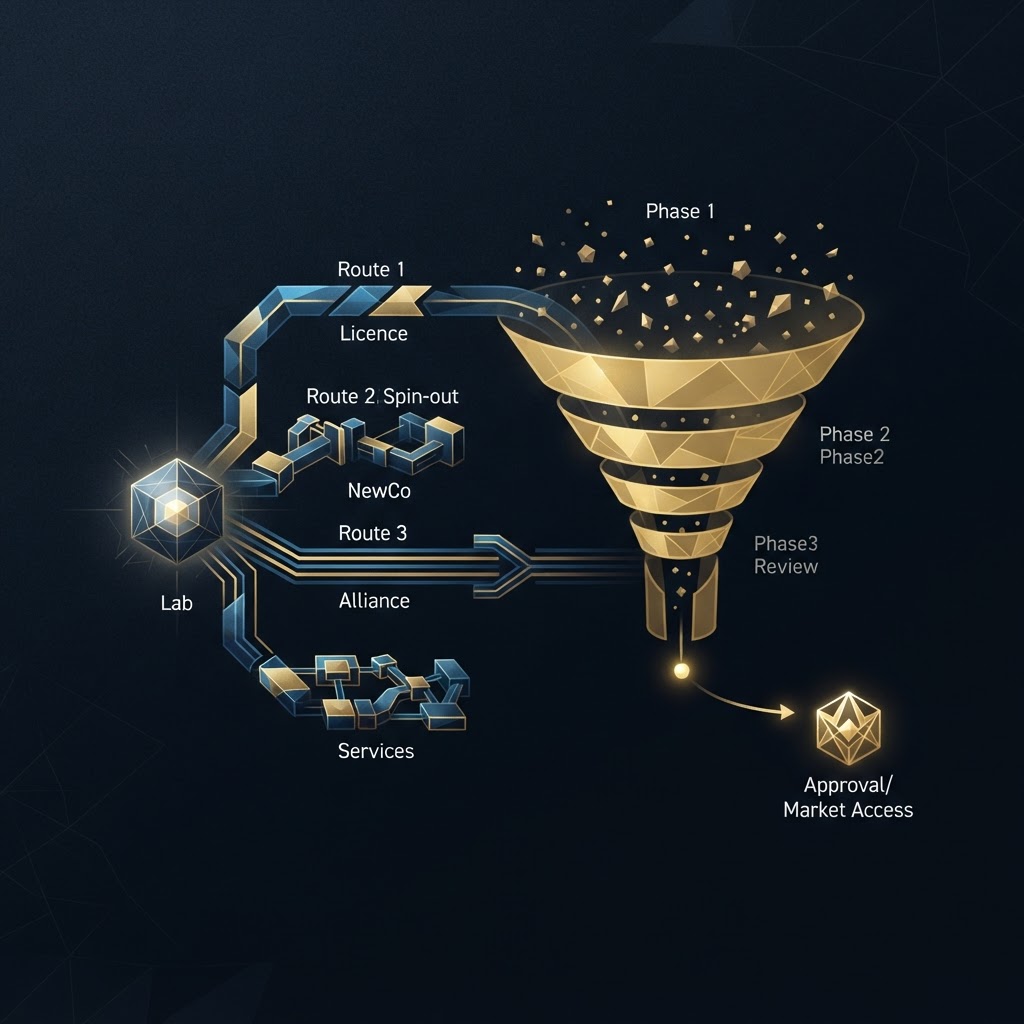
Cancer research commercialisation is the process of moving an oncology discovery (a drug candidate, a diagnostic, a device or a research tool) out of an academic, hospital or charity lab and into the hands of a company that can carry it through trials, approval and sale. It happens through a licence, a spin-out, an industry alliance or a services contract. Which route wins is not a matter of taste. In oncology it is decided by arithmetic, and the arithmetic is harsher than in any other therapeutic area.
This guide sets out who does the work, why the odds shape every deal, the four routes with real oncology transactions, and what an investor or venture builder needs to see before backing a cancer asset.
What cancer research commercialisation means in practice
Most cancer science is produced by institutions that cannot develop a drug themselves. A university lab can identify a target and make a tool compound. It cannot fund a phase 3 trial. Commercialisation is the handoff between the two worlds, and it is run by specialist offices.
The largest is in the UK. Cancer Research Horizons, the wholly owned translational arm of Cancer Research UK, holds exclusive rights to over £400m of the charity's research each year and runs a network of 200 drug discovery scientists across six UK sites. By the charity's own account it is the second biggest licensor of cancer research treatments globally, has helped form over 60 spin-out companies, and has helped 11 drugs to market, with over 6 million doses given to patients.
In the US the equivalent federal office is the NCI Technology Transfer Center, which licenses inventions from NIH laboratories. Every major cancer centre, from Memorial Sloan Kettering to the Institute of Cancer Research in London, runs its own office too. The principles are shared with the wider field of commercialisation of academic research. What changes in oncology is the risk profile.
Why oncology is the hardest field to commercialise
The approval odds
A cancer drug entering human trials is far more likely to fail than to reach patients. BIO's analysis of 9,985 phase transitions from 2006 to 2015 found oncology had the lowest likelihood of approval from phase 1 of any of its 14 disease categories, at 5.1%, against 11.9% for everything else. Solid tumours fared worse than blood cancers, 4.0% against 8.1%. The damage happens late: phase 3 is where oncology falls furthest behind.
Other datasets land in the same place. A study of 24,448 oncology development programmes from 2000 to 2018 put the phase 1 to approval probability at 3.3%, ranging from 0% in osteosarcoma to 10.1% in breast cancer. A 2022 study that tracked drugs tested in phase 1 in 2015 found 6.2% had been approved by 2021.
What raises the odds
The same research shows where the odds improve. Using biomarkers to select patients raised the phase 1 to approval probability by an average of 13.3 percentage points in the 2019 study. An AACR analysis of 10,083 programmes found that drugs already approved in another indication were more than three times as likely to succeed as candidates on a novel mechanism, and that biomarker pre-selection more than doubled the chance of approval against a historical average of 4.1%.
For anyone commercialising cancer research, this is the most useful data on the page. A patient selection story is not a scientific nicety. It is the single biggest lever on the value of the asset.
The four routes out of a cancer lab
The Institute of Cancer Research lists the mechanisms plainly: collaboration, licensing, consulting, clinical trial contracts and spin-outs. In practice they collapse into four routes.
1. Licensing to an established company
The default in oncology. A licence hands the asset to a company that already has the capital and trial infrastructure to absorb phase 3 risk. The ICR states in its research impact submission that its preferred strategy is to license directly to a commercial partner where that means faster development, and that an exclusive licence has to be offered or the company will not invest.
Edinburgh's NXP900 shows the route at university scale. The compound was a decade in development before a patent was filed, and the resulting licence to Nuvectis Pharma was worth over $3.5 million. Edinburgh's own rule of thumb: licensing suits a technology with a discrete application and a well understood market. Exclusivity terms carry most of the value in these deals, which is why the exclusive vs non-exclusive patent licence decision matters more than the headline fee.
In the US, the NCI offers exclusive and non-exclusive licence types, including a Start-Up 3.0 exclusive licence programme aimed at early-stage companies for selected NCI patented therapeutics, vaccines, devices and diagnostics.
2. Spin-out company
A spin-out makes sense when no partner will take the asset yet, or when the technology is a platform with many applications. The ICR created Piramed Pharma to commercialise its PI3 kinase inhibitor work; Roche acquired it in 2008 for $160 million, with a later $15 million milestone payment. Cancer Research UK's Spirogen went further: after toxicity problems with its first compounds, the team combined the chemistry with antibodies and in 2012 created ADC Therapeutics, a spin-out of the spin-out, which developed Zynlonta.
Spin-outs are the minority route even at the most active offices. In the 2023-24 financial year Cancer Research Horizons created 6 new start-ups and signed 106 commercial licensing deals. If you are going this way, the mechanics of how to spin out a company from a university apply in full.
3. Industry collaboration and alliances
Here the pharmaceutical partner is in from the start. The CRUK-AstraZeneca Antibody Alliance combines the charity's cancer biology with AstraZeneca's antibody engineering. The logic is the odds again: bringing industrial rigour in early makes a product more likely to survive the clinic.
4. Clinical trial contracts and consulting
The least glamorous route and often the steadiest. Cancer centres run industry-funded trials and sell expert time. These contracts rarely build a company, but they build the relationships that later licences come from.
How oncology deals are structured
Oncology deals load their value into later payments, because the licensee is pricing in approval odds of roughly one in twenty. Birmingham spin-out Revitope's 2020 agreement with Junshi Biosciences is a typical shape: up to $160 million per molecule in milestones, plus 10% royalties on net sales, and $10 million for a 9.99% equity stake.
Read those numbers carefully. "Up to $160 million" is conditional on each clinical and commercial milestone being hit, and the approval data says most will not be. The equity cheque is the only certain money. For how the royalty stack works in a university deal, see our guide to university spinout royalties.
The licensor also gets obligations to enforce. NCI requires a business development plan with performance benchmarks, annual commercialisation reports, and can revoke a licence for non-use. The ICR builds in return clauses: when the first partner on abiraterone discontinued development, the rights came back and a new partner took the drug to approval.
Timelines: decades, not years
Cancer commercialisation runs on a clock most investors are not used to. At Memorial Sloan Kettering, development of the antibody Danyelza began over 30 years before approval. The technology office spent over a decade looking for a partner, signed a licence with Y-mAbs Therapeutics in 2015, and the FDA granted accelerated approval in November 2020.
That is not unusual, which is why the lab to market timeline is the first thing to model, not the last. Diagnostics move on a different track: most in vitro diagnostics and devices need a conformity assessment, such as UKCA marking in the UK, rather than the phased trials a medicine goes through.
What an investor or venture builder needs before backing a cancer asset
We look at science that would otherwise never leave the lab. EX EPIC has a EUR 160M+ capital track record financing, patenting and deploying deep tech across 4 continents, including Seraph Group in decentralised biomanufacturing, and our IP arm EX IX has filed 24 patent families. We are not an oncology developer. But the filter we apply to any lab-stage asset is the same one the cancer data argues for:
- IP filed before anything is published. Published, unprotected science can be developed by anyone. A sound patent strategy for deep tech startups is a precondition for any licence or round.
- A patient selection story. Biomarkers are the largest single improvement in approval odds in the data above. An asset with one is a different investment from an asset without.
- A first indication chosen on odds, not prestige. Breast cancer programmes reached approval at roughly three times the oncology average. Where the asset could go matters less than where it can win first.
- A route chosen on risk. If a partner with phase 3 capacity will license it now, a spin-out has to justify why it should carry that risk instead.
- A financing plan that matches the clock. Cancer assets that need fifteen years cannot be funded on a five-year fund's patience.
An asset that clears all five has a financing case. One that clears two has a research programme.
FAQ
Who owns cancer research done with charity funding?
Usually the host institution owns the IP, and the funder holds commercial rights by agreement. In the UK, Cancer Research Horizons holds exclusive rights to the research Cancer Research UK funds, so a CRUK-funded researcher commercialises through it alongside their university office.
Can a startup license a cancer invention from the US government?
Yes. The NCI's Start-Up 3.0 exclusive licence programme is built for early-stage companies and covers selected NCI patented therapeutics, vaccines, devices and certain diagnostics. Applicants submit a business development plan that becomes the performance benchmarks in the licence.
What happens if a licensee stops developing a cancer drug?
A well written licence returns the rights. The ICR recovered abiraterone after its first partner discontinued, then relicensed it to a partner that secured approval. NCI licences can be revoked for non-use of the patent.
Are diagnostics easier to commercialise than cancer drugs?
They follow a different path. Most in vitro diagnostics and devices go through conformity assessment, such as UKCA marking in the UK, rather than the phased clinical trials a medicine needs. That changes the evidence package and the regulator conversation, not the need for protected IP and a clear first market.