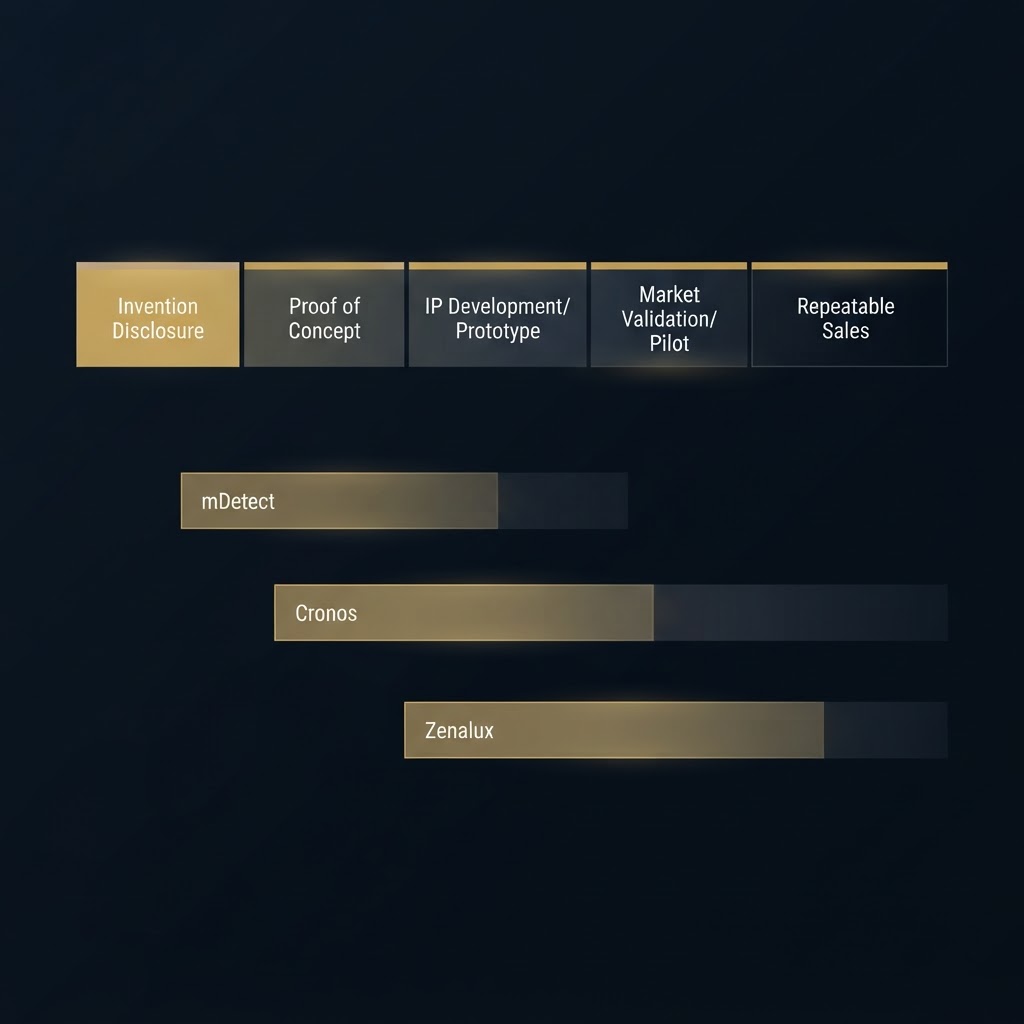
Every founder who has ever stood in a lab with a working prototype has asked the same question. How long until this is a product someone pays for? The honest lab to market timeline for deep tech is not a number. It is a stack of stages, each with its own clock, and most of the published answers quote only one of them.
This article stacks them all. Disclosure, patent, license, company formation, prototype, qualification, first revenue. Every duration below is sourced. Three named spinouts run through the same stages so you can see where real companies landed. The last section is the operator view from a venture builder that finances, patents and deploys this kind of technology for a living.
The short answer: one timeline, four clocks
If you want a single range to hold in your head, here it is. Software can reach the market in months, deep-tech hardware typically takes 3 to 7 years, therapeutics take a decade or more, and studies of university technology consistently find average lab to market timelines around 8 years.
Seen from the technology transfer office, the same journey runs 18 to 60 months from invention disclosure to first revenue, across ten stages, and only 5 to 10 percent of disclosures ever produce meaningful revenue. Those two framings do not contradict each other. The TTO clock stops when a licensee books its first sale. The founder's clock keeps running until sales are repeatable.
The reason no single figure survives contact with a real company is that a deep-tech venture is synchronising four clocks at once: technology, customers, capital and ecosystem. The technology can be ready while procurement has no budget until next year. Capital can arrive before a procurement pathway exists. Regulation can lag the prototype by years. Each stage below has a technology duration, and then a waiting time set by the other three clocks.
The lab to market timeline, stage by stage
Stage 1: disclosure and patent filing
The clock starts when a researcher files an invention disclosure with the university. Patent filing and prosecution then run 2 to 4 years, but that work happens in parallel with everything else. A license can be signed on a pending application, so almost nobody waits for grant.
What does block the timeline is finding someone to take the invention forward. Columbia Technology Ventures' data on its cumulative deals shows that fewer than half of licenses are executed within the first two years after disclosure. A disclosure still unlicensed at year five, even with active patent filings, has about a 20 percent chance of ever being licensed. The first two years after disclosure are when the odds are best. After that, they decay.
Stage 2: the license or option
For a founder spinning out their own invention, Pillar VC, where half the portfolio is university spinouts, has published the most practical month by month plan. Licenses take 3 to 6 months, split into five steps: confirm the licensing office is open in principle (2 weeks), build the business plan with your team (2 to 4 months), agree founder splits, incorporate and start raising (2 to 4 months), reach terms with the licensing office (2 to 4 months), and complete the license alongside the seed close (2 to 3 months). The steps overlap, which is how five of them fit into six months.
If the plan is not ready, an option buys time. Options generally run 6 months to a year and guarantee the right to license later. We cover the mechanics in university license option agreement and the full range of negotiation durations in how long a university license takes.
Stage 3: incorporate, raise, hire
Commercify's benchmark for spinout formation is 6 to 18 months, longer than the license itself. That is the time it takes to turn a term sheet into a company with a bank account, a founding team with agreed equity, and enough money to pay them. For most spinouts, this stage ends when the seed round closes and the license is countersigned, which Pillar's plan deliberately schedules as a single event.
Stage 4: prototype to qualified product
This is where deep tech earns its reputation. The lab to market roadmap published by Duke's von Windheim and Myers gives a stage table that is still the clearest reference: technology development 5 to 10 years, proof of concept 1 to 2 years, prototype 6 months, alpha product 6 to 12 months, qualification and manufacturing 12 months. For physical science companies the concept stage alone requires three to ten years, most of it inside the university before a company exists.
The Dutch development agency BOM, working from a sample of around 40 deep-tech ventures, puts the post-spinout engineering phase at 18 to 30 months from product definition to product development, plus 6 to 12 months of product validation. Validation is the step most founders underestimate. Done badly, the same analysis found it adds 12 to 24 months of delay.
Stage 5: first revenue to repeatable sales
From license execution to first product revenue, Commercify's range is 2 to 7 years depending on field. Software licensed from a university might ship in 12 to 18 months. A therapeutic licensed at preclinical stage can take 8 to 12 years.
The venture data agrees. CTVC's 2025 analysis found the median time from Series A to first commercial revenue was 6.2 years for hardware-intensive climate startups, against 2.1 years for climate software. The same piece notes that moving from TRL 7 to TRL 9 historically accounts for 70 to 80 percent of total development cost, and that underfunded companies routinely take two to three times longer than funded ones.
Stack the stages and the arithmetic is simple. Two years to a license, one more to a funded company, three to five to a qualified product, and the eight year university average stops looking pessimistic. It looks normal.
How the timeline changes by sector
The sector sets the clock speed before anything else does. TD Shepherd's comparison puts traditional tech at 12 to 24 months from concept to market and deep tech at 4 to 8 or more years, with deep tech spending 12 to 36 months on proof of concept, 24 to 60 months on testing and validation, and a further 12 to 36 months on commercialization and scaling.
Within deep tech the spread is wide. Hardware and industrial systems sit at the short end because the buyer is a company that can run a pilot. Advanced materials sit in the middle because qualification by the customer's own engineers takes years. Anything regulated for human health sits at the long end: Commercify's decade or more for therapeutics, the IOP roadmap's note that medical device commercialization continues for years after first preclinical sales.
For an investor the sector answer matters more than the average. A fund that models eight years for a hardware spinout and eight years for a therapeutic will be right about one and badly wrong about the other.
Three spinouts, three real clocks
mDetect: five years from founding to seed round
mDetect, a Swinburne University spinout using cosmic ray muons to image through rock and concrete, has a public timeline that maps cleanly onto the stages above. The team co-founded the company in 2018, filed a patent application in 2019, established it as a deep-tech startup in 2020 and joined a 12 week program with $30,000 of equity-free seed funding, built the first commercial prototype in 2021 alongside a $1.5 million government manufacturing grant, and closed a $1 million seed round in 2023 to hire business development staff and set up contract manufacturing. Five years from founding to a seed round, with the first commercial prototype in year three, and the money in the early years coming from grants rather than equity.
Cronos: 18 years to full product success
The IOP roadmap's lead case is Cronos Integrated Microsystems, a MEMS company later acquired by JDS Uniphase. It took five years to validate the technology platform, ten if the fabrication facility that preceded it is counted, three more years of iterative prototyping and market validation, and three more to complete product development and establish products in the market. Financial success for founders and investors arrived at year eight. Full product success took 18 years, and that does not count the basic MEMS research that came before.
Zenalux: 12 years to first sales
Zenalux Biomedical, a Duke spinout building an optical device for monitoring cancer therapy, took 12 years from invention to first product sales for preclinical applications, with full clinical commercialization still years away at the time of writing. Same roadmap, same university ecosystem, different sector, a timeline half again as long because the customer is a regulator before it is a hospital.
Where the years actually go
Line the stage durations up and they do not add to 18 years. The gap is waiting, and the waiting has identifiable causes.
Customer validation done late. BOM's finding that poor customer validation costs 12 to 24 months is the single largest avoidable delay in the data. The fix is to start the commercial clock long before the product exists. Stackmatix's TRL-based playbook puts it plainly: commercial activity should begin at TRL 3 or 4, with publishing and scouting relationships at TRL 3 to 4, paid evaluations and joint development agreements at TRL 6 to 7, and volume deals only at TRL 8 to 9.
The capital clock. BOM defines deep tech by development timelines above five years and resource needs above 10 million, with roughly 40 percent more capital required than a traditional tech startup. Exits peak six to seven years after first investment but can extend beyond 15. Most venture funds still close after ten. That mismatch is why so many deep-tech companies raise on timelines the technology cannot meet, then either scale prematurely or run out of cash one milestone short.
The ecosystem clock. Supply chains, certification bodies and procurement frameworks all have their own speed. European deep tech raised $20.3 billion in 2025 by Dealroom's count, and more capital does not make a certification body test faster.
Selection. Only 5 to 10 percent of disclosures produce meaningful revenue, and the odds of a license fall sharply after year two. A long timeline on a technology nobody will buy is not patience, it is a sunk cost. We lay out how to tell the difference in how to evaluate a deep tech startup and the recurring patterns in why deep tech startups fail.
What a venture builder changes about the timeline
At EX EPIC we finance, patent and deploy breakthrough science. The group has a EUR 160M+ capital track record. Zero-X, our waste-to-energy company, has designed, financed and installed 200+ units across 11 countries. EX IX, our patent liquidity marketplace, launched with 24 patent families filed and roughly 100 more validated in the pipeline. The EX EPIC Academy has deployed 250+ operators across the portfolio.
From that seat, the pattern in the timeline data is unmistakable. The stages themselves are fixed by physics, regulators and procurement. Nobody shortens a 12 month qualification cycle by wanting to. What a builder removes is the sequencing. In the default spinout path, a researcher discloses, waits for a licensing decision, waits for a patent filing, writes a business plan, recruits a co-founder, raises a round, then starts hiring engineers. Each handoff is a clock restarting from zero, and the Columbia data shows how expensive those restarts are: every year a disclosure sits unlicensed, the odds of it ever reaching a market fall.
A venture builder runs those steps in parallel. Patent filing, team formation and financing happen as one workstream from the moment a technology is selected, because the capital, the IP function and the operator bench already exist. Grant funding, which carried mDetect through its first three years, is applied for from day one rather than discovered after the seed round fails to close. We describe the model in venture studio for scientists, the non-dilutive stack in EU funding for deep tech startups, and the founder's own path in how to spin out a company from a university.
The lab to market timeline for deep tech will stay measured in years. The question worth asking is how many of those years are spent building and how many are spent waiting for the next handoff.
FAQ
How long does it take to get a university patent granted?
Patent filing and prosecution typically take 2 to 4 years. A license can be signed while the application is still pending, so the patent clock rarely blocks the spinout clock.
When should a deep tech startup start talking to customers?
At TRL 3 to 4, before anything is shippable. Early conversations are about credibility and scouting relationships, not sales. Paid evaluations and joint development agreements belong at TRL 6 to 7.
Why do venture funds struggle with deep tech timelines?
Most venture funds are 10 year closed structures. Deep-tech exits peak six to seven years after first investment but can extend beyond 15, so the fund's clock can run out before the company's does.
What share of university inventions ever make money?
Around 5 to 10 percent of invention disclosures produce meaningful revenue. Technology transfer is a portfolio business, where a few large wins fund everything else.