A venture studio for scientists is a company that builds companies around research. It supplies the operators, formation capital and legal plumbing a lab never had, so a result can become a business before the grant runs out. That part every studio agrees on.
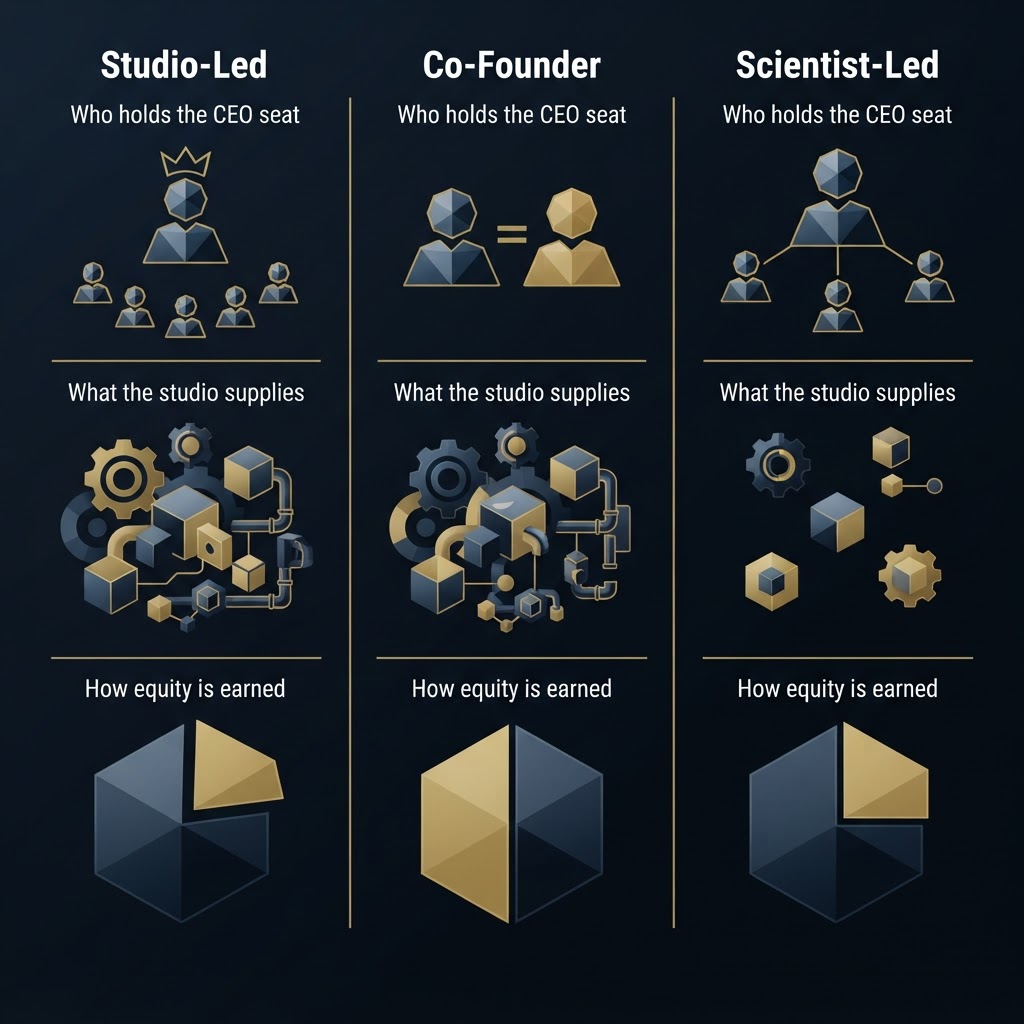
What they do not agree on is you. Some studios want the scientist as CEO. Some refuse to hand the company to anyone else. Some recruit a CEO and keep the inventor close to the science. Those are three different deals, and the homepages ranking for this search each sell one of them as if it were the only one.
This piece lays the three side by side, says who each fits, and gives you five questions that settle the choice. If you need the underlying model first, start with what a venture studio is.
What a venture studio for scientists actually does
The clearest neutral definition comes from CASRAI's guide to university venture studios: the distinguishing feature is not the money, it is the embedded operating team. A technology transfer office evaluates a disclosure, patents it and looks for a licensee. A venture fund writes cheques into companies that already exist. A studio does something neither does. It scouts labs, defines the business opportunity with the inventor, recruits a founding CEO and builds the first product roadmap, supplying labour at the stage where there is not yet enough company for an investor to evaluate.
CASRAI points to MIT Proto Ventures as the first venture studio of its kind run inside a university, with full-time venture builders embedded in labs. Outside universities, independent studios do the same work and take equity for it. Both kinds are covered in more depth in our guide to university venture studios, and the institutional contrast is its own article: how a studio differs from a technology transfer office.
Why the normal startup path breaks for science
Tim Keller has watched more than 40 companies pass through Inventopia, the deep-tech incubator partnered with UC Davis, over eight years. His conclusion, in a UC Davis essay on the broken startup treadmill, is blunt: most of the companies that fail do not fail because the technology did not work.
They fail in two ways. The first is human: academic founders making rookie mistakes because they have never run a business. The second is slow capital starvation. The standard model raises a round per milestone and gives up about 20% of the company each time. Science does not hit milestones on schedule. Miss one, run out of money, and the company is dead with the science intact.
His opening story is the one every scientist should read before signing anything. A physician held a patent spun out of UC Davis. The team won a federal SBIR grant, built a working prototype and had investors interested. Then a public medical company asked for the same device for a different cancer. The physician held sole control, did not want that customer, would not leave his day job and would not give equity to people who would. Investors walked. Years later the same public company bought a different startup to solve the exact problem.
The lesson is not that scientists should hand over their companies. It is that control has to go to whoever will do the work, and a studio is a structure for deciding that on purpose rather than by accident.
The three models, and the role each gives you
Model 1: you lead, the studio builds around you
Here the scientist is the founder and the studio is the wraparound team. Empirical Ventures' studio is the clearest example. Applicants go through Forge, an in-person residency plus a remote commercial sprint, then a Greenlight decision. Those who pass get £150k of formation capital and an operator team for 6 to 12 months: pitch decks, data room, customer discovery, financial models, IP legals, first hires and investor introductions. The stated goal is to raise the first external pre-seed round. "You stay in the driving seat."
Conception X goes further. It does not pair scientists with business co-founders at all, on the view that researchers can and should lead on how their discoveries are used. Its fellowship runs alongside the PhD and draws from 90+ universities in 11 countries.
Fits you if you want to be CEO, you are ready to learn fundraising and sales, and your field rewards a technical leader in front of investors.
Model 2: you co-found with an operator partner
In the middle sit studios that join as co-founders and take a share of the work and the equity. Converge Lab comes in as a minority partner, handles IP protection, legal and regulatory structuring, and helps assemble the core team. IKP ARK embeds operators inside MedTech and HealthTech ventures for 12 months across three phases, with a maximum of five startups per cohort. Its equity is milestone-vested, earned through capital and execution rather than granted up front, and it supplies embedded regulatory, engineering and manufacturing functions.
Fits you if you want real authority over the technology and a say in strategy, but you know regulatory filings and manufacturing are where you would lose a year.
Model 3: the studio originates the company around your research
At the far end, the studio finds the research, recruits a CEO and builds the company, with the scientist as inventor, adviser or chief scientist. This is the pattern CASRAI describes for university studios. It usually runs alongside a licence from the institution, which is where spinning a company out of a university gets its paperwork.
Fits you if you want your result in the world and your career in the lab. You trade ownership for the right not to become a manager.
None of the three is the correct one. The mistake is signing with a Model 1 studio when you wanted Model 3, or the reverse, and discovering the mismatch at the first board meeting.
Five questions that decide which studio fits you
1. Which job do you want in five years? Be honest. If the answer is "running my lab", a CEO seat is a liability to you and to the company. The UC Davis physician did not want the job and would not let anyone else have it. That is the one combination that reliably fails.
2. What does the studio supply beyond money? £150k of formation capital is useful. An embedded regulatory lead for a medical device is worth more. List the three hardest non-science tasks between you and a first customer and ask each studio who, by name, does them.
3. How is the studio's equity earned? A stake that vests against delivered milestones, as at IKP, aligns the studio with the build. A large stake granted on day one for introductions does not. Before you negotiate a number, run the equity arithmetic behind a studio deal, including what you still own after two priced rounds.
4. What happens to your post? Most programmes let you start while still employed. Empirical accepts applicants deep in a PhD, postdoc or industry role but expects heavy part-time or full-time work once the company launches. Conception X is built to run inside the PhD timeline. Know your institution's rules on outside equity and time before you apply.
5. Is the research ready? IKP ARK takes only technology at TRL 3 or above. Empirical prefers founders who have not raised dilutive money and may not have approached their tech transfer office yet. Studios differ on how raw they like it, so match your stage to their gate rather than stretching the claim.
What a builder brings when the timeline is a decade
Most studio programmes end at a pre-seed round. Deep science does not end there. Energy, carbon and biotech companies spend years between prototype and revenue, and what they run short of in those years is rarely another idea. It is patents that survive diligence, operators who can install and run hardware in the field, and capital that does not panic when an experiment slips.
That is the gap EX EPIC was built to fill. According to exventure.co, the group has a capital track record above EUR 160M and finances, patents and deploys deep tech across four continents. Its IP arm has filed 24 patent families with about 100 more validated in the pipeline. Zero-X has designed, financed and installed waste-to-energy systems in 11 countries, more than 200 units in the field. And the EX EPIC Academy has trained and deployed more than 250 operators into the portfolio, which is the answer to the question every scientist founder eventually asks: who is actually going to run this?
That is a Model 2 and Model 3 profile. It suits a scientist who wants the science protected and deployed more than they want the CEO title. If you are still deciding whether your result should become a company at all, weigh whether to license the patent or build the company first. A studio only helps once the answer is build.
FAQ
Do I have to leave my PhD or academic job to work with a venture studio?
Not at the start. Empirical and Conception X both take applicants who are still in a PhD, postdoc or research role. The commitment rises once the company is formed and raising, so plan the transition with your institution before that point.
Does a venture studio own my patent?
Usually not directly. Where the research came from a university, the institution typically owns the IP and licenses it to the new company, and studios work alongside that licence. Read the licence terms, not the studio pitch, to see who controls the patent.
How early can I approach a venture studio?
Earlier than most scientists assume. Some studios prefer you before any dilutive funding and before formal tech transfer talks. Others set a technical floor such as TRL 3. Check each studio's gate and approach the one that matches your stage.
What if the studio decides my research is not a company?
That is a legitimate result, not a failure. Conception X, where 34% of teams go on to build high-growth companies according to its own figures, explicitly counts a focused research organisation, an open-source project or a fellowship as good outcomes for science that reaches the world another way.