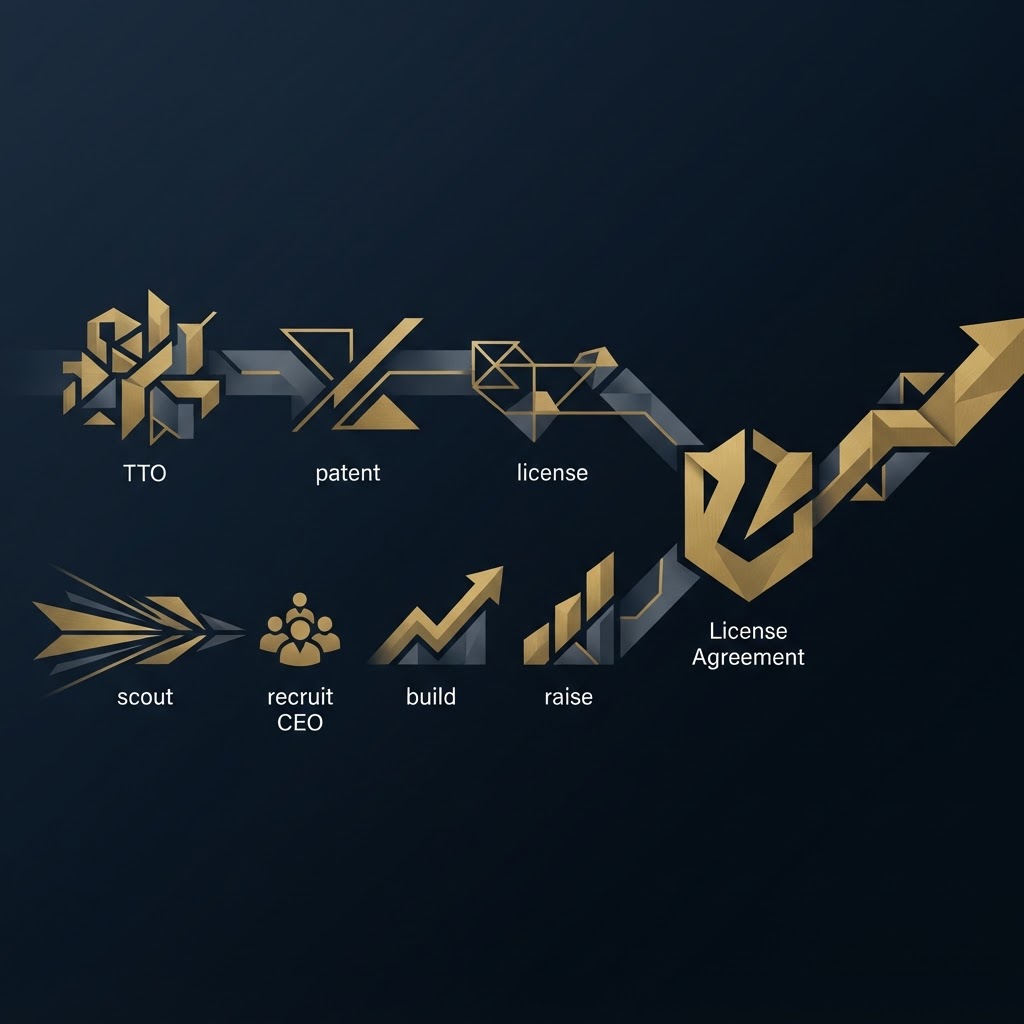
The venture studio vs technology transfer office debate is usually framed as a rivalry. It is not one. A technology transfer office (TTO) protects university research and licenses it. A venture studio builds a company around it. One owns the paperwork. The other supplies the people.
The question that matters is the handoff. Somebody has to turn a patent into an operating business: hire a CEO, find the first customer, raise the first round. For most of the history of university commercialization, nobody was formally responsible for that step. Studios exist to fill it.
This piece sets the two side by side, shows where they overlap, explains which deal terms change when a studio arrives, and gives a simple frame for which route fits which technology. If you need the underlying model first, start with what a venture studio is.
The short answer
A TTO decides whether to patent an invention and who gets the right to use it. A venture studio decides whether there is a company in that invention and then staffs it. The clearest neutral statement comes from CASRAI's guide to university venture studios: the distinguishing feature of a studio "is not the money, it is the embedded operating team."
The same guide is explicit that the two are layers, not substitutes. Companies formed through a studio still license the underlying university IP, and the TTO's disclosure, patenting and licensing functions remain necessary. What changes is that company formation becomes an actively resourced job instead of something the TTO supports from the sidelines.
What a technology transfer office actually does
The TTO spinout process
The UK government's independent review of university spin-out companies describes the standard sequence. An academic files an invention disclosure. The TTO analyses the commercial opportunity and decides whether to patent it at the university's expense. The TTO and the academic then decide jointly whether to license the IP to an existing company or use it as the basis for a spinout.
The review's founder survey suggests most spinouts take 4 to 12 months from the point the academic and TTO agree to spin out to having all agreements signed. The delays it lists are telling: finding co-founders, securing investment, agreeing staff involvement, managing conflicts of interest, patent due diligence. Only some of those are legal work. The rest is company building, and that is not what the office was designed for.
Why TTOs are not built to build companies
A TTO is a licensing and compliance function inside a university. Its budget reflects that. Ashley Stevens' survey of US academic licensing offices found institutions spend on average 0.6% of their research budgets on technology transfer, split between patent protection and operating costs. Over half of the programs bring in less money than they cost to run. Only 16% are self-sustaining.
The same survey found revenue maximization is a distant third motive, behind faculty service and translating research. That is a reasonable mission for a university office. It also explains the gap. An office that is measured on service, funded as overhead and staffed with licensing professionals will not hire a founding CEO, build a prototype or run a sales pipeline. It was never asked to.
This is not a criticism of TTO staff. It is a description of the job. Licensing a patent to an incumbent that already has engineers, factories and customers is exactly the right tool when such a buyer exists. The trouble starts when the best use of the invention is a company that does not exist yet.
What a venture studio does differently
A studio starts from the opposite end. CASRAI describes venture builders who scout labs, identify a real problem a piece of research could solve, and then work with the inventor to define the business, recruit a founding CEO and build the initial product roadmap. The studio contributes labour at the earliest, highest-failure stage, before there is enough of a company for a VC to evaluate.
Summit Venture Studio puts the division plainly: a TTO manages invention disclosures and licensing, while a studio executes commercialization. Its process pairs each technology with an Entrepreneurial Lead who serves as founding CEO, and its own summary of the old model is that "traditional tech transfer often ends at licensing."
The most instructive real deployment is at Notre Dame. As Global Venturing reports, the university set up a $35m fund managed by High Alpha Innovation, with an on-campus studio fed by the university's IDEA Center. Diligence typically takes four months, and a "do not pass, go" verdict is treated as a valid outcome. The studio brings in external professional founders and does not launch companies with researchers as CEO or CTO. A partner sits in meetings from the point of invention disclosure, the first formal contact a researcher has with the TTO.
That last detail is the whole story. The studio does not bypass the TTO. It sits inside the TTO's process and adds the one thing the office lacks: people whose job is to build.
Venture studio vs technology transfer office, side by side
| Technology transfer office | Venture studio | |
|---|---|---|
| Core job | Protect and license IP | Build a company around IP |
| Who owns the IP | The university | Still the university, licensed to the new company |
| Trigger | Faculty files a disclosure | Studio scouts labs, often before disclosure |
| Who builds the company | The licensee or a faculty founder | The studio's embedded team |
| Who is CEO | Whoever the founders find | Usually a recruited operator |
| Capital | Patent costs, sometimes gap funds | Formation capital plus labour |
| Equity | University equity for the license | Studio equity on top, in most models |
| Success metric | Licenses, disclosures, faculty service | Companies that raise and ship |
The table hides one important variation. Not every studio takes equity. CASRAI notes that MIT Proto Ventures, described as the first venture studio operated inside a university, does not take equity in the ventures it creates. Most private studios do.
Where the two meet: the deal terms that change
Three equity layers, one negotiation
In a conventional spinout, the license, the university's equity and the founders' equity can be negotiated once a team and a business plan exist. CASRAI warns that with a studio this changes: because the studio is proposing to build a company, not license a finished invention, the license terms, institutional equity and inventor equity have to be settled earlier and as a single package.
There are now three layers on the cap table before any investor arrives: the university, for the license; the inventor; and the studio, for its work. For reference points, the UK review endorses the TenU USIT guidance of 10 to 25% university equity for a life sciences spinout with high university support, and 10% or less for software-only IP. It also stresses that a deal should be judged as a whole, since high asks on equity, royalty and milestones together make a spinout harder to fund. For the licensing side in more detail, see what universities charge to license a patent and our piece on university spinout royalties.
The layers matter because deep tech rounds compound. UC Davis' Graduate School of Management argues that giving up around 20% per round breaks companies whose science takes a decade to mature. A studio stake that looks modest at formation is a much larger number after four rounds. Everyone at the table should model that before signing.
Earlier engagement and conflict of interest
Because studio builders scout research directly, faculty may be approached before they have filed a disclosure or even decided the work is commercial. CASRAI flags what that raises: inventorship, confidentiality, and what the IP policy requires before outside studio staff can look at unpublished work. It also flags an institutional conflict question. If the university holds equity in the studio's fund, the partnership itself may need disclosure and management, separate from the individual inventor's conflicts.
A TTO that partners with a studio needs these rules written down before the first scouting visit, not after the first term sheet.
Which route fits which technology
The honest answer is that each route wins in a different case.
License through the TTO when an incumbent can absorb the invention. A component that improves an existing product line belongs with the company that already makes the product. Our breakdown of when to license the patent or build the company walks through that test.
Spin out through the TTO when a committed founder already exists: an inventor or a student ready to go full time, with a clear market. The TTO's standard process, slow as it can be, handles this case. The steps are covered in how to spin out a company from a university.
Bring in a studio when there is no founder, the market is unclear and the timeline is long. That is the typical profile of deep tech hardware, energy and materials. Here the missing input is not a license. It is an operating team.
That last case is where we work. EX EPIC finances, patents and deploys deep tech across four continents, with a EUR 160M+ capital track record. The build side is people-heavy: Zero-X has designed, financed and installed more than 200 waste-to-energy units across 11 countries, EX IX launched with 24 patent families filed and roughly 100 more validated in its pipeline, and the EX EPIC Academy has deployed more than 250 operators across the portfolio. None of that is licensing work. It is what a TTO would need to hire if it wanted to build instead of license, and it is why the sensible model is partnership rather than replacement.
For researchers weighing their own role in a studio deal, see which studio model suits a scientist. For institutions designing a program, our guide to university venture studios covers the in-house versus external partner choice.
FAQ
Does a venture studio replace the university's technology transfer office?
No. Companies formed through a studio still license the university's IP through the TTO, and disclosure, patenting and licensing remain the office's job. The studio adds an embedded team that builds the company.
Do venture studios take equity in university spinouts?
Most private studios do, in exchange for their company-building work. Some do not: MIT Proto Ventures does not take equity in the ventures it creates. Studio equity is separate from the university's equity for the license and from the inventor's equity.
Can the professor be CEO of a studio-built spinout?
It depends on the studio. Some prefer the scientist to lead. High Alpha Innovation's studio at Notre Dame does not launch companies with researchers as CEO or CTO, and treats them as founders and advisers instead.
How long does a TTO spinout take?
Most spinouts in the UK founder survey took 4 to 12 months from the agreement to spin out to completed paperwork. Finding co-founders and investment are among the main causes of delay.