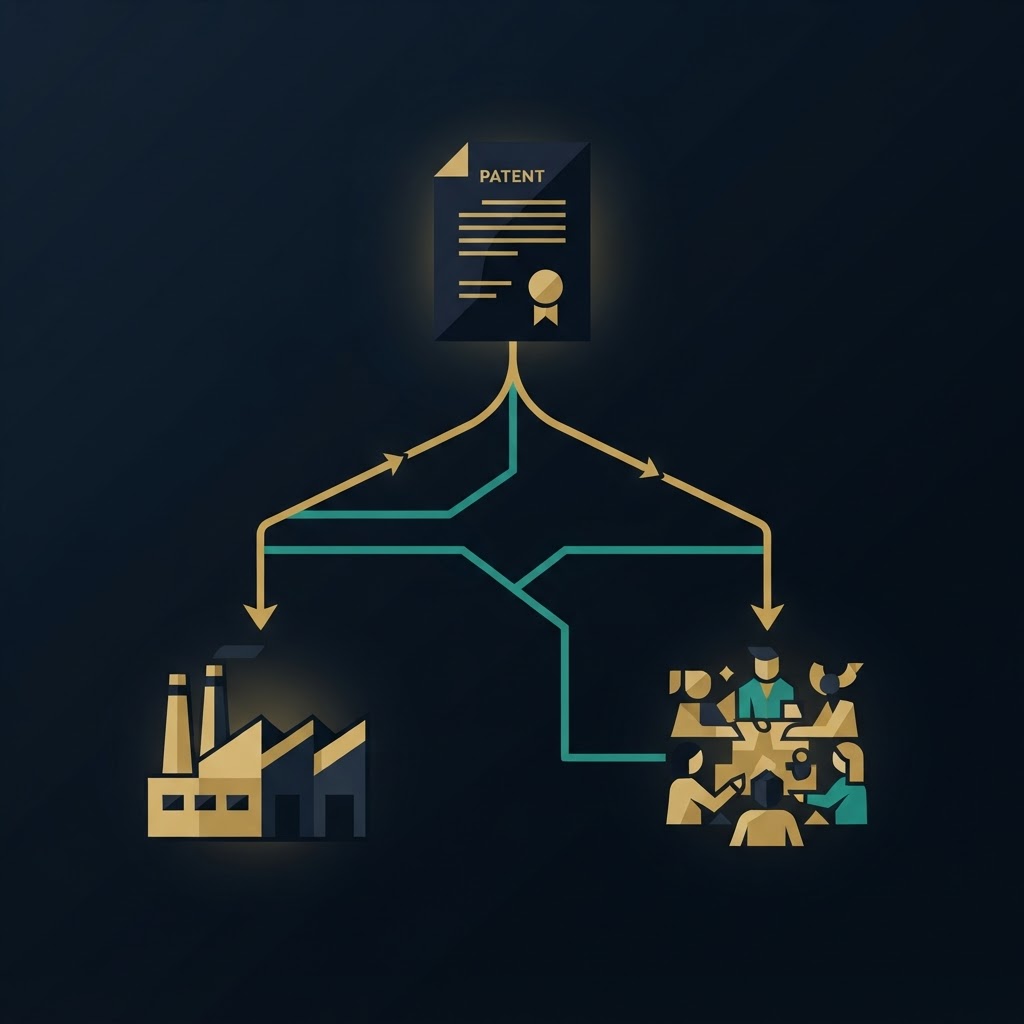
You hold a patent, or an application on its way to becoming one. Two doors are open. License it to a company that already makes and sells things, and collect a royalty. Or build a startup around the patent and take the whole market yourself. Every guide on the license or build question gives the same answer: it depends on your personality.
That answer was written for a different kind of inventor. The pages that rank for this decision talk about guitar picks, kitchen gadgets and "mailbox money". For a new battery chemistry, a gasifier design or a bioprocess, personality is the least important variable. What decides it is who can actually carry the invention to market, how long the patent protects you while they do, and whether the capital that journey needs can be raised.
We make this call from the builder side. EX Venture finances, patents and deploys deep tech on a EUR 160M+ capital track record, with 24 patent families filed and roughly 100 more validated in pipeline, and waste-to-energy hardware installed in 11 countries. Some of those patents should be licensed. Some should become companies. Most should be split between the two.
Why the usual answer does not fit a deep-tech patent
The standard frame puts two characters in front of you. Nolo calls them the "inventor-for-royalties" and the "entrepreneurial inventor", and the choice between them comes down to how much you enjoy running a business. Stephen Key, who has done both, writes that the decision is "more often than not" a matter of personal preference.
For a consumer product that is fair. The invention is finished when the prototype works, and the rest is manufacturing, retail and marketing: known skills you can hire.
Deep tech breaks that frame in three places. The invention is rarely finished when the patent is filed, so "build" means years of development before there is anything to sell. The company that would license it usually needs proof at pilot scale before it will sign. And "build" rarely means the inventor personally owning the patent and a factory. It means a company that holds a licence to the patent, raised capital against it, and hired operators who know the market. That changes both options.
What each path actually pays
Licensing: a small share, sooner, if you land it
Royalties are thin by design. Nolo puts them at 2 to 10 percent of net revenues. Consumer licensing deals are usually priced on the wholesale price, not retail, with many landing in the 3 to 10 percent range, and even after signing it can take months or longer before the first royalty cheque arrives. Rates vary widely by sector, so check average patent licensing royalty rates for your field before modelling either path.
The bigger number is the success rate. A study by Zimmer and Westrum, cited by Nolo, found only about 13 percent of inventors who tried to license their invention succeeded, and Nolo notes the figure is probably flattering because unsuccessful inventors were less likely to answer. Licensing is low risk only once you have a licensee. Finding one is the risk.
Building: the whole margin, later, if you survive
The same study found nearly half of inventors who produced and marketed their own invention reported success. That looks like a clear win for building until you count the cost. Key needed a quarter of a million dollars just to fulfil Walmart orders for a guitar pick that cost under a penny to make. FindLaw lists what a builder has to finance that a licensor does not: tooling, mass production, distribution, collections and patent enforcement.
Scale that to deep tech. Commonwealth Fusion Systems was spun out of MIT in 2018 around a superconducting magnet, demonstrated a 20 tesla field in 2021, and raised roughly $1.8 billion in Series B funding the same year. Building captured the value of that patent. It also needed a balance sheet no individual inventor has.
The four-question test
Swap the personality quiz for four questions about the patent itself.
Who owns the complementary assets?
A patent is rarely enough to reach a customer. You also need manufacturing, regulatory approval, distribution and a brand buyers trust. If one incumbent owns all of those and a new entrant would take a decade to build them, license. Nolo's own example is industrial machinery: if you lack the money and factory space to mass-produce it, licensing to a company already set up to make it may yield better results. If nobody owns those assets yet, because the market does not exist, there is nobody to license to, and building is the only path.
Is the patent the product or a feature?
If your claim improves one component of someone else's system, a better seal, a faster control loop, a cheaper catalyst, the natural buyer is the system maker, and a standalone startup will spend its life selling a part. License. If the claim is the reason the product exists at all, as with the fusion magnet, the patent is the company. Build.
How long is the window?
A patent runs out whether you use it or not. ILG lists remaining patent life as a factor across every path: long remaining terms support building, short ones push you toward faster money. Deep-tech timelines make this sharper. Prosecution alone routinely takes 18 to 36 months, and a startup that needs six years to reach revenue may find most of its protection gone by the time it sells anything.
Can the capital need be financed?
Building is only an option if somebody will fund it. Venture investors will back a patent-first company when the patent de-risks a big market, which is exactly what happened with the fusion magnet. They will not fund a feature patent into a thin niche. If the honest answer is that no investor would fund the build, that is your answer.
Score the four. Incumbent owns the assets, patent is a feature, window is short, capital is unavailable: license. The reverse on all four: build. Anything mixed leads to the next section.
Build usually means license in
Here is what most guides miss. When a researcher "builds a startup around a patent", the startup usually does not own the patent. The university or the lab does, and the startup licenses it in.
That is now the main route university patents take to market. In AUTM's 2020 survey, over three quarters of licenses and options were done with startups and small businesses, academic discoveries produced a record 1,117 startups, and agreements with large companies had fallen 23.8 percent since 2015. The trend has held: AUTM's FY2025 survey reports licenses with startups up 15 percent and agreements including equity up 16 percent.
So for a researcher the real choice is not license versus build. It is license to an incumbent versus license to a company you found. The negotiation is the same kind of document. What differs is the counterparty, the equity, and who carries the risk. If that is your position, the steps to spin out a company from a university matter more than any royalty table.
The answer is often both: split by field of use
Patents are rarely one market. A claim on a heat-recovery method may apply to power generation, cooling and industrial drying. You do not have to pick one path for all of them.
ILG recommends sequencing and hybrid models: license to generate revenue while building knowledge, or build a presence in one market and license into others. The Epirus team makes the same point from the investor side: one strong patent can become a product, a licensing business or an acquisition target, often all three at different stages. And the licensing market has moved in the direction that makes splits easy. Nearly 83 percent of university agreements in 2020 were non-exclusive.
The practical version: build in the one field where you own, or can build, the complementary assets. License every other field to the incumbent who already owns them. The startup gets a focused market and a defensible core. The licences bring in non-dilutive cash and prove the patent's value to investors. That is also the core of a patent licensing business model that sits alongside an operating company rather than replacing it.
How EX Venture makes the call
We do not start from the inventor's temperament. We start from the asset.
When a technology reaches us, the first question is whether we would deploy it ourselves. Zero-X has designed, financed and installed waste-to-energy systems across 11 countries, with 200+ units deployed. A patent that strengthens hardware we already build is held and built on, not licensed away, because licensing it would hand a competitor the edge we paid to create.
Where we would not deploy it, the patent still has a buyer. EX IX, our patent liquidity marketplace, launched with 24 patent families filed and around 100 more validated in pipeline, mostly clean energy. Fields of use outside our operating businesses go there, to be licensed or sold to companies that own the route to market.
Two lessons from running both sides:
- Decide per field, not per patent. The same filing can be a company in one market and a licence in three others.
- Decide before prosecution closes your options. Claim scope and target countries are cheap to adjust early and expensive later. Our patent licensing strategy guide covers the portfolio-level version of this call; the single-patent version is what a startup built around a patent has to get right on day one.
Licensing is not the timid option, and building is not the brave one. Each is a bet on who is best placed to carry a specific invention to a specific market. Make that bet per field of use, with numbers, and the license or build question mostly answers itself.
FAQ
When is the best time to approach potential licensees?
Usually once the invention is patent pending and you have a working prototype. Going in with a raw idea tends to mean poor royalty rates or rejection, while waiting for the granted patent adds leverage but delays cash, so the pending phase with reduced technical risk is typically the sweet spot.
Can a university spinout license the patent it was built on?
Yes, and it is the normal route. Most US university licenses and options now go to startups and small businesses, and deals that include equity for the university are growing, so the founding team typically negotiates an exclusive licence in exchange for royalties, fees and a share of the company. The typical university patent licensing fees are worth knowing before that negotiation starts.
What is the difference between licensing and assigning a patent?
A license is like renting: you keep ownership and the licensee gets rights to use the invention. An assignment is a permanent sale of the patent, after which you have no rights left. An unlimited exclusive licence can behave much like an assignment, so read the terms, not the title.
Should I keep paying to prosecute a patent I cannot commercialise?
Only if a path still exists. Money already spent on filing is gone whichever route you pick, and ILG warns against the sunk cost trap of pursuing a path just to justify past spend. Decide on future returns: a licensee, a buyer, or a company worth funding.