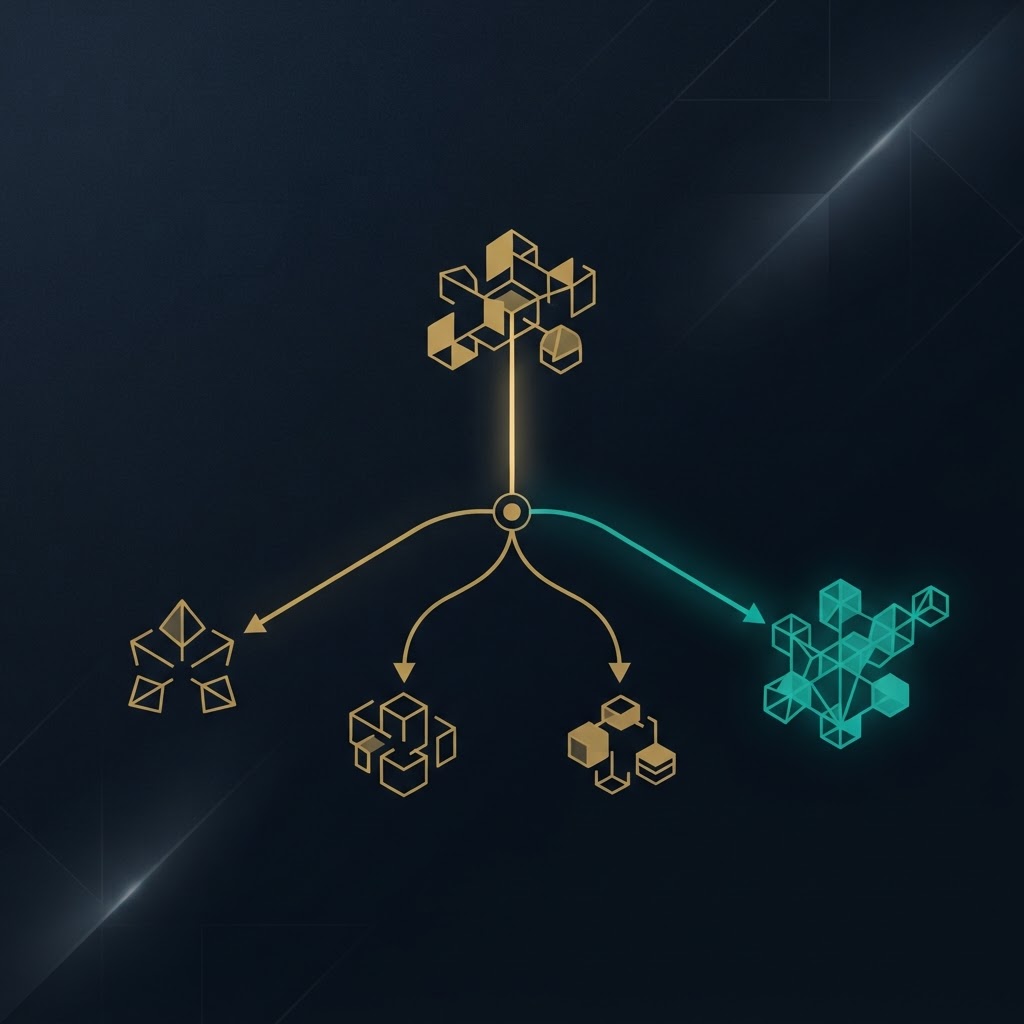
Most advice on patent licensing strategy answers the wrong question. It explains how to get a licence signed: how to find infringers, how to write the demand letter, how to structure the royalty. That is execution. The strategy is the decision that comes before it, and it is made per asset: which patents in your portfolio should be licensed to somebody else, which should be held to protect a business you operate yourself, and which should be sold.
Get that wrong and no amount of programme quality recovers it. You can run an immaculate licensing campaign around a patent you should have kept, and the campaign will succeed, and you will have sold the moat for a royalty.
At EX Venture we make this call as an owner rather than an adviser. The group finances, patents and deploys deep tech across four continents on a EUR 160M capital track record, which means every patent we file is attached to something we may end up building ourselves. That changes the answer more often than the SERP suggests.
What a patent licensing strategy actually decides
Corporate IP practice recognises four monetisation pathways: licensing for recurring royalty revenue, litigation to compel action, a hybrid that creates leverage while pursuing a commercial resolution, and outright sale for immediate liquidity. Each carries a different risk profile, and the discipline is to start from the asset and the commercial objective rather than from a preferred tactic, because the goal is to maximise risk-adjusted value, not to pick the most aggressive strategy.
That framework is sound and incomplete. It is written for corporate IP departments sitting on an estate, so it omits the option that matters most to a technology company: build. Patents are exclusionary rights, not financial instruments, and an owner who commercialises the invention captures the full market value rather than sharing it with licensees or discounting it to a buyer.
So the real menu is five: license, litigate, hybrid, sell, build. For an operating company, hold-and-build is frequently the correct answer, and choosing it deliberately is a strategy rather than the absence of one. The rest of this article is how to tell which asset belongs in which bucket. If you are still assembling the portfolio itself, start with patent portfolio strategy and come back here.
Screen the asset before you screen the market
The first screen is not market size. It is whether the patent can carry a programme at all.
Asset quality comes first, not last
Before any monetisation route is chosen, an owner should be able to state, per asset: infringement strength, claim coverage, validity, remaining term, ownership chain, existing licensing encumbrances, and prosecution history vulnerabilities. Asset quality determines the range of viable options, which is why it belongs at the front of the process. A patent with strong infringement evidence but real validity concerns still has value, but its best route is not the same as one that is robust on every dimension.
The uncomfortable version of this rule: no monetisation programme compensates for a weak patent. If the claims do not reach commercially deployed technology, a licensing campaign converts a paper asset into an expensive paper asset.
Chain of title and freedom to operate
The questions an investor asks in diligence are the same ones that decide whether you can license. Investors probe claim breadth and prosecution history, which countries the rights cover and why, whether the named inventors are still at the company, whether assignment documentation is clean, and whether a freedom-to-operate analysis exists. Even a strong patent loses its value if it was improperly assigned from the inventors to the company, and patent rights are territorial, so a licence is only worth what the granted geography supports.
Run that checklist on yourself before a counterparty runs it on you. Every gap it finds is a discount you will pay later.
When licensing is the right answer
Licensing is the right route when the commercial objective is long-term royalty income, preserving a business relationship, opening cross-licensing options, driving industry adoption, or participating in a standard. In each of those, commercial cooperation is worth more than confrontation.
Counterparty behaviour then determines the approach, often more than patent quality does. A cooperative implementer takes a licence. A strategic competitor with high commercial stakes usually needs a hybrid posture. A holdout who refuses meaningful engagement is a litigation question, not a licensing one, and a financially distressed target is a sale or settlement.
Exclusive versus non-exclusive
Exclusivity is the term that moves the money. Exclusive licences command higher royalty rates and larger upfront payments because the licensee is buying a competitive advantage, and they usually carry minimum performance commitments so the technology does not sit idle. Non-exclusive licensing can generate more total revenue where the technology is fundamental and many companies can incorporate it.
The tell is whether your value comes from one partner winning or from everyone adopting. Fundamental technology wants breadth. A single-market advantage wants a committed partner with a floor on performance.
The royalty base decides the leverage
Rates get the attention, but the base is what creates pressure. Mapping the patented technology to the product categories that use it, quantifying deployment scale, and identifying the revenue streams a royalty would be calculated against is often the most commercially significant step in the whole assessment, because the royalty base determines the damages exposure that gives a target its incentive to settle.
Rate benchmarks vary by industry and are worth studying separately. Our IP arm has the numbers in average royalty rate for licensing intellectual property.
When holding beats licensing
Here is what the ranking pages leave out. If you can deploy the technology yourself, licensing is a decision to accept a fraction of the value in exchange for removing execution risk. Sometimes that trade is right. Often it is a builder underestimating their own capacity.
Your IP portfolio should reflect your business model rather than run parallel to it. If you sell through OEM partners you need licensing-friendly IP that partners can sublicense. If you expect to be acquired you need clean chain of title and broad claim scope. If you intend to compete with incumbents head on, you need a portfolio large enough to support cross-licensing negotiations, which means those assets are not available to license out cheaply, because their job is leverage.
Holding is only rational if you can actually deploy. That is the test most patent holders fail and the reason the advice defaults to licensing. In our case the deployment record is the evidence: Zero-X waste-to-energy systems have been designed, financed and installed across 11 countries, with more than 200 units in the field. When the group files around a gasification process, the question is not what a licensee would pay. It is what the next 200 installations are worth with that claim in place and what they are worth without it.
The same logic runs through the whole portfolio. See patent strategy for deep tech startups for how filings get sequenced against a ten-year development clock, and IP as an asset class for how investors price the result.
Sequencing the decision across a portfolio, not a patent
Real portfolios contain all three answers at once, and the license, hold or build call is priced years before anyone sends a demand letter.
Filing strategically means filing three to five years ahead of the product roadmap. Continuation applications keep a family alive to capture new claim scope as the product evolves, continuation-in-part applications add new matter when the core invention improves, and a PCT application buys 30 months to assess which national markets justify full entry. Cost forces triage: a provisional application runs roughly $1,500 to $3,000 in attorney fees, and a full utility patent can run $10,000 to $20,000 or more through prosecution.
Those windows are the strategy. The 30 month PCT decision is the last cheap moment to change your mind about geography, and continuation practice is the last cheap moment to change your mind about scope. A patent whose claims were never shaped for a licensee will not become licensable after grant.
At portfolio scale this becomes an allocation problem rather than a filing problem. EX Venture's IP arm has 24 patent families filed with roughly 100 more validated in the pipeline, and the work is deciding which of those families protect deployments, which support licensing programmes, and which are candidates for the liquidity marketplace. Tracking that allocation over time is patent portfolio management, and it is a standing process rather than an annual review.
Running the programme once you have decided to license
If licensing wins the decision, the execution is well established and runs in four phases: candidate selection, evidence of use development with target prioritisation, outreach and negotiation, then IPR risk assessment and the litigation backstop.
Licensing-ready patents share three traits: claim scope covering commercially deployed technology at the independent claim level, a prosecution history that does not undercut the infringement mapping, and enough remaining term to justify the investment. Targets are then ranked on how clearly infringement can be demonstrated against their specific products, the size of the royalty base, how aggressively they litigate, and whether an early licence sets a precedent that makes the next ones easier.
Note what that sequence assumes. A portfolio that was never analysed, with no evidence of use charts and no target ranking, is not running a licensing programme. It is sending letters.
Four mistakes that destroy licensing value before you start
- Public disclosure before filing. Presenting at a conference or launching before a provisional application is on file can close filing windows and create prior art against your own invention.
- IP assigned to founders personally. Rights sitting with individuals rather than the company break the chain of title, and a broken chain is a discount at every future negotiation.
- No freedom-to-operate analysis. Without it you can hold an enforceable patent and still be blocked from practising your own technology.
- Filing reactively. Patents filed only after a competitor appears or an investor asks protect where you were, not where you are going.
FAQ
Should I license or sell my patent? Sale suits immediate liquidity, limited internal enforcement resources, a shortening remaining term, or a preference for certainty over upside. Licensing suits recurring royalty income and preserved commercial relationships. A sale is not a fallback for a failed licensing effort, and in many circumstances it is the highest-value outcome available.
Can you license a patent that is still pending? Yes, but the terms differ. Remaining term and validity are screening criteria, so a pending application is licensed as a risk-allocation exercise: what the licensee pays now, what changes on grant, and who carries the risk that the claims narrow during prosecution. Treat it as a staged deal rather than a discounted version of a granted-patent licence.
Is exclusive or non-exclusive licensing better? Neither is better in the abstract. Exclusive licences carry higher rates, larger upfront payments and usually minimum performance commitments. Non-exclusive licences can generate more total revenue where many implementers can adopt the technology.
How do you decide which patents in a portfolio to license? Start with which ones are licensing-ready: independent claims that read on commercially deployed technology, a clean prosecution history, and enough remaining term. Then remove any asset whose job is protecting something you deploy or intend to deploy yourself.
Does a licensing strategy make sense before a patent is granted? It is the only time it is cheap. Continuation practice and the 30 month PCT window are the points where claim scope and geography are still adjustable, and both close long before a licensing programme starts.