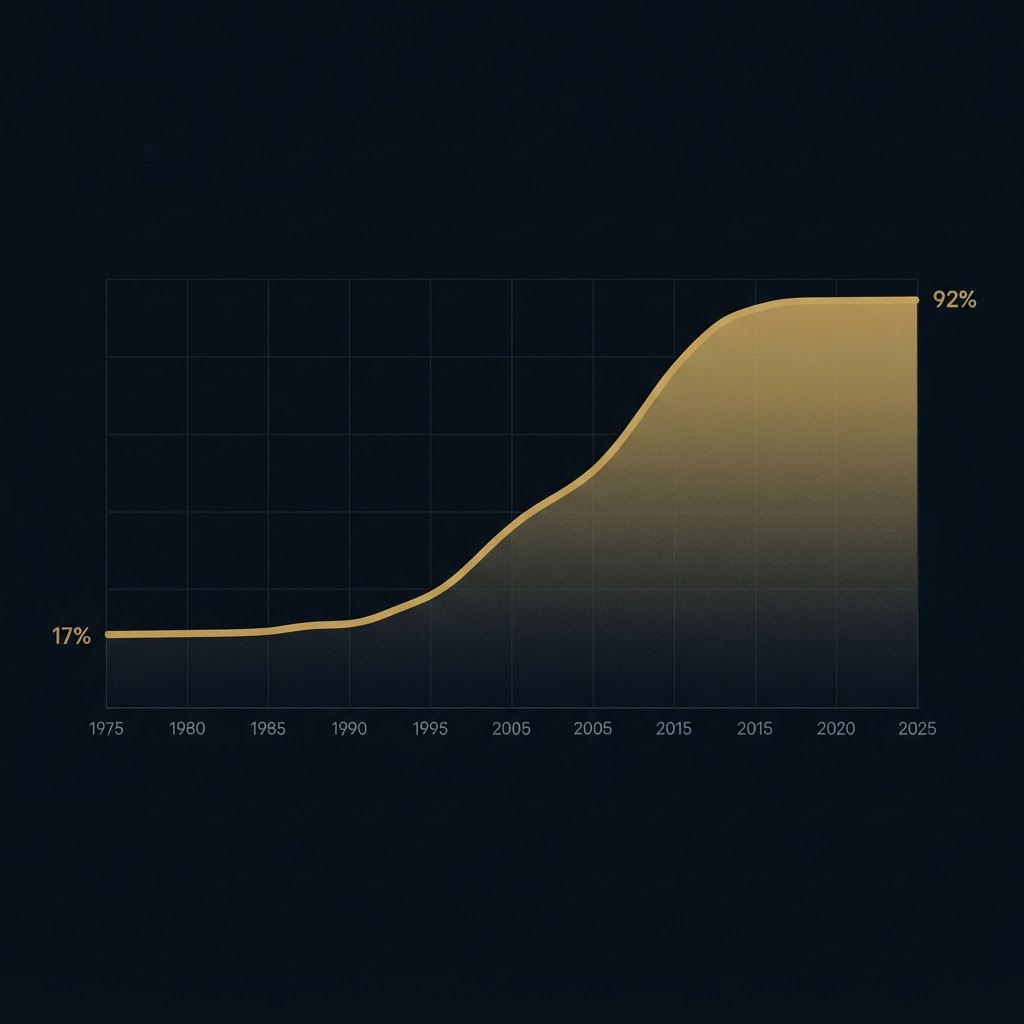
IP as an asset class is no longer a conference slogan. Almost all of the value in public markets now sits in things you cannot touch, and credit funds, royalty buyers and family offices are building strategies around that fact. The problem is that "IP" in an investor's mouth can mean four very different exposures, and the asset behaves nothing like real estate, bonds or equity.
We build companies around patents at EX Venture. We file them, license them and try to sell them. This is what the asset looks like from the inside, and where investors most often misread it.
Why IP is suddenly being called an asset class
Start with the shift in where value lives. In 1975, intangible assets made up 17% of the market value of the S&P 500. By the end of 2025 that share had reached roughly 92%, and it held near 90% through the sharpest rate tightening in four decades. The economy inverted. Most corporate worth is now knowledge, code, brands and patents.
Capital followed. Private credit assets under management are expected to exceed $2 trillion in 2026 and approach $4 trillion by 2030, according to Moody's, and lenders describe asset based finance against IP as one of the fastest growing corners of that market. When asset light companies need to borrow, their patents, trademarks and software are what they have to pledge.
So the demand side is real. The supply side, meaning assets an investor can actually buy, value and exit, is where things get harder.
The balance sheet problem: the asset you cannot see
Here is the first thing most investors miss. A company that invented its own patents usually shows almost none of their value on its balance sheet.
Under IAS 38, research spending is expensed as it is incurred. Development spending can only be capitalised once strict criteria are met, and internally generated brands, customer lists and similar items are never recognised as assets at all. Acquired IP is a different story: buy a patent and it lands on the books at cost.
The result is a systematic blind spot. Two companies with identical portfolios can report very different asset bases depending on whether they invented or bought them. Meanwhile the IP inside the business can be large. One WIPO training deck on IP backed lending puts the median share of licensable IP at around 25% of company value, in a range of 10% to 45%, while stressing in the same breath that there is no established market for IP and that its value is an opinion.
That combination, large and mostly invisible and hard to price, is exactly what makes IP interesting and exactly what makes it dangerous.
The four ways to actually own IP exposure
"Investing in IP" is not one trade. It is at least four, each with its own risk engine.
Royalty streams
You buy the right to a share of revenue from a licensed asset, without running the business. Pharma is the most institutional version. Annual pharma royalty transaction volume runs at roughly $5 billion, with $29.4 billion originated between 2020 and 2024, and the category leader Royalty Pharma has earned about 15% return on invested capital since 2019 by focusing on commercial stage drugs.
The pitch from specialist managers is diversification. Healthcare royalty funds argue their returns have low correlation to equities and fixed income, with a risk profile close to private credit secured on patents. The royalty ends when the patent does, which we come back to below. What a stream is worth starts with the rate, and EX IX breaks down the average royalty rate for licensing intellectual property. For the licensor's side of this trade, see our guide to patent licensing strategy.
IP backed credit
You lend against IP as collateral. This is where private credit is moving, and it is where the valuation problem bites hardest. The EUIPO's 2026 report finds that lenders apply conservative assumptions, high haircuts or outright exclusion of IP from recoverable value, because there is no common valuation standard, and it points to guarantee schemes as the bridge until trust builds.
Equity in IP heavy companies
The most common exposure, and the least pure. You own the company, and the patents are one part of what you own. Deep tech is the obvious case. BCG's analysis of about 1,100 venture funds found deep tech funds earned a 26% weighted IRR against 21% for traditional venture, with deep tech now holding a stable 20% share of VC funding. The same research notes that deep tech takes 25% to 40% longer between funding rounds. The IP protects the upside, but you are also buying the engineering risk and the timeline.
Direct patent ownership
You own the patent itself and earn from licensing, enforcement or sale. This is the purest exposure and the least liquid. It rewards someone who knows how a portfolio is built, which claims matter and where filings should sit. Our piece on patent portfolio strategy covers the construction side, and patent portfolio management covers keeping it alive.
What investors get wrong about IP
Mistaking a valuation for a price
Real estate lenders work with loan to value benchmarks of 60% to 80% because comparable sales exist. IP has no equivalent reference market. A valuation report is a model. A price is what one buyer pays on one day. Treat the first as the second and you will overpay or overlend. EX IX explains why a patent valuation is not the price in more depth.
Ignoring the expiry date
Patents are wasting assets. When exclusivity ends on a drug, the patent cliff can wipe out 70% to 80% of branded revenue within 12 to 18 months. Concentration makes it worse: one pharma royalty pool had two drugs representing more than half of its collateral. Music offers the other warning. Bowie Bonds, issued in 1997, were later downgraded to junk when file sharing broke the revenue model the bonds assumed.
Assuming the collateral stays put
IP is easy to move. In 2017 J.Crew transferred pledged IP into an unrestricted subsidiary and borrowed against it again, a move now known as the J.Crew Maneuver. Lenders added blocker clauses. Borrowers adapted: Xerox moved pledged IP into a joint venture it owns 49% of and raised another $450 million. Every IP credit document is a contest over whether the asset you lent against is still there.
Treating IP as global
Patent rights stop at the border of the office that granted them. A US patent does nothing in Germany or Singapore. Legal regimes differ too. North America is roughly five years ahead of Europe on IP backed finance, and European lenders lean toward registered patents and trademarks because software ownership is harder to prove under EU rules.
Underpricing illiquidity
Long dated, privately valued assets can hold a theoretical value that the market refuses to pay. Hipgnosis Songs Fund saw its catalogue valuations challenged by an independent valuer in 2023 and traded at a material discount to net asset value. Private royalty funds also tend to ask for minimum commitments of $500,000 to $1 million, so the exit is rarely quick.
How to diligence an IP asset before you buy exposure
Whichever of the four routes you take, the questions about the underlying rights are the same. Patent attorneys at Fish & Richardson suggest investors ask how broad the claims are, what happened during prosecution, and in which countries rights are held and why. We would add four of our own.
- Remaining life. How many years of exclusivity are left, per jurisdiction, and what replaces the income after that?
- Concentration. How much of the value sits in one patent family, one licensee or one product?
- Chain of title. Who invented it, who owns it, and can that be proven without a fight?
- Collateral controls. If you are lending, what stops the asset from being moved out of reach?
If the IP sits inside an early stage company, pair this with the wider checklist in how to evaluate a deep tech startup.
The missing piece is liquidity, not value
Investors rarely lose on IP because patents are worthless. They lose because there was no way to price or exit the asset when it mattered. Every problem above, from haircuts to NAV discounts to lenders chasing moved collateral, traces back to thin markets.
That is the gap we are working on. EX Venture has a capital track record of more than EUR 160 million, and its IP arm launched EX IX as a patent liquidity marketplace with 24 patent families filed and around 100 more validated in the pipeline, with a clean energy focus. Building patents inside operating ventures teaches you the same lesson every time: a well drafted family with a clear owner and a clear use is easy to talk about and still hard to sell without a venue built for it.
For investors, the practical takeaway is simple. IP as an asset class is real, but it is not one asset. Decide which of the four exposures you want, price the illiquidity honestly, and diligence the rights, not the report. Family offices weighing where this fits alongside other illiquid bets can start with our guide to deep tech investing for family offices.
FAQ
Can patents be used as collateral for a loan?
Yes. Lenders and private credit funds do lend against patents and trademarks. Expect conservative valuations and large haircuts, and in Europe expect a preference for registered IP over software. Public guarantee schemes are increasingly used to share the lender's risk.
How can an individual investor get exposure to intellectual property?
The accessible routes are listed royalty companies such as Royalty Pharma, private royalty funds, which usually need six or seven figure commitments, and shares in IP heavy companies. Note that listed vehicles still move with the stock market.
Are royalty investments correlated with the stock market?
The underlying royalty income, especially in healthcare, tends to have low correlation to economic cycles because demand for treatment is not discretionary. Once wrapped in a listed share, though, the vehicle picks up equity market correlation.
Why don't patents show up at full value on a balance sheet?
Accounting rules expense research as it happens and only allow development costs to be capitalised under strict conditions. Patents a company invents are therefore mostly invisible, while patents it buys are recorded at cost.