Deep tech investing for family offices stopped being a curiosity somewhere around 2023. It is now a line item. The published guidance has not caught up: the material aimed at family offices is trend evidence, and the material with real diligence method in it was written for venture funds that keep a technical partner on staff. This article is the third thing. We finance, patent and deploy this class of company for a living, so what follows is the view from inside the ventures your capital would be underwriting.
Why family offices keep turning up on deep tech cap tables
The asset class argument is settled. BCG's investor guide puts deep tech at a stable 20 percent share of venture capital funding, up from about 10 percent a decade earlier, and its analysis of roughly 1,100 venture funds found a five-year weighted average internal rate of return of 21 percent for traditional venture investors against 26 percent for deep tech focused funds. On a non-weighted basis the two sat at 26 and 25 percent. Deep tech is not a concessionary allocation dressed up as a return-seeking one.
Family office money specifically has moved fast enough to be measurable. Reporting on the Indian market, which is the cleanest recent dataset anyone publishes, tracked single family office investment into deep tech startups rising from $15.3 million in 2020 to $467.1 million in 2025, with $215.6 million already committed by 27 July 2026. The number of Indian family offices went from around 45 in 2018 to more than 300 by 2024, managing $30 to $35 billion between them, per PwC. Deep tech startups there raised $1.62 billion across 140 rounds in the first seven months of 2026, a 106 percent increase in capital on fewer deals.
Fewer deals, more capital. That is a market getting more selective, not less interested.
The structural edge is the holding period, not the thesis
A family office has exactly one durable advantage over a fund, and it is not judgment. Nobody is calling the capital back. Coverage of the same shift notes that family offices can hold positions for 15 to 20 years, while venture funds managing other people's money typically promise a return inside five or six years. Deep tech does not fit inside five or six years. The mismatch is the whole opportunity.
The FINTRX white paper on the category describes family offices as opportunistic, flexible and patient over the long term, which is accurate and also the point at which most articles stop. So state the counterweight plainly: a long horizon is only an edge if the company is progressing against milestones you can verify. Otherwise it is a long runway for a venture that is not going anywhere, and the absence of a fund clock removes the one mechanism that would have forced the question. Patience without measurement is just a slower loss. Everything below is about the measurement, and the sibling piece on how to evaluate a deep tech startup goes deeper on the company-level version.
What the journey actually costs
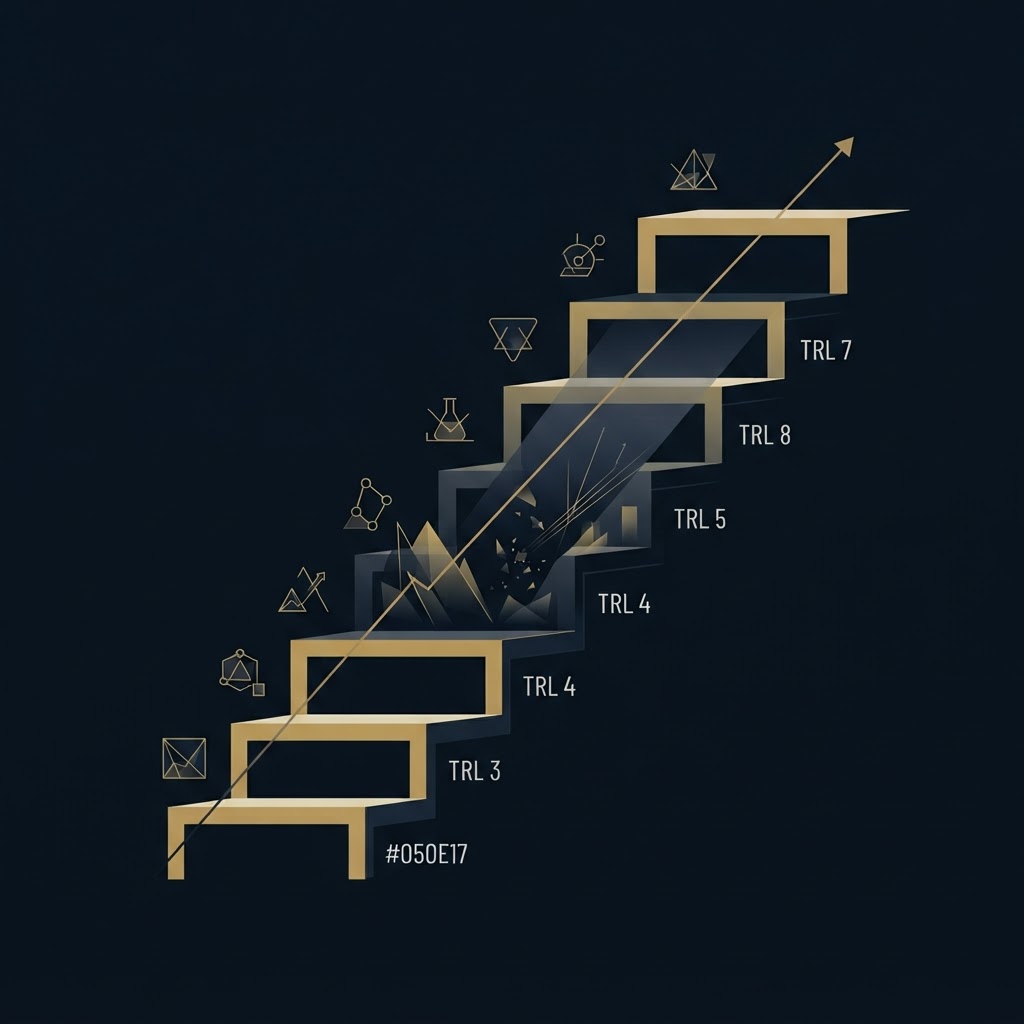
Price the timeline before the equity. Diligence practitioners put it bluntly: deep tech ventures require roughly 35 percent more time and 48 percent more capital than traditional tech startups to generate revenue. The dangerous stretch runs from TRL 4 to TRL 7, the gap between validated in the laboratory and ready for commercial deployment, and it is structurally underfunded. The EIC Transition programme, built precisely to bridge it, had its core challenge tracks suspended in 2024. Most European deep tech unicorn rounds land at TRL 6 to 7, after technology risk has largely been retired and when the money is no longer cheap.
This is compounded by what these companies build. More than 80 percent of deep tech ventures are making physical products, which drags in engineering risk, unit economics, and the unglamorous problem of manufacturing something twice. Software fails in a quarter. Hardware fails in a shipping container, eighteen months after the round closed.
We know the far end of that curve because we have walked it. Zero-X, inside our portfolio, has 200 or more waste-to-energy units deployed across 11 countries, financed and installed rather than announced. That is what TRL 9 looks like when it finally arrives, and it took a decade of the capital structure that most funds cannot offer.
The diligence a generalist process will miss
Scientific risk and engineering risk are different bets
The most useful distinction in the whole category, and the one a generalist process collapses, comes from a seed investor writing about evaluating scientific risk. Scientific risk is the risk that the underlying physical or biological phenomenon does not behave the way the founders believe. Engineering risk is the risk that a phenomenon already demonstrated in a laboratory cannot be reproduced reliably at commercial scale, cost and quality.
They call for different evidence and different money. Scientific risk is resolved by experiments and peer review. Engineering risk is resolved by capital, tooling and time. A company carrying both is not twice as risky, it is a different investment entirely, and the diligence question is which one you are actually being asked to fund.
TRL tells you where you are, not what can still go wrong
NASA's nine-level Technology Readiness Level scale is the lingua franca of deep tech, and it is a weak investment framework for two specific reasons. It conflates scientific validation with engineering development, so a technology at TRL 4 may still carry serious scientific risk if the lab conditions were not representative of commercial use, while one at TRL 6 may be scientifically sound and facing a brutal scaling problem. And it says nothing about the cost of the journey. Two companies at TRL 4 might need $5 million and 18 months, or $50 million and five years, to reach TRL 6. Same number, different asset.
Assume the number is optimistic until you have checked it. TRL 4 presented as TRL 6 is common enough to be a named failure mode. Ask what evidence supports the claimed level, not what the deck says the level is.
IP provenance is a chain, not a count
Patent count is the vanity metric of deep tech diligence. Provenance is the real one, and European deep tech is disproportionately born out of university labs where the assignment chain is rarely clean. The recurring defects are specific: co-inventors who left the institution without signing, background IP licensed on a field-of-use basis rather than assigned, government-funded research carrying public access obligations, and cross-licensing requirements back to the parent institution. None of these stop a seed round. All of them surface in exit diligence, when the acquirer runs the check you did not.
At the early stages the standard is simply clean ownership, and a practical technical diligence guide reduces it to questions any allocator can ask: did every founder and employee sign an IP assignment, was foundational work done in another institution's lab and is that licence clear and exclusive, did contractors assign their work product, and is the conception of key inventions documented and dated. The same guide makes a second point worth stealing: fund value inflection points, not technical milestones. Completing an experiment is an achievement. Materially de-risking the business is an investment.
We file rather than opine here. EX Venture has 24 patent families filed and roughly 100 more validated in the pipeline through EX IX, so the assignment chain is a thing we have negotiated, not read about. If you want the founder-side version of the same problem, our note on patent strategy for deep tech startups covers how a portfolio should be built to survive this exact review, and IP as an asset class covers what those assets are worth once they are clean.
Find the people who could falsify the claim
The final test is the cheapest and the one most often skipped. In every technical domain there is a small community of specialists who would immediately recognise a serious error in a company's claims. Find them and ask.
The companies that destroy capital are not the ones making obviously implausible claims. Those get filtered by anyone. They are the ones making superficially plausible claims containing a subtle technical error that only a domain expert catches. Those attract generalist money first, then stall when a specialist follow-on investor runs proper technical diligence and passes. Your diligence has to reach the standard of the next round's investor, or you are funding a company into a wall.
Where the deals actually come from
Access is a separate problem from judgment, and it is solved in different places. The best opportunities surface where the work happens: university labs, accelerators and studios, and insider rounds run by people who already understand the technology. Reputation as a partner rather than as a cheque is what wins allocation in those rooms, and it tends to win a better entry price too, because founders in this category are buying industry access as much as capital.
Here is the part that argument leaves out. Proximity to the lab is also precisely where an allocator without technical diligence capability is easiest to sell to. The enthusiasm is real, the science is genuinely interesting, and nobody in the room is incentivised to slow you down. Access and capability have to arrive together or the access is a liability.
That is the structural case for going through a builder rather than around one. A deep tech venture builder does not introduce you to a technology, it finances, patents and staffs it, which means the science risk and the IP chain have already been underwritten by someone carrying the same downside you are. EX Venture has run that model to a EUR 160 million plus capital track record across four continents. It is one structure among several, and it is worth understanding what separates deep tech from high tech before deciding which one you need.
The risks that do not make it into the deck
Deal flow is not a stable input. Single family offices made 40 direct investments in April 2025, down 31 percent on March and 47 percent year on year, as tariff uncertainty hit. A programme built purely on opportunistic sourcing goes quiet at exactly the moment pricing improves.
Concentration sits in a person. In a spinout, the question is almost never whether the technology works. It is whether the scientific capability survives the founding researcher leaving.
Regulatory exposure lands before technology risk does. Deep tech, defence tech and dual-use categories bring foreign investment control regimes, export control regulations and compliance obligations that constrain who may hold the asset and where it may be sold, independent of whether the science works.
The capability gap produces mispricing, not avoidance. Many family offices lack in-house technical due diligence and invest anyway. The result is risk carried at the wrong price rather than risk declined.
The capable end of the market looks different in a way worth copying. When SandboxAQ closed a $450 million Series E, it followed a $300 million round backed by family offices and individuals including Marc Benioff, Jim Breyer and David Siegel, extended by a further $150 million with Ray Dalio's family office among the buyers. Breyer read the technical literature with the founder before investing. Dalio's office took multi-year conversations to commit. That is what unhurried capital with technical access actually does.
A working checklist before the first cheque
Seven things to be able to answer. Not seven things to allocate against.
- Which risk am I funding, scientific or engineering, and what resolves it.
- What evidence supports the claimed TRL, and what does the next level cost in money and years.
- Does the company cleanly own its core science, inventor by inventor.
- Which milestone in this plan is a value inflection point rather than an experiment.
- Who in the world could falsify the central technical claim, and have I asked them.
- Will the next round's investors apply harder diligence than mine, and does the company survive it.
- Do export control, foreign investment or dual-use rules constrain who may hold this asset.
One thing this article deliberately does not give you is a target allocation. There is no credible published benchmark for what share of a family office portfolio should sit in deep tech, and inventing a range would be worth less than nothing. Nothing here is investment advice or a recommendation to invest.
What we will say from the build side is narrower and testable. Capital, protected IP and an operating team are what move a technology out of a laboratory. Most ventures that die had one of the three. A family office can supply the first, and should be honest about whether it can supply the other two or needs a partner who already does.
FAQ
Is deep tech riskier than traditional venture capital? The risk is different in kind rather than obviously higher in outcome. BCG's analysis of roughly 1,100 venture funds put the five-year weighted average IRR at 21 percent for traditional venture capital against 26 percent for deep tech focused funds, with non-weighted figures of 26 and 25 percent. What differs is the shape of the risk: science that may not reproduce, and physical products in more than 80 percent of ventures.
How long does a deep tech investment take to exit? Longer than a fund cycle permits. Family offices in this category describe holds of 15 to 20 years against the five to six year return timeline venture funds promise their limited partners, and diligence practitioners put the additional time to first revenue at roughly 35 percent over a traditional tech startup.
What is the difference between a single family office and a multi family office in deep tech? Mostly decision speed and tolerance for concentration. FINTRX platform data found that 69 percent of family offices showing interest in deep tech were single family offices and 31 percent were multi family offices, with 53 percent domiciled in the United States, per the FS Private Wealth reprint of the paper.
Does a family office need in-house technical expertise to invest in deep tech? It needs access to it, whether or not it employs it. The dangerous deal is not the implausible claim but the superficially plausible one containing an error only a specialist would catch, and an office without that access tends to misprice risk rather than avoid it.
Why do university spinout patents fail diligence so often? Because ownership is a chain rather than a document. Technology transfer offices draft assignments in the institution's interest, so co-inventors who left without signing, background IP licensed on a field-of-use basis, and government funding obligations all surface later, usually in exit diligence when the cost of fixing them is highest.