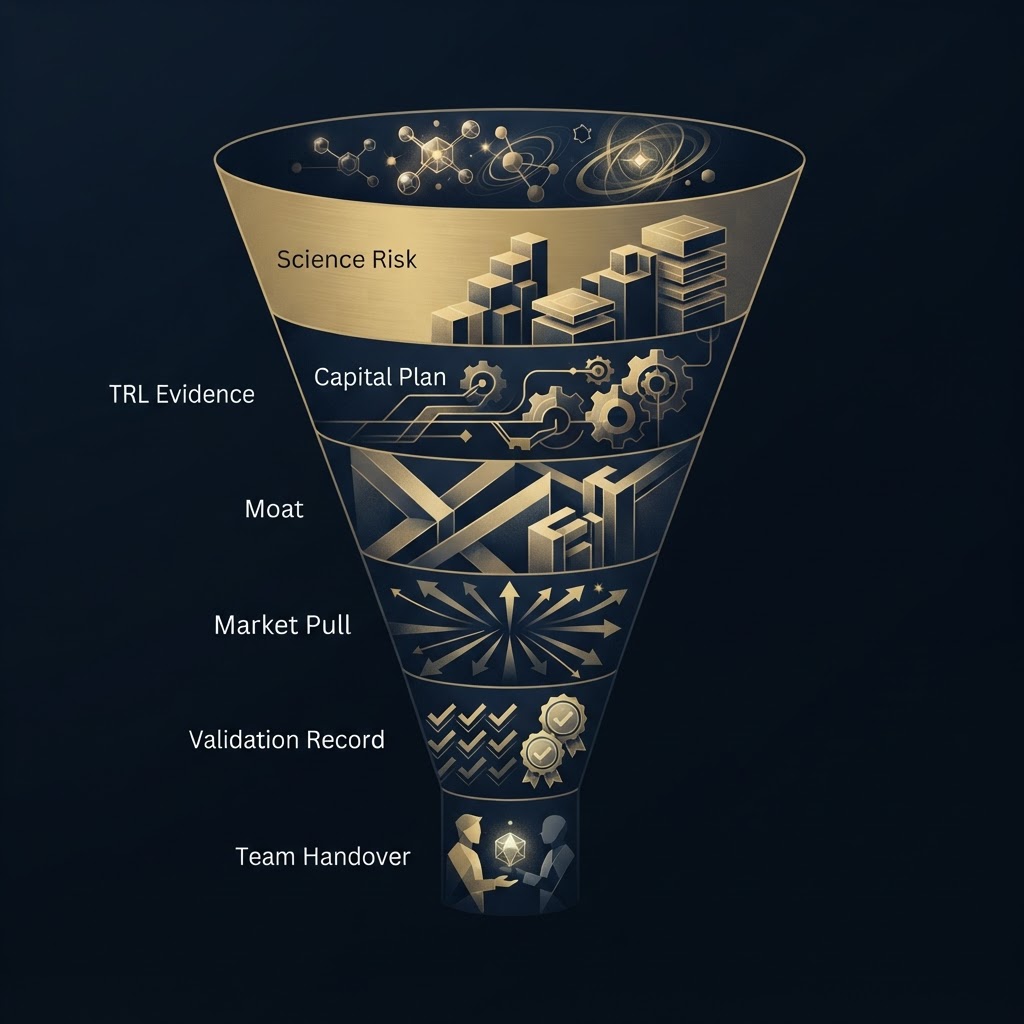
Every method for how to evaluate a deep tech startup runs into the same wall in the first hour. The metrics are not there yet. The Global Deep Tech Report 2026 found that roughly 77 percent of deep tech startups report no revenue at all, 10,400 of the 13,600 companies it tracked. There is no retention curve, no CAC, often no product a customer has ever paid for. So the diligence has to be run on evidence rather than traction, and that is a different discipline.
What follows is a seven step sequence. We finance, patent and deploy this class of company for a living, so the order matters to us in a specific way: these are the questions whose wrong answers we later have to operate around.
Why standard startup diligence breaks here
A software company carries one dominant risk at a time. A deep tech company stacks three at once. One European deep tech fund describes the layers as scientific risk, engineering risk and market risk: whether the operating principle is actually confirmed by hard evidence, whether it can be turned into something repeatable outside the lab and in a customer's hands, and whether the customer has the motivation, budget and purchasing process to buy it.
That fund reframes the central question well. Not "will this sell", but what would need to be true for this company to become large, which assumptions are most fragile, and what is already evidence rather than hypothesis. Everything below is a way of forcing that distinction on a data room.
Step 1: Name the risk you are actually funding
The most useful cut in the category separates scientific risk from engineering risk. Scientific risk is the risk that the physical or biological phenomenon does not behave as the founders believe. Engineering risk is the risk that a phenomenon already demonstrated in a lab cannot be reproduced reliably at commercial scale, cost and quality.
The dangerous case is not either one. It is the mislabel. A team demonstrates an effect under highly controlled conditions and reads that as scientific validation, when the demonstration conditions sat so far from commercial use that the extrapolation is still an open scientific question. Battery chemistry is full of coin cell results that never survived a practical format at useful temperature and cycle life. Scale dependence is where this goes wrong most often.
Get this answer first, because it determines which of the next three steps carries the weight. The allocator level version of the same problem, sizing and pacing a programme rather than a single deal, sits in our note on deep tech investing for family offices.
Step 2: Treat the TRL number as a claim, not a fact
Technology Readiness Level is the shared vocabulary of deep tech and a weak investment framework on its own, for two reasons that are worth stating plainly.
It conflates scientific validation with engineering development. A company at TRL 4 may still carry real scientific risk if the lab conditions were unrepresentative. A company at TRL 6 may be scientifically settled and facing a brutal scaling problem. The number tells you where you are, not what kind of uncertainty remains.
It is also silent on the cost of the journey. Two companies at TRL 4 can be 5 million dollars and 18 months from TRL 6, or 50 million dollars and five years. Same number on the deck, entirely different asset.
So ask for the evidence behind the level rather than the level. A structured diligence practice asks for replicable data, third party lab results, prototype test reports and failure analyses, plus a defined set of next proof milestones. The failure analyses are the tell. A team that cannot describe how its technology fails has not yet pushed it hard enough to know.
Step 3: Price the valley, not the round
This is the step generalist processes skip, and it is where deep tech money is actually lost.
The economics are unforgiving. Deep tech ventures need up to three and a half times the capital of a regular tech startup to hit the same revenue milestones, and only around 12 percent progress from Seed to Series B, with roughly 2.5 percent reaching Series D. That attrition is not spread evenly. It concentrates between TRL 4 and TRL 7, as companies move from lab prototype to pilot to full scale demonstration, and it produces the equity financing trap: because banks will not lend against novel, illiquid, unproven production assets, founders fund hard assets with successive equity rounds, dilution accelerates and burn explodes while revenue stays flat.
There is a second gap further out, and it is the one most decks ignore. Moving from pilot to commercial deployment can require 50 to 200 million euros, a band where companies have outgrown venture capacity but lack the commercial proof infrastructure investors and banks require. No single capital source bridges both gaps.
The practical rule is short. The round must fully fund the next de-risking event, not most of it. Partial funding through a certification or a first commercial line is how a technically sound company dies. Ask what the capital plan looks like two rounds out, and whether it assumes money that does not exist for this asset class, which is also why the grant and blended finance route matters more here than in software. We cover that sequencing in EU funding for deep tech startups.
Step 4: Test the moat, not the patent count
Patent count is the vanity metric of deep tech diligence. A patent gives a temporary, territorially limited right to exclude, not a freedom to operate. A startup can hold a patent on an improvement and still need a licence to a broader earlier patent owned by someone else, which is why reviewing a company's own portfolio is not a substitute for a freedom to operate analysis. In a dense patent landscape, a missing FTO analysis is a more serious finding than a missing patent.
Value sits in claim scope. Two patents covering similar technology can be worth wildly different amounts depending on what the claims actually block and how cheaply a competitor can design around them. A patent is also a disclosure: European applications publish 18 months from filing or priority, so competitors can read the solution whether or not the patent ever grants. If you want the mechanics of turning that into a number, our patent arm covers what a patent valuation actually measures.
We are on the filing side of this. EX Venture has 24 patent families filed and roughly 100 more validated in the pipeline through EX IX, so the gap between a filing and a defensible position is a thing we have negotiated rather than read about. The founder side view is in patent strategy for deep tech startups.
Step 5: Ask for market pull, not market size
Deep tech traction is measured in pilots, paid proofs of concept and letters of intent, not signups. The question that separates them is whether successful pilots convert into purchase orders or rollout commitments. A pilot with no defined success criteria and no written commitment behind it is a research collaboration the customer is happy to fund with someone else's money.
Look for a beachhead: one narrow, high value use case where the technology wins on merit before regulatory and scaling risk have been retired.
From the deployment side we would add one test the published frameworks miss. In the markets where this hardware actually earns, the buyer, the permit and the offtake are three separate conversations with three separate parties, and a pilot that quietly skipped one of them has not proven a route to revenue. Zero-X, inside our portfolio, has 200 or more waste to energy units deployed across 11 countries, and the constraint at that end of the curve is almost never the science.
Step 6: Read the independent validation record
Someone else may have already run the technical scrutiny you cannot. Competitive, peer reviewed programmes are a legible signal, and the Swiss ecosystem shows how strong it can be: ETH Zurich and EPFL spin-offs record a 90 percent five year survival rate against a 50 percent national average, the ETH Pioneer Fellowship takes 10 to 15 companies from over 100 applicants a year, and only about 20 percent of Venture Kick entrants reach the final stage.
The transferable rule is not "look for Swiss companies". It is to separate open access support from competitive selection. A coaching programme almost anyone can join carries no information. A grant that survived academic peer review, a national innovation agency's project funding, or a staged programme the company cleared three times, carries a lot. Ask which the badge on the deck actually is. The same logic explains why the technology transfer route matters, which we unpack in how to commercialize university research.
Step 7: Judge the team by what it can hand over
Winning teams in this category blend scientific depth, engineering discipline and commercial skill, and the maturity signals are unglamorous: detailed experiment and pilot schedules, hiring plans tied to risk milestones, advisors with real domain standing, and visible self awareness about which capability is missing.
Our build side test is narrower. Can the technology be operated by someone who did not invent it. In a spinout the risk is rarely that the science fails; it is that the scientific capability lives in one person and leaves with them. A company that has written nothing down, trained nobody, and cannot run a plant without its founder on site is carrying a concentration risk that no patent covers.
That is also the honest case for going through a builder rather than around one. A deep tech venture builder finances, patents and staffs the venture, which means the science, the IP chain and the operating team have been underwritten by someone carrying the same downside. EX Venture runs that model on a EUR 160 million plus capital track record across four continents with 250 or more operators deployed through its academy. Before deciding which structure you need, it is worth being clear on what separates deep tech from high tech.
The red flags that survive a good pitch
None of these is fatal alone. Several together signal structural risk rather than gaps.
- Data that is anecdotal or has never been reproduced by an outside party.
- Regulatory timelines with no cost, no lead time and no contingency budget attached.
- Long lead components with a single unqualified supplier.
- Pilots without written success criteria.
- IP limited to provisional filings with no freedom to operate work.
- A capital plan that funds most of the way to the next milestone.
- Technical knowledge that exists only in the founder's head.
The green flags are the mirror image and they are cheap to check: independent third party validation of test data, a regulatory roadmap with time and budget, qualified manufacturing partners with early yield data, paid pilots with expansion pathways, and a documented cost reduction roadmap.
One closing note on what this framework does not do. It will not tell you whether to invest, and nothing here is investment advice. It will tell you which question you are actually being asked to underwrite, which is the part most processes get wrong before they get to the price.
FAQ
What TRL should a deep tech startup be at before a seed round? There is no fixed gate, and the level matters less than what it costs to leave it. TRL 3 to 5 covers lab validation and prototype proof of concept, TRL 6 to 7 covers pilots and limited field trials with defined performance metrics, and TRL 8 to 9 covers qualified production systems. The useful framing is that the Seed to Series B journey sits inside TRL 4 to 7, so the seed question is what the next level costs in money and years, not which label applies today.
Why do deep tech startups stall after the seed round rather than before it? Because the early stage is not where they underperform. UK data puts seed to Series A conversion at 29.7 percent for deep tech against 26.9 percent for the rest of tech, so deep tech is at least as good at clearing the first hurdle. The gap opens later, at Series D and beyond, where conversion falls to 1.5 percent against 2.4 percent for the rest of tech, reflecting longer development cycles and capital requirements that late stage investors are not structured to meet.
Is patent pending worth anything in due diligence? It secures priority, not exclusivity. Rights arise only on grant, claims are almost always narrowed during prosecution, and some applications never grant at all. Grant at the European Patent Office typically takes three to five years, while the application publishes long before that. Treat patent pending as a dated placeholder and ask what was filed, how broad the claims are, and what the search report found.
Can you evaluate a deep tech startup without in-house technical expertise? Not alone, but the gap is closable without hiring a physicist. Two substitutes carry real information: results that have been independently replicated or tested by a third party lab, and competitive peer reviewed programmes that already applied technical scrutiny. The third route is a specialist review, and the point of it is not to confirm the claim but to find the person who could falsify it.
Do deep tech investments take longer to exit than regular tech? Not as much as the category's reputation suggests. Only 33 percent of successful deep tech startups take longer than 10 years to exit, against 40 percent of regular tech startups, and deep tech funds have historically averaged 16 percent net IRR against 10 percent for traditional tech funds. What differs is not the exit horizon so much as the capital intensity along the way.