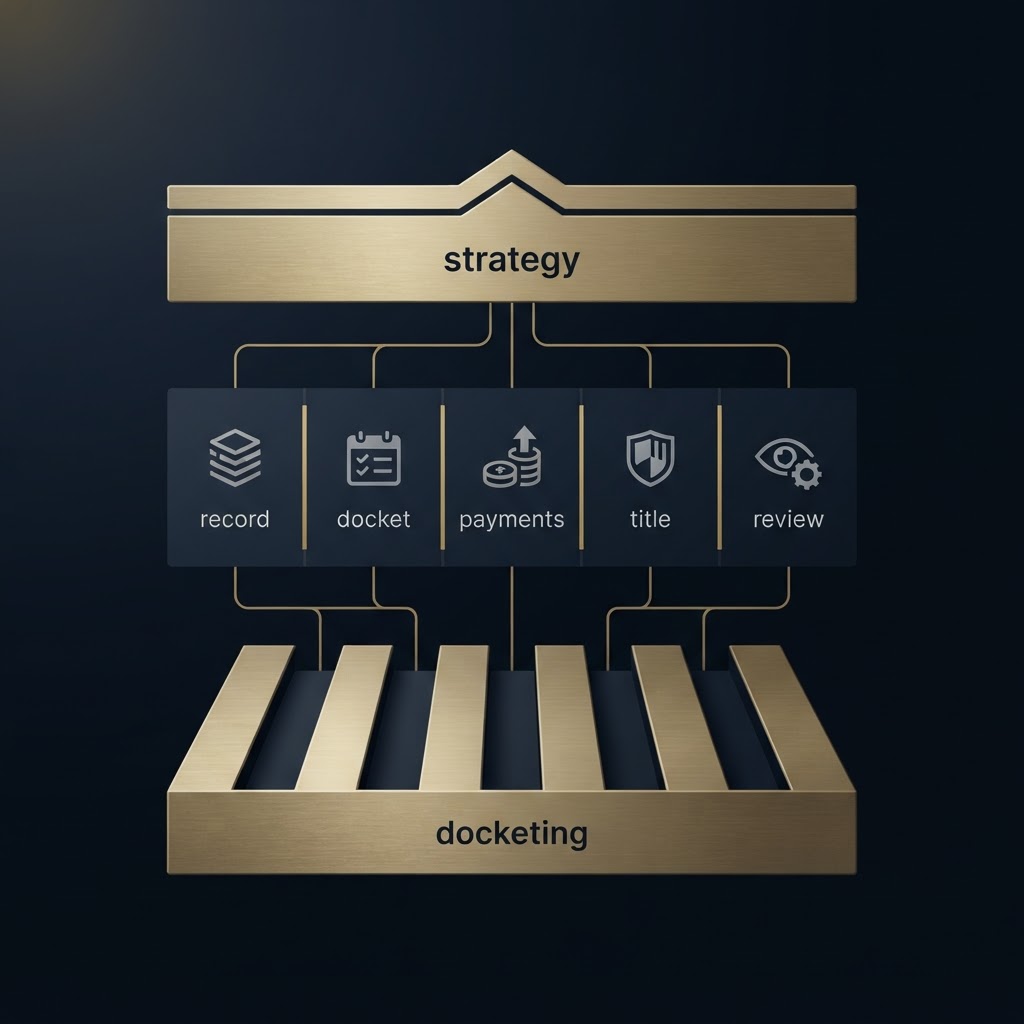
Ask what patent portfolio management is and you get five answers, each shaped by who is selling. A law firm says counsel. A docketing vendor says deadlines. An analytics platform says scoring. An outsourcer says lifecycle administration. All of them are describing one part of the same machine.
Here is the owner's version. Patent portfolio management is the operating system that sits underneath a patent strategy. The strategy decides what the portfolio should be. Management keeps it that way for twenty years: it knows what you own, what every asset costs next year, who decides whether to pay, and whether the paperwork will survive a buyer's lawyer.
We write this from the owner's side of the table. EX Venture finances, patents and deploys deep tech, with 24 patent families filed, roughly 100 more validated in the pipeline, and 200 plus energy units deployed across 11 countries. A portfolio like that does not fail at the filing. It fails in the years after, quietly, one unread renewal invoice at a time.
Patent portfolio management, defined
The cleanest definition on the current search results calls it the ongoing process of deciding what to file, what to keep, what to abandon, and when to pay, a budgeting and calendaring discipline rather than a filing task, running across the full twenty year life of a utility patent.
Two words in that sentence matter most: budgeting and calendaring. Management is where legal status meets cash. Every patent is a stream of future obligations, and every one of those obligations is a decision someone either makes deliberately or makes by default.
The most common confusion is treating software as the function. As one practitioner guide puts it, the most common mistake is conflating "we have an IP management system" with "we are doing portfolio management". A docketing tool tells you a fee is due. It does not tell you whether the patent still protects anything.
If you are still deciding what to file, where, and how the portfolio should earn, that is a different question, answered in our patent portfolio strategy guide. This article is about running what you already have.
Strategy, management and docketing are three different layers
| Layer | Question it answers | Cadence | Who should own it |
|---|---|---|---|
| Strategy | What should this portfolio protect and earn? | Yearly, and at every major pivot | Founders and the board |
| Management | Does each asset still do that job, and is it worth next year's bill? | Continuous, with scheduled reviews | One named internal owner |
| Docketing | What is due, where, and by when? | Daily | Counsel, a provider, or software |
Most small portfolios have the top and bottom layers and nothing in between. Counsel files, a reminder arrives, someone approves the invoice. That middle layer is where the money and the risk live.
The five jobs inside the function
1. Keep one system of record
Everything else depends on a single list you trust. At minimum one row per asset: number, family, filing and priority dates, jurisdiction, status, the product it maps to, the next deadline, total spend to date, and a strategic role. The same guide notes that the role column is the one most teams skip, and the one that makes the audit useful instead of decorative. Messy records are not a cosmetic problem: they produce duplicate payments, missed deadlines, wasted outside counsel cycles and poor licensing choices.
2. Run one docket
Keep every deadline in one system that a named human checks. Many portfolios go abandoned in the gap between "I assumed they were watching" and "I assumed you were", and the two clocks founders miss most are the twelve month provisional conversion and the thirty month national stage entry under the Patent Cooperation Treaty.
Data entry is the hidden risk. If a grant date, priority date or family relationship is entered incorrectly, every subsequent deadline calculation inherits that error. One wrong date at intake can cost you a patent a decade later.
3. Decide every maintenance payment
US utility patents carry three maintenance fees after grant. Current undiscounted rates are $2,150 at 3.5 years, $4,040 at 7.5 years and $8,280 at 11.5 years, with small entity status cutting them by 60 percent and micro entity status by 80 percent. Paying inside the six month grace period adds a $540 surcharge at each milestone. Those figures come from the same Goldstein guide, which also makes the point that entity status should be audited, not assumed, because companies grow, get acquired or license to larger players.
The fee curve steepens fast: US official maintenance fees rise by roughly 87.9% between the first and second payment. Outside the US the bill is annual, and foreign annuities can run $2,000 to $5,000 per country per year and increase over the patent's life. Across a multi-country family, that is the number to forecast before anything else, and our sister company EX IX has mapped how much patent renewal fees add up to over the full twenty years.
Two rules keep this job honest. First, separate the decision from the payment. The PatentRenewal audit guide frames it well: the review decides whether a patent is kept, the renewal process makes sure the decision lands on time, and silence should never count as an instruction not to renew. Second, notice who sends the reminder. BlueIron is blunt that the people sending reminders, outside counsel and docketing services, get paid when you pay, so nobody in that chain has a reason to say stop. The decision belongs to someone who is not paid by the renewal.
4. Keep the chain of title clean
A patent you cannot prove you own is worth very little in a deal. Every inventor needs a written assignment to the current owner, and timing matters: under US law an unrecorded assignment can be void against a later purchaser without notice unless it is recorded within three months or before that purchase. Title defects are where diligence stalls. For deep-tech companies with university co-inventors, contractors and spin-out histories, this is the job most worth doing before anyone asks.
5. Review and assign every asset a role
Once a year, every asset gets a job title. The Tradespace framework uses five: core defensive, core offensive, pipeline, optionality, and pruning candidate. Its fastest screen is one question per asset: if this expired tomorrow, would anything in the business change?
The review routinely finds more than people expect. In one published case, an audit of a 40-asset portfolio found that half the families covered deprecated code paths, eight families were pruned before the 7.5 year fees, a continuation was filed on a new architecture, and a licensing discussion opened. Lower spend and new revenue came out of the same exercise.
Remaining term belongs in the review too. Litigation typically takes two to four years on BlueIron's estimate, so a patent with three years left is rarely worth maintaining for enforcement alone. The economics of what to cut, and when the cost curve says to cut it, are covered in our strategy guide linked above.
The line items that quietly grew
Two newer US costs turn old habits into deliberate choices. A continuation, divisional or continuation in part filed more than six years after the earliest benefit date now carries a $2,700 surcharge, rising to $4,000 past nine years. A first Request for Continued Examination costs $1,500 and each one after that $2,860. Both come from the Goldstein management guide cited above. Keeping a family alive indefinitely used to be a reflex. It now has a price, which makes it a management decision rather than a prosecution habit.
Who should run it
The split that works for most companies is simple: outsource execution, keep judgement. Providers commonly take deadline calculation, database entry, fee payment coordination and reporting, while final go or no go renewal decisions, strategic value assessments and business justification for abandonment stay in-house. If you switch providers or systems, the same Teak guide recommends tracking in parallel for one full maintenance cycle, and a transition typically takes four to twelve weeks.
The internal owner does not need to be a patent attorney. It needs to be someone who can read a product roadmap, talk to finance, and say no to an invoice.
The deep-tech version of the job
Most portfolio management advice assumes software timelines, where the product ships well inside the patent term. Deep-tech hardware breaks that assumption in three ways.
Term burns before revenue. A family filed at the concept stage may reach its first commercial installation years later. By the time the equipment earns, the fee curve has already started climbing. The remaining-term question in every review is harsher for hardware than for software, which is why filing timing, covered in our patent strategy for deep tech startups, and management cannot be run by separate people who never talk.
The jurisdiction map moves. When deployment spans 11 countries, coverage should follow where equipment physically sits, where competitors manufacture and where enforcement works. That map shifts every year, so the jurisdiction list is a management output, not a filing-day decision to be renewed forever.
Assets meant to earn outside the company need to be ready every day. A portfolio of 24 filed families with a validated pipeline behind it is not only a shield. Some of those assets will be licensed, sold or financed, and a buyer's diligence reads the record, the docket history and the chain of title before the claims. A clean system of record is what turns patents into IP as an asset class instead of a folder of filings. Choosing which assets go out, and on what terms, is the job of a patent licensing strategy.
A starter cadence for a ten-family portfolio
The Tradespace guide describes large IP departments running weekly docket reviews, monthly spend dashboards, quarterly portfolio reviews and semi-annual board reports. A ten-family deep-tech company can scale that down without losing the point:
- Weekly: someone checks the docket. Ten minutes.
- Monthly: outside counsel and annuity spend reconciled against the system of record.
- Quarterly: product and finance confirm the asset-to-product map still holds.
- Yearly: the full review. Every asset gets a role, every role gets a budget, every pruning candidate gets a licensing check before it is dropped.
- On events: a funding round, an acquisition approach, a new country or a pivot triggers a targeted review.
A full audit is less work than it sounds. For a small or mid-sized portfolio the PatentRenewal guide puts it at around two to four weeks, and a focused review of one product line at a few days.
FAQ
What does a patent portfolio manager do? They own the middle layer between strategy and docketing: the system of record, the maintenance decisions, title hygiene and the annual review. They coordinate counsel, finance and product, and they are the person allowed to say that a patent is no longer worth paying for.
Is patent portfolio management the same as patent docketing? No. Docketing tracks what is due and when. Management decides whether each of those deadlines is worth meeting, what it will cost across jurisdictions, and what the asset is for. A company can have perfect docketing and no portfolio management at all.
What happens if you miss a patent maintenance fee? In the US there is a six month grace period with a surcharge. After that the patent expires, and reinstatement requires a petition showing the delay was unintentional, which is neither guaranteed nor cheap. Outside the US each country sets its own grace rules, which is why one docket matters.
Should a startup outsource patent portfolio management? Outsource the execution, not the decisions. Deadline calculation, payments and reporting are good candidates for a provider. The go or no go call on each renewal, and any abandonment, should stay with someone inside the company who is not paid when the fee is paid.