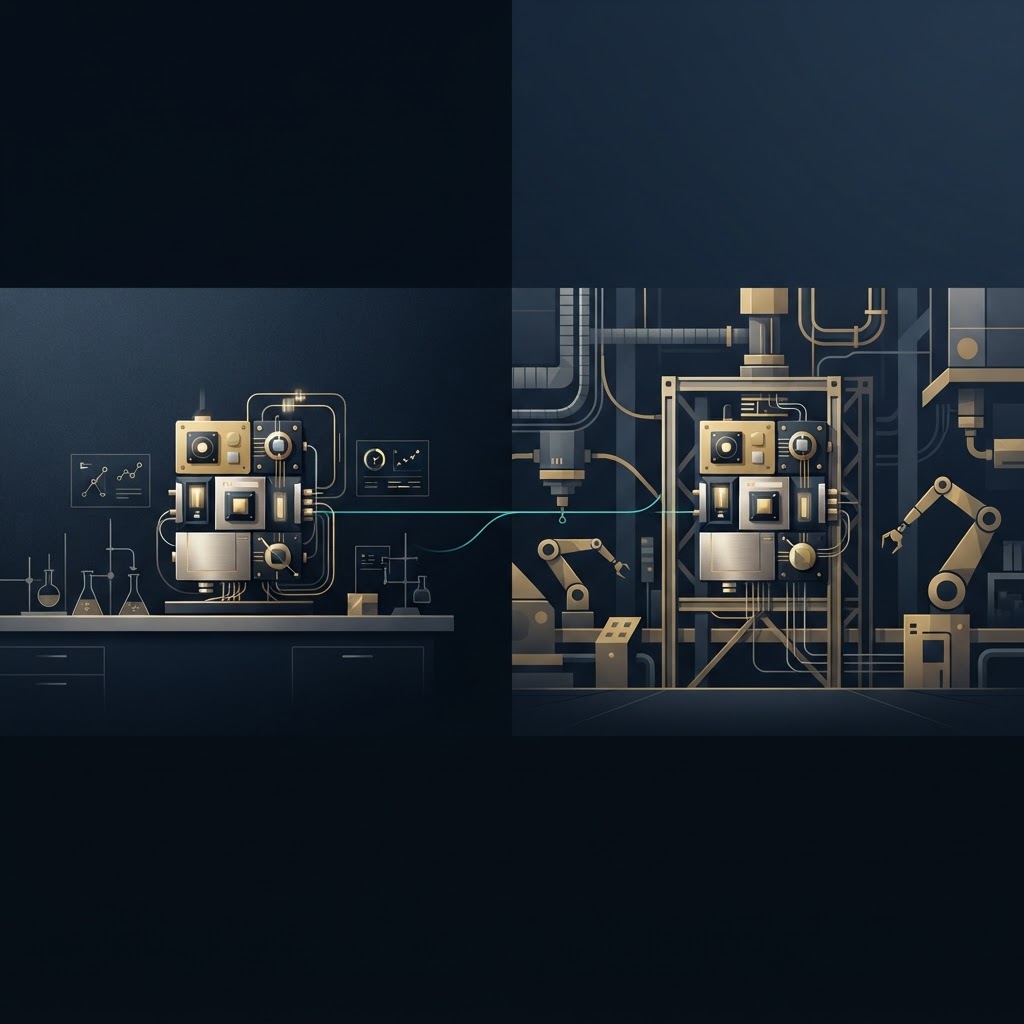
A deep tech startup studio is a company that builds companies around science. It does not take applications from founders who already have a startup. It finds a technology, pays for the work before any company exists, files the patents, recruits the operators, and takes founding equity for all of it. That sequence is the whole difference between a studio and an accelerator, and in deep tech the difference decides whether the science ever leaves the lab.
We run this model. EX EPIC finances, patents and deploys deep tech across four continents, so this is a view from inside the mechanism. If you want the generic definition first, read what a venture studio is. If you want the job description, read what a deep tech venture builder does. This article is about the choice: why a science-based company should be built in a studio, what the data says about that claim, what it costs, and how to tell a real studio from a programme with a studio's name.
What a deep tech startup studio actually is
The cleanest description comes from an incubator director who switched sides. After watching more than 40 companies pass through a UC Davis deep-tech incubator over eight years, Tim Keller concluded that most did not fail because the technology did not work, and launched a venture studio where ideas come to life as projects, not as a full-time pursuit for any one person, served by a shared technical team working across multiple projects. Only once a project is validated and has attracted customer interest does it get matched to a full-time CEO and sent out as a standalone company with its own round.
That is the studio in one paragraph. The company is the output, not the input. Everything an accelerator assumes already exists, a team, an entity, a pitch, is what the studio manufactures.
Why the accelerator model breaks on science
The valley of death has coordinates
Everyone says valley of death. The peer-reviewed blueprint for deep tech venture building pins it to the Technology Readiness Level scale: it starts around TRL 2 or 3, where a proof of concept or lab prototype exists, and ends around TRL 7 or 8, when the technology runs in a lead customer's industrial setting. Academic money stops at the top of that stretch. Commercial capital does not arrive until the bottom. An accelerator programme of a few months sits nowhere near the middle of a climb that takes years.
The reason is structural, not a matter of effort. Deep tech ventures face long R and D cycles, capital-intensive prototyping, regulatory complexity and fragmented value chains, and traditional venture capital has struggled with them because of the long time horizons and the risk-to-reward ratio. A software company can iterate its way through a demo day. A gasifier cannot.
The solo-company ratchet
Keller's diagnosis of the failure mode is the most useful sentence on this subject. The standard model assumes every idea needs a company around it, and that the company is financed through rounds in which you give up roughly 20 percent of ownership each time. For science that is lethal twice over: progress is hard to predict, so if a milestone slips and the money runs out you are dead, and the dilution per round pushes founders toward fewer, bigger raises that often fail. He calls this a software investment model and argues it should stop being applied to every kind of company. The failures he saw fell into two buckets: rookie strategic mistakes by academic founders, and being crushed slowly by the capital needs of commercialization. Both are consequences of the structure, which means both are preventable.
Accelerators do not touch either bucket. They take the company as given and coach it. The studio removes the company from the equation until the science has earned one.
What the studio does that an accelerator cannot
Source the technology, do not wait for it
An accelerator opens applications. A studio goes looking. HighTechXL in Eindhoven started as an accelerator and switched in 2018 to sourcing technologies directly from research institutes, because applicant teams had no access to the best technology while a large pool of European breakthroughs never found their way to market. Its codified process runs in four phases, collecting, screening, assessing and selecting, and between 2019 and 2022 it sourced four technologies each from CERN, TNO and ESA. It focuses on patented technologies specifically because the patent buys time to build a company around them. Technofounders in France describes the same approach, working with more than 10 research organizations to identify technologies and placing a venture partner as interim CEO through the pre-seed phase.
Deep Science Ventures inverts the order and starts from the outcome rather than the invention: identify an underperforming sector, narrow to an opportunity area, recruit an entrepreneurially minded scientist into the team, then integrate proven knowledge and IP to test the riskiest aspects at the earliest stage, before incorporation. Either direction, the point stands. The technology is chosen, not received.
Pay for the pre-company stage
Before incorporation there is nothing to invest in, so the studio pays from its own balance sheet: validation, market work, patent filings, salaries. Empirical Ventures in the UK publishes what that looks like: GBP 150,000 of staged formation capital plus an operational team for six to twelve months, covering data rooms, customer discovery, IP legals, early hires and investor introductions, with no programme fees. The goal of that period is narrow: launch the company and raise its first external pre-seed round. That is a job an accelerator cannot do because an accelerator's product starts after the company exists.
Kill early, redeploy the team
The quiet advantage is what happens when the science disappoints. In a conventional startup, failure is a shutdown. A studio that owns a majority stake can pivot an underperforming team into a new project and repurpose the assets, as the same Forbes column notes, which is precisely the incremental betting Keller describes: fund the work, discard what is not working, let the promising projects develop at their own pace without a dedicated team or a big round. Capital goes to experiments, not to entities.
The discipline that makes this honest is a second gate. e-Novia in Milan routes every scouted initiative through an independent investment committee that assesses technology maturity, industrial applicability, business model scalability and a verifiable rather than assumed market need before any resources are committed. A committee that merely ratifies the team that proposed the project loses its risk-control function. Ask any studio who can say no to its own partners.
Pre-negotiate the industrial and regulatory path
Forbes calls privileged access the defining characteristic of a successful studio: industrial partnerships negotiated before the company needs them, pre-vetted investors and corporate buyers, government-backed financing, and regulatory playbooks built once and reused across ventures. In deep tech the customer is a factory, a utility or a hospital, and the sale runs through certification, supply chains and procurement rules. A studio amortizes that learning across its portfolio. A twelve-week programme cannot.
What the outcome data says, and what it does not
The numbers everyone quotes come from the Global Startup Studio Network, which surveyed 258 studio-created startups and reported that 84 percent raise a seed round, 72 percent of those reach Series A against 42 percent for traditional startups, so 60 percent of all studio companies reach Series A; that studio startups go from zero to seed in 10.7 months versus 36, and to Series A in 25.2 months versus 56; and that average IRR was 53 percent against 21.3 percent.
Proof over panic means saying what those numbers are. They are self-reported and studio-favourable by construction, studios that failed quietly are under-represented, IRR is annualised so faster milestones mechanically inflate it, and few studio portfolios have run a full cycle to liquidity, so the figures lean on unrealised marks. Anyone quoting 53 percent IRR as settled fact is over-claiming, and that includes studios.
The independent view is more modest and more useful. The Big Venture Studio Research 2024 project compared exit rates across pre-seed support organisations and found pre-seed venture funds at 38 percent, venture studios at 24 percent, and accelerators and founders-first funds at 14 percent, with studios reaching successful exits fastest at 4.5 years; 76 percent of studios were launched in the last ten years, and 70 to 90 percent of all pre-seed ventures fail. Read that carefully. Studios do not beat a disciplined pre-seed fund on exit rate. They do beat accelerators, by a wide margin, on the stage where most capital is destroyed. For a deep tech founder choosing between the two, that is the comparison that matters, and it is the one the Forbes column never makes.
The price: equity and control
A studio takes more than a fund. Forbes puts typical studio ownership at 30 to 60 percent, with founder equity structured through vesting and milestone bonuses, and in exchange the founder gets salary security, an operational team and lower personal financial risk. The published floor is lower when the founder brings the science: Empirical Ventures prices its GBP 150,000 at a GBP 1,000,000 valuation before any IP is licensed in, about 13 percent for the studio, and counts a further GBP 250,000 of sweat equity from its operating team per company. The range is wide because it tracks who did the work. A studio that sourced the technology, paid for two years of validation and filed the patents owns more than one that wrapped a team around a scientist's own research. Either way, the trade is founding equity plus real influence over early direction, and a studio that will not state it plainly in the first meeting is worth less than one that will.
How EX EPIC runs the model
Our version compresses to three verbs: finance, patent, deploy. EX EPIC has a EUR 160M+ capital track record and finances, patents and deploys deep tech across four continents; Zero-X, its waste-to-energy venture, has designed, financed and installed 200+ units across 11 countries; EX IX, the patent layer, launched with 24 patent families filed and roughly 100 more validated in the pipeline; and EX EPIC Academy has deployed 250+ operators across the portfolio. Those four numbers map onto the four studio jobs above. Sourcing and IP became their own venture. The pre-company stage is financed from the group balance sheet. Operators are manufactured rather than hoped for. And deployment, hardware running in eleven countries, is the only evidence that the first three were done correctly. The regional version of that argument, where the gap between science and builders is widest, is in deep tech venture studios in Southeast Asia.
How to vet a deep tech startup studio
Six questions separate a studio from a programme that borrowed the word.
- Where does the technology come from? A studio names its channel: a campus, an institute network, a thesis. An accelerator says "apply".
- Who writes the first cheque? From the studio's own balance sheet before incorporation, or from a fund after it.
- Is IP work inside the process? The strongest models test the riskiest technical claims and integrate the patents before the company exists. A referral to a law firm after incorporation is a different and weaker service.
- Does it place operators or supply mentors? An interim CEO from the studio is an operator. A weekly office hour is not.
- Who can say no? An independent gate that can kill a partner's favourite project is the sign the kill-early promise is real.
- What has it deployed? Hardware in the field, licences signed, regulatory approvals won. A portfolio page of logos is not a track record.
If the answers point the right way, the next questions are about the mechanism and the money. How venture studios build companies walks the sequence from idea to spin-out, the venture studio model covers the economics, and venture studio versus accelerator versus incubator is the side-by-side. If you are the scientist in this story, venture studio for scientists is written for you, and why deep tech startups fail is the list of things the studio exists to prevent.
FAQ
Is a deep tech startup studio the same as an accelerator? No. An accelerator takes an existing company into a fixed programme and returns it with advice and a small cheque. A studio co-founds the company, usually sources the technology before any company exists, pays for the pre-company stage and keeps a founding stake. The UC Davis model goes further and keeps ideas as projects, with no company at all, until the science is validated.
How much equity does a deep tech startup studio take? It depends on who did the work. Forbes gives a typical range of 30 to 60 percent for studios that build from scratch. Empirical Ventures publishes about 13 percent for GBP 150,000 at a GBP 1,000,000 pre-IP valuation when the founder brings the science. Ask which end of that range applies and why.
Do studio-built startups really raise faster? The GSSN survey says 10.7 months to seed against 36, and 25.2 months to Series A against 56. Those figures are self-reported by studios, under-count the ones that failed quietly, and IRR comparisons based on them are inflated by the faster clock. Treat them as directional, not audited.
Can a scientist keep their research post and work with a studio? In the project-based model, yes at the start, because nobody is asked to be CEO before the project has earned a company. Studio launch programmes are different: Empirical Ventures expects founders to be heavily part-time or full-time during the six to twelve months before the first external round.
Who owns the IP in a studio-built deep tech company? Typically the research institute licenses it into the new company, which is why HighTechXL focuses on patented technologies and why Deep Science Ventures integrates IP before incorporation. The studio's share of the company, not of the patent, is how it gets paid for that work.