How much equity do venture studios take? Anywhere from about 10 percent to 80 percent of the company, with a third or more at founding being the most common ask. An operator who has run studios puts the spread at 15 to 80 percent. Steve Blank puts it at 30 to 80 percent, against 5 to 10 percent for an accelerator. A range that wide is not an answer. It is three different questions quoted as one number. Which kind of studio is asking? At what moment is the stake measured? And how much of what the studio "invests" is cash rather than its own invoice? Answer those three and the range collapses into something you can negotiate against. ## The short answer, and why it is a range Studios take a founding stake because they act as a founder. They generate or select the idea, recruit the team, fund the first months and do part of the build. An accelerator backs a company that already exists. A studio helps create it, and it prices itself like a co-founder rather than an investor. Inside that logic, the size of the stake tracks one thing: how much of the company the studio supplied before you arrived. Studio supplies the idea, the IP, the team and the capital, and the stake runs high. You bring the idea and the team and the studio brings support, and it runs low. Almost every published figure is an average across both kinds of deal, which is why they disagree. ## Equity by studio model The clearest split comes from an investor that backs studios for a living. The Vault Fund Venture Studio Primer sorts them into three types and gives each its own ownership band. ### Formation studios: the studio is the founder Formation studios generate and test ideas in-house, and the studio partners are the initial founders of every company. The primer puts them in the 30 percent plus band, with common founder shares on top of preferred shares bought with cash. It describes typical initial capital of 250,000 to 500,000 dollars, and studio ownership across the category of 30 to 60 percent. You join as a CEO or co-founder of something that already has a thesis, a test result and a budget. ### Commercialization studios: the studio brings the IP Commercialization studios license data and IP from research institutions and build companies around it. The primer lists Atlas Venture, Third Rock and Flagship Pioneering as examples and puts initial ownership at 40 to 80 percent. The reason is simple: the studio is contributing the core asset, the licensed science, plus the selection process that found it. This is where deep tech, therapeutics and agtech sit. ### Incubator-style studios: you bring the idea Early-stage incubators recruit founders who arrive with their own idea and offer shared resources and capital. The primer puts them at 10 to 20 percent, closer to a fund than to a co-founder, and notes they have less control over later rounds as a result. | Studio model | Who brings the idea | Typical initial stake | |---|---|---| | Incubator-style | Founder | 10 to 20 percent | | Formation | Studio | 30 percent and up | | Commercialization | Research institution, via studio licence | 40 to 80 percent | One line from Blank is worth holding against any offer: a studio asking for more than 60 percent is hiring an employee rather than backing a founder. That is not a rule, but it is how the next investor will read your cap table. ## Equity by moment: incorporation, post-seed, realized deals The second reason figures disagree is timing. The same deal produces different percentages depending on when you look. Hexa, the Paris studio formerly known as eFounders, publishes its full terms. It commits 700,000 euros for 33.33 percent at incorporation. Founders and Hexa then dilute pro rata in every round, so Hexa aims to hold 25 percent after the seed. Its own worked example after a seed in which a VC takes 20 percent and a 5 percent option pool is created: founders 50, Hexa 25, VC 20, option pool 5. A founder saying "a third" and an investor saying "a quarter" are describing the same contract. Survey numbers are usually taken at founding. The Global Startup Studio Network found that on the day a company is founded the average studio takes roughly 34 percent, with a high around 80 and a low of 15. Deal-level data lands lower. The Big Venture Studio Research 2024, built from PitchBook pre-seed deals, found a median studio stake of 17 percent, an interquartile range of 12 to 23 percent, and a 10th to 90th percentile spread of 5.5 to 36 percent. The authors flag the limits themselves: 38 deals from 23 studios, lower than the 25 to 40 percent typical range reported in earlier work. Read it as what studios bought in recorded pre-seed deals, not as a census of founding cap tables. So when someone quotes "studios take 17 percent" and someone else quotes "studios take a third", ask which instrument and which date. Both can be right. ## Cash or invoice: what the percentage actually buys The third reason is the least visible. Studios contribute work as well as money, and the work is priced by the studio. Hexa is the transparent case, and that transparency is exactly why it is useful. Of its 700,000 euros, 400,000 is invoiced by Hexa for the support provided during the studio period, and 300,000 stays in the company's bank account for founder pay, early salaries, tools and travel. More than half of the headline investment is the studio's own services. That is a legitimate structure, openly disclosed. Most studios do not disclose the split at all. Shares differ too. Studios often take common shares for sweat and preferred shares for cash, or all one kind. Preferred carries a liquidation preference, so the same percentage is worth more to the studio in a modest exit than common would be. And some offers stack fees on top of equity. One founder was offered 35 percent plus a 25,000 dollar monthly payback out of future funding rounds, with no founder salary. On paper that is a mid-range stake. In practice the founder is financing the studio. The practical rule: before comparing two percentages, reduce each offer to cash into the company, services invoiced back out, and fees owed later. Pricing that properly, per point of equity, is covered step by step in is a venture studio worth it for founders. ## What the founder keeps after the next rounds The studio's number matters less than yours after the next two rounds, because that is the cap table a Series A lead will judge. Carta gives the benchmark. In its Founder Ownership Report 2026, the median founding team holds about 56 percent at seed and 36 percent at Series A. In physical industries the Series A figure drops to 30.5 percent, against 37.5 percent in digital ones. Now run three illustrative studio offers through the same path: Hexa's own seed example (a 20 percent round plus a 5 percent pool), then a Series A selling 20 percent. These are illustrations on stated assumptions, not market data. | Studio stake at founding | Founders at founding | Founders after seed | Founders after Series A | |---|---|---|---| | 15 percent (incubator-style) | 85 | 63.75 | 51 | | 33.33 percent (Hexa) | 66.67 | 50 | 40 | | 60 percent | 40 | 30 | 24 | At a third, founders end Series A slightly above the Carta median. At 60 percent they land at 24, below even the physical-industry median, with a studio that still holds 36 percent. That is the cap table Vault Fund warns about: downstream investors push back when a studio owns a large slice and the operating founder does not, because they worry the person running the company is no longer incentivised to see it through. Note too that dilution multiplies. Every round takes a share of what is left, so a studio stake is never "just" its headline number. It shapes every subsequent percentage on the table. ## Why deep-tech studios sit at the top of the band If you are commercializing research, expect offers from the high end of the range, and judge them on different grounds. The primer's reasoning for the 40 to 80 percent band is that a commercialization studio contributes the licensed IP itself. That is the start of the bill, not the end. A science venture also needs patent filings across jurisdictions, public funding sequenced against equity so dilution stays survivable over a long build, manufacturing, and a team that can install and operate hardware where customers are. Carta's physical-industry line shows the cost of that path: hardware founders already keep less by Series A than software founders do, before any studio stake is counted. So a large stake can be correct for a deep-tech venture, but only if it buys those things. A studio that takes commercialization-level equity and delivers incubator-level support is the 50 percent for nothing problem in a lab coat. That is the standard EX EPIC holds itself to as a deep-tech venture builder. The numbers worth asking any builder for are deployment numbers, and ours are public: a capital track record, 200 or more waste-to-energy units deployed across 11 countries, 24 patent families filed with about 100 more validated in the pipeline, and 250 or more operators trained and placed. Ask a studio for its equivalents before you discuss its percentage. If your venture starts inside a university, the institution takes its own slice before any studio does, which changes the starting point; that split is the subject of university spinout equity split. For why studios need large stakes to survive at all, see how venture studios make money and the structures compared in venture studio business model. ## FAQ Is 50 percent equity too much for a venture studio to take? For an incubator-style deal where you brought the idea and the team, yes: that band sits at 10 to 20 percent. For a commercialization studio supplying licensed IP, capital and operators, 50 percent can be within range. The test is what sits behind it. Half the company for introductions and a services contract is a punitive valuation, not a partnership. How much equity does an accelerator take compared with a venture studio? Accelerators typically take 5 to 10 percent for a fixed programme and a small check. Studios take several times that because they help create the company rather than accelerate one that exists. Do venture studios take common or preferred shares? Often both. Founder-style common shares for the studio's work, preferred shares for the cash it invests. Ask for the split, because preferred shares with a liquidation preference get paid first in a small exit. Does a smaller studio stake mean better odds for the company? The 2024 Big Venture Studio Research reported better success rates where the studio's initial stake was below 20 percent. The sample is small, so treat it as a signal rather than a law, but it matches what later investors say about founder incentives.
Back to The LoopInsights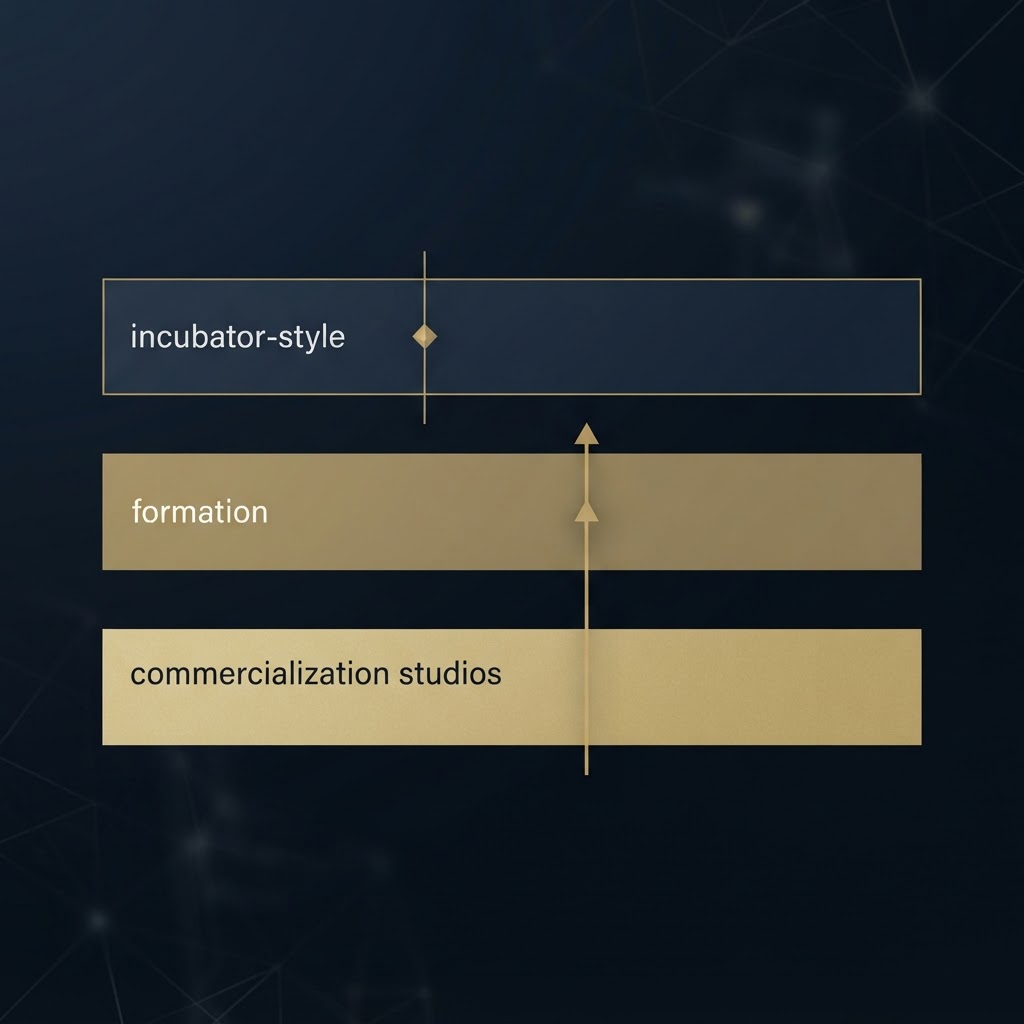
How Much Equity Do Venture Studios Take? Real Ranges
EX EPIC·2026-10-26
How much equity do venture studios take? 10 to 80 percent depending on model and timing. The ranges explained, Hexa's real deal, and what founders keep.
For more information, reach out to media@exventure.co. Julien Uhlig is available for advisory work, board seats and media appearances.
EX-AI Summit 2026
18-20 November. Online, Las Palmas, Bali.
Three days on what happens to work, capital and institutions when the map stops matching the ground. The academy that trains the operators across every company in the group is EX Epic Academy - 25,000+ applications, 12 per cohort, 200+ alumni across 19 countries.