A spinout transfer fee is the money a university takes when something leaves its hands for good. Sometimes that something is your company, sold to an acquirer or floated on a market. Sometimes it is the patents themselves, moved out of the university and into the spinout you built around them.
Founders tend to skim this clause because it pays out "later". That is exactly why it deserves attention now. The fee is set on day one, when your leverage is lowest, and collected on the best day of the company's life, when it is largest.
This guide separates the two meanings, lays out the published numbers, runs one real worked exit, and ends with the terms worth fighting for.
What a spinout transfer fee actually is
Term sheets rarely use the words "transfer fee". You will find the same economics under four other names: exit fee, change of control fee, windfall payment and buy-out price. They fall into two families.
Type 1: the exit or change of control fee
This is a percentage of the proceeds, or a fixed sum, paid to the university when the company is sold or lists. The UK University Spin-out Investment Terms (USIT) guide describes it plainly: a university may want a change of control, exit fee or "synthetic equity" clause instead of, or on top of, a shareholding.
It is spreading. The Hutch Law spinout founder handbook calls it "an increasing trend" for universities to ask for an exit fee in lieu of stock, typically in the very low single digit percentage range.
Type 2: the IP transfer or buy-out fee
The second family pays the university to let go of the patents. Most spinouts start with a licence, not ownership, and investors push back on that. The Knowledge Transfer Ireland practical guide records the investor argument that the company "needs to own the IP" to raise its value and attract funding, and notes that some research organisations let the licence convert to an assignment once the spinout has raised a pre-defined amount.
USIT describes a hybrid: IP can be assigned to the spinout after the patent issues, with an exit fee negotiated and reversion rights kept by the university. So the two families often travel together. You get the patents now and pay for them when you sell.
What published deal terms show
There is no global standard. There are a few unusually transparent templates, and they are worth reading side by side.
UK: 1 to 3 percent, often capped
USIT says that where an exit fee is used, a low single digit percentage, for example 1 to 3% of change of control or exit proceeds, or a set fee, is typically negotiated. It also says these clauses "are not common in the UK university spin-out ecosystem". One USIT case study shows the full package: a c. £50k signing fee, royalties of 0.5 to 1.5% on net sales, and success milestones on IPO and exit of 0.5 to 2% of valuation, up to a maximum of £5m.
Investor fund DSW Ventures reviewed one published UK template with a 2% exit fee capped at £5m, lower percentages above £25m, alongside a £50k signing fee and royalties of 0.5 to 2.5%. Their point on the signing fee alone: for a company starting on the £250k Seed EIS maximum, that is 20% of the round handed straight back to the university.
Israel: exit fee instead of equity
Bar-Ilan University's tech transfer company BIRAD publishes its standard tracks. Its founders track takes no equity at all. Instead the company pays a fixed, non-dilutable exit fee of 2%, 3% or 4% of exit proceeds, depending on whether it chooses the fast, medium or long track.
The clever part is the buy-down. At the company's sole election, the percentage drops by 0.5 points for every US$50M of valuation achieved, with step prices between US$250,000 and US$1,000,000, down to a floor of half the original rate. No board seat, no anti-dilution, no pre-emptive rights.
Denmark: a fixed buy-out price
Denmark's national standard licensing models take the Type 2 route. Under Model B a spinout can agree a fixed price, up front, to buy out the university's IP rights entirely, with a 35% price reduction if it buys within 36 months of signing.
The trade is windfall payments. If control of the company shifts, a one-time exit windfall applies: DKK 375,000 below a DKK 15M valuation, DKK 750,000 between DKK 15M and 35M, and DKK 1.5M above that. A separate payment kicks in if annual turnover passes DKK 250M. The Model B1 licence text defines the trigger tightly: more than 51% of ownership moving into non-founder hands.
| Model | Equity | Transfer fee | Escape route |
|---|---|---|---|
| UK, USIT norm | Usually yes | 1 to 3% of exit, or a set fee | Cap, often £5m |
| Bar-Ilan founders track | None | 2 to 4% of exit | Buy down to half |
| Denmark Model B | Optional | DKK 375k to 1.5M by valuation | Fixed patent buy-out |
Why investors call it double-dipping
The core objection is that an exit fee does not dilute. DSW puts it bluntly: "The exit fee sounds innocuous. It is not." Whatever the company gives away to raise money, the university's percentage of the sale price stays put and is paid ahead of shareholders.
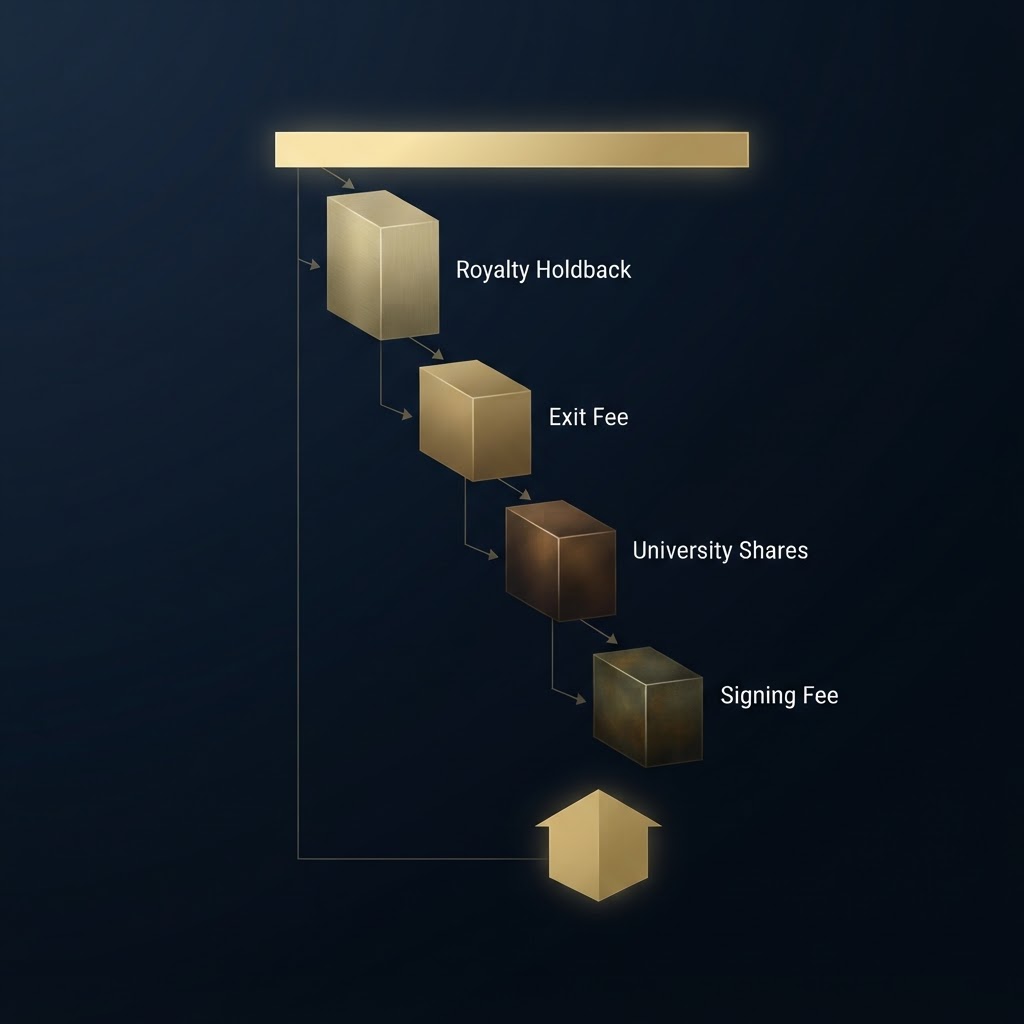
Their worked scenario shows how the layers stack. A therapeutics spinout starts 80% management, 20% university. It raises £30m and gives up 60% of the company. It sells for £100m, but the acquirer holds back £6m for royalties that survive the exit until the patents expire. The exit fee takes £1.1m off the remaining £94m. The university's diluted 8% stake is worth £7.4m. Add the £50k signing fee and the university's total take is £14.6m, nearly half of it from add-ons rather than shares.
DSW's headline: "that attractive 10% stake is really 20%."
The NVCA's US-BOLT climate term sheet reflects the same tension from the US side. Universities may ask for equity, a success fee or both, and investors may push for one instead of both because it is simpler.
When a transfer fee is the better deal
None of this makes the fee bad by default. Compared with equity, it has real advantages for a founder.
- A cleaner cap table. On the Bar-Ilan track the university holds nothing and asks for no board seat. Seed investors see founders and investors only.
- Less paperwork, fewer conflicts. The Hutch Law handbook notes an exit fee removes a significant amount of equity documentation and, at some universities, greatly reduces conflict of interest complications.
- No exit, no fee. USIT reminds both sides to consider the case where the spinout never exits. Equity is a claim on every dollar of value; an exit fee is a claim on one event.
- Ownership of the patents. A Type 2 buy-out gives the company the asset investors want it to own, and the Danish discount rewards moving early.
The fee becomes double-dipping when it is stacked. A meaningful protected stake, plus running royalties, plus a percentage of the exit, is three claims on the same invention. USIT itself says equity and licence fees should be negotiated together, with higher fees offsetting lower equity or vice versa. For the upfront side of that trade, EX IX has compared what published schedules show for university patent licensing fees.
Six terms to negotiate
- One mechanism, not three. If the university wants an exit fee, trade it against equity. If it insists on university spinout anti-dilution, that is your leverage to remove the fee.
- A hard cap. A percentage of an unknown number is an open cheque. The UK templates cap at £5m; ask for a cap in money, not a vague milestone.
- A falling rate. Bar-Ilan's buy-down to a floor and DSW's lower percentage above £25m both reward success instead of taxing it. Ask for steps.
- A tight trigger. USIT says the trigger should be clearly defined, for example a qualified IPO. Denmark uses more than 51% of control. Make sure a large financing round or an internal reorganisation does not count as an exit.
- A fixed buy-out price. If you will want to own the patents, agree the price and the window now, while the technology is unproven. The Danish 36-month discount shows the logic.
- Royalties that end. Ask what happens to university spinout royalties at exit. If they survive the sale, the acquirer will price them in, so the exit fee is paid on a number already reduced by them.
Each of these costs negotiating time, and time is already scarce: see how long a university license takes.
How we look at it as a venture builder
At EX EPIC we finance, patent and deploy breakthrough science that would otherwise stay in the lab, backed by a EUR 160M+ capital track record. Our patent marketplace EX IX launched with 24 patent families filed, so we sit on both sides of this table: as the party paying for IP and as the party holding it.
Our view is simple. A transfer fee is not a penalty; it is a price. A clean price with a cap, a floor and a defined trigger is usually easier to raise against than a larger stake that clutters the cap table. What we walk away from is the stack: equity, protection, royalties and an exit cut, all on one patent family.
If you are still at the start, begin with how to spin out a company from a university, then come back to this clause before you sign.
FAQ
Who pays a spinout exit fee, the company or the shareholders?
Legally the spinout pays it, per USIT. Economically it comes off the top of the sale price before shareholders are paid, which is why investors treat it as a non-diluting claim that ranks ahead of their own shares.
Does an exit fee apply if the company never exits?
No. The fee is tied to a defined event such as a sale or qualified IPO. That is why universities usually pair it with royalties or milestones, so they still earn if the company grows without ever being sold.
Can a spinout buy down its exit fee?
Under Bar-Ilan's published founders track, yes. The company can reduce the rate by 0.5 points for each US$50M of valuation reached, paying a set step price each time, down to a floor of half the original percentage.
Do royalties survive a sale of the spinout?
Often they do. In the UK template DSW reviewed, both royalty streams survive the exit until the patents expire, so an acquirer inherits them and lowers its offer accordingly.