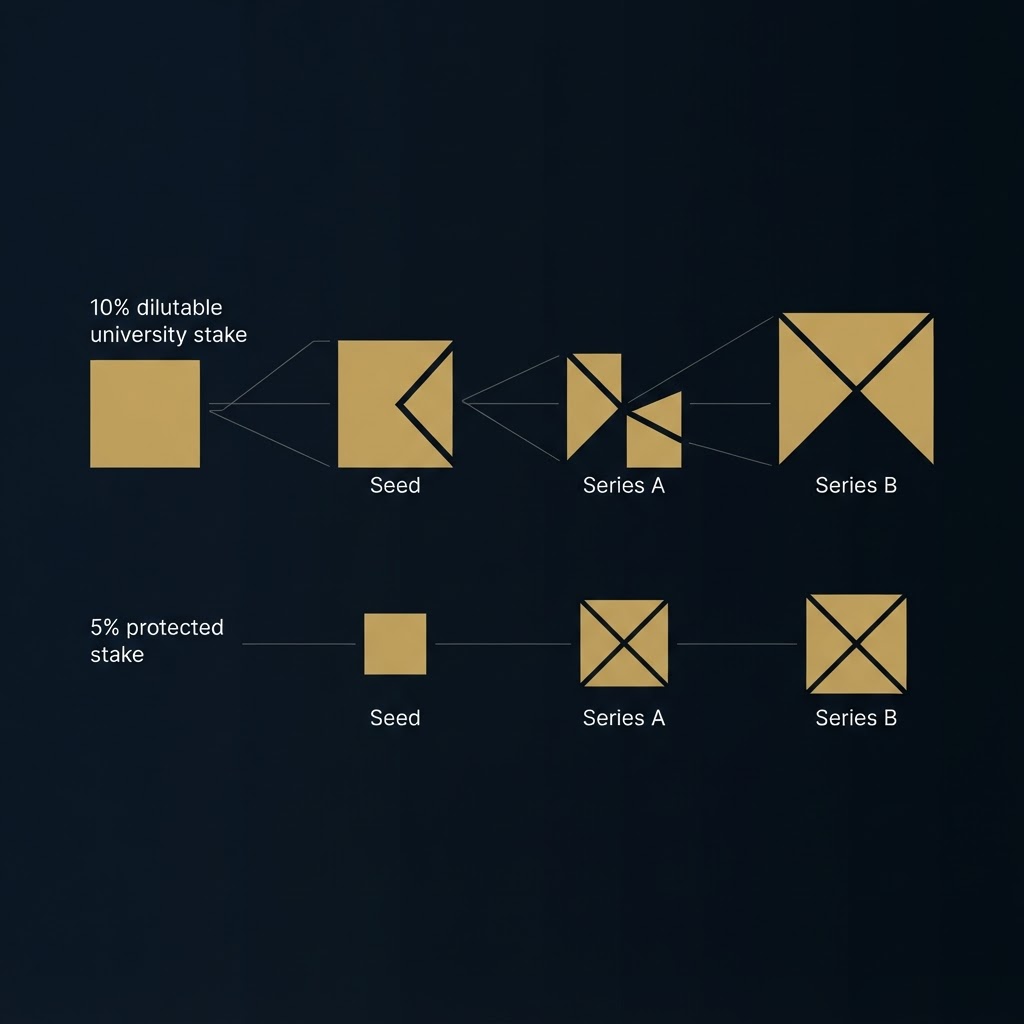
The university spinout anti-dilution clause is one line in a term sheet. It decides who pays for the university's stake every time you raise money, and most founders sign it without running the numbers.
Here is the short version. The university takes a small stake and the company promises to issue it free top-up shares so that stake never drops below a fixed percentage. The promise lasts until a cap, usually a sum of money raised. Every top-up share comes out of the pockets of the founders, the option pool and your earliest investors.
That is not automatically a bad deal. Sometimes it is the best deal on the table. But you should know exactly what you are trading before the lawyers finalize it.
What anti-dilution means in a university spinout
The cleanest wording sits in the US-BOLT climate term sheet published by the NVCA, a template universities and investors built together. The licensee issues the university, "without further consideration", enough extra common stock that its shares never represent less than x% on a fully diluted basis. That protection runs until the company has raised a set amount in bona fide financings, which the template calls the Dilution Cap.
Three words in that clause do most of the work:
- Fully diluted. The base counts every share, every convertible and every option reserved in the stock plan. Expanding the option pool triggers a top-up too.
- Without further consideration. The university pays nothing for the extra shares.
- Cap. When the cap is hit, the stake becomes ordinary common stock and dilutes like everyone else's.
Not the same as VC price protection
Do not confuse this with the anti-dilution term venture investors ask for. The Hutch Law spinout founder handbook separates the two. Venture investors get price-based protection, weighted average or full ratchet, which only activates if a later round is priced below theirs. University anti-dilution is percentage-based: it activates on every financing until the cap, even when your valuation is soaring. The handbook's example: a university holding 8% asks to be restored to 8% after the first financing.
What the published guides actually recommend
There is no single market standard. There are three regional habits.
US: small stake, protected through a cap
A VC and tech transfer roundtable hosted by Columbia found three accepted models:
- Mid single digit equity with anti-dilution through a Series A, sometimes written as "through $___M raised" because A rounds vary so much in size.
- A bigger starting stake with no anti-dilution at all.
- Change of control or "synthetic equity" terms that pay the university a very low single digit percentage, or a set fee, at exit.
Global Venturing describes the common US form as 5 to 20% founding equity with anti-dilution to the end of Series A. The Hutch Law handbook puts typical university ownership at 5 to 10% of issued shares.
UK: bigger stake, usually dilutable
The UK default runs the other way. The University Spin-out Investment Terms (USIT) guide sets a landing zone of 10 to 25% founding equity for a university licensing foundational technology. Where the stake is protected, it notes, founding equity is "commonly below 10%" and the protection falls away at a pre-agreed milestone such as a fundraise of a certain size.
The government's Independent Review of University Spin-out Companies gives the sharpest comparison. Imperial offers founders a choice: 10 or 20% dilutable equity depending on the field, or 5% non-dilutable equity capped after a set amount of investment. The review also found that average university stakes fell from around 25% to around 18% over ten years, and that many UK investors "prefer not to complicate cap tables with non-dilution provisions".
In practice protection is still rare there. In the review's founder survey, 75% of founders said the university stake dilutes alongside everyone else, against 10% who said it was protected. The mean founding university stake was 24%.
Netherlands: dilutable, with one twist
The Dutch National IP Deal Terms for spin-offs give the research institution fully dilutive shares of the same class as the founders. The exception is narrow and smart: until a milestone (a set level of net sales or venture investment), the institution's percentage is not reduced by shares issued to build out the team. Investors dilute everyone. New hires do not dilute the institution.
For a German or Singapore founder licensing from abroad, that spread matters. You may be negotiating against a US template, a UK norm and a Dutch model in the same year.
The math: 5% protected vs 10% dilutable
The UK review states the key insight plainly: in these scenarios there is "no substantial difference between a low non-dilutable stake and a dilutable one that is 1.5-2x larger." Here is why, using a hypothetical company. These numbers are illustrative, not market data.
Assume every round sells 25% of the company to new investors and the cap sits at $10M raised.
| Stage | Raised to date | 10% dilutable | 5% protected to $10M |
|---|---|---|---|
| Founding | $0 | 10% | 5% |
| Seed | $3M | 7.5% | 5% (topped up) |
| Series A | $11M | 5.6% | 5%, or 3.75% if the crossing round is excluded |
| Series B | $31M | 4.2% | 3.75% (or 2.8%) |
Two things jump out. First, the protected 5% ends up close to the dilutable 10%, which is exactly the review's point. Second, the protected version costs the founders more early, when shares are cheapest and the cap table is being judged by seed investors. At seed, the university holds 5% instead of 3.75%, and that 1.25 points came from the common holders.
The review adds a warning that cuts both ways: a lower non-dilutable stake "does not guarantee that the university will end up owning a smaller share on exit."
Seven terms to push back on
If the university insists on protection, negotiate the mechanics. These are the terms that move real money.
- Cap in money, not round names. "Through Series A" is vague when an A can be $5M or $50M. The Columbia roundtable flags "through $___M raised" as the better drafting. Put a number on it.
- The crossing round. US-BOLT leaves a bracket open: if the cap is hit mid-round, does protection cover the whole round or stop at the cap? In the table above, that one bracket is the gap between 5% and 3.75%. Push for "will not".
- Tranched rounds. US-BOLT notes that parties should agree how multi-tranche financings are handled, for example metering in the university's equity tranche by tranche. Without that, a milestone-based seed can trigger a top-up on money that never arrives.
- Delayed issuance. Some universities, per US-BOLT, delay issuing any equity until the cap is met. That can simplify early rounds. Make sure the final number is fixed today, not renegotiated later.
- Preemptive rights that shrink. Universities usually want participation rights on top. Columbia's guidance: if the university skips a round, its right in the next round should cover only the percentage it then holds, not its original stake. Many universities assign these rights to Osage University Partners, so expect a real investor to use them.
- No perpetual protection. Global Venturing covers the "golden share", a 1% stake that stays protected all the way to exit. It reports investors resist it because it does not mesh with later share classes and liquidation preference stacks. Protection should end.
- Equity or a success fee, not both. US-BOLT notes universities may ask for equity, a success fee, or both, and investors may push for one instead of both. If you concede anti-dilution, that is your leverage to drop the exit fee. USIT puts exit fees, where used, at a low single digit percentage such as 1 to 3% of proceeds.
Also look at the rest of the package: equity trades against cash. Higher university spinout royalties or an upfront spinout transfer fee can justify a smaller or dilutable stake, and USIT explicitly says equity and license fees should be negotiated together. For the cash side of that trade, EX IX has broken down what published schedules show for university patent licensing fees.
When accepting anti-dilution is the smart trade
Protection is not always the founder's loss. Global Venturing reports university modelling suggesting the effect depends on the business: a university can come out worse under anti-dilution when a company exits early or drives straight to revenue, as software often does, and better when a capital-intensive company raises heavily and exits late, as therapeutics often do.
Read that from the founder's side. If you are building a capital-light company that expects a modest raise, a small protected stake may genuinely cost you less than a large dilutable one. If you are building hardware, energy or biotech that will burn through several big rounds, the protection mostly expires before the heavy dilution starts, and a small headline number helps you sell the cap table.
There is also a fundraising argument. The UK review notes that some overseas investors are more used to low, non-dilutable university stakes and may invest more readily when they can compare like with like. Columbia's roundtable adds that these university stakes are usually "so diluted by the time of a meaningful exit" that they rarely become significant, so the fight is often less about the final number than about how clean the company looks at seed.
How we look at it as a venture builder
At EX EPIC we finance, patent and deploy breakthrough science that would otherwise stay in the lab, backed by a EUR 160M+ capital track record. That puts us on the investor side of these negotiations, and our view is simple: a clause you can model beats a clause you have to argue about later.
So when we look at a spinout term sheet, we check four things. Is the cap a number? Is the crossing round settled? Does the option pool trigger top-ups? Does the university get protection and an exit fee at once? If those four are clean, a protected single digit stake is rarely a deal breaker.
Two practical notes before you negotiate. First, anti-dilution talks add time, and time is already the scarce resource: see how long a university license takes. Second, if the tech transfer office route is stalling, it is worth understanding the trade-offs of a venture studio versus a technology transfer office. And if you are still at the start, begin with how to spin out a company from a university.
FAQ
Do universities still get anti-dilution after Series A?
Usually not. Protection ends at the cap, and the US-BOLT template leaves the parties to decide whether it covers the entire round that crosses the cap or stops at the cap itself. After that, the university's shares dilute pro rata like any other common stock.
What is a university golden share?
A proposed variant where the university holds a very small stake, around 1% at founding, but is protected until exit and paid that percentage of net proceeds in priority to other shares. It has been debated mainly in the UK, and investors have resisted it because perpetual protection clashes with later share classes.
Can a university take both equity and a success fee?
Some ask for both. The US-BOLT template notes that universities differ, and that investors may push for a success fee instead of equity, but not both, because it is simpler. If you accept anti-dilution, use it to negotiate the success fee down or out.
Does anti-dilution cover shares issued to new hires?
Under a US-style fully diluted clause, yes: options reserved in the stock plan count, so growing the pool can trigger a top-up. The Dutch National Deal Terms take a narrower approach, protecting the institution only against team share issuances until a milestone, while investor rounds dilute everyone.