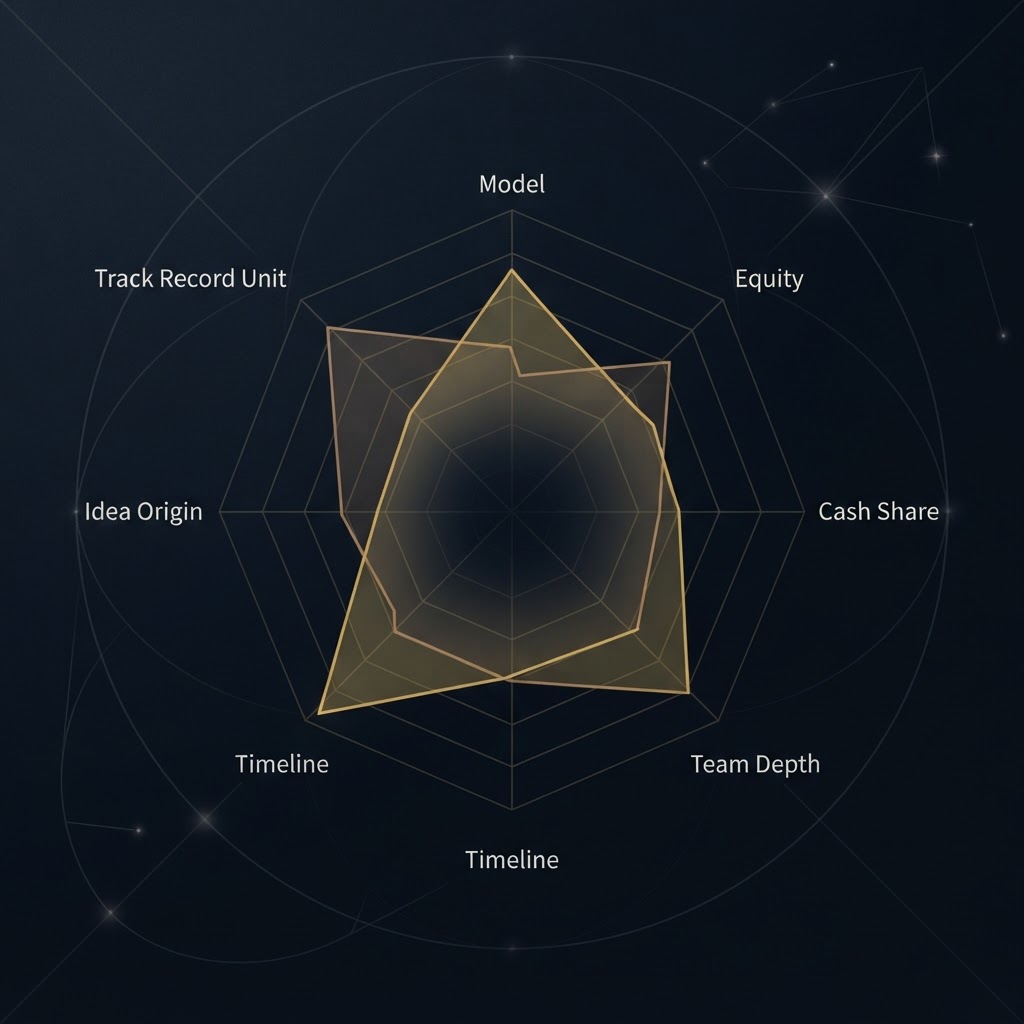
Most pages that promise a venture studio comparison compare the wrong thing. They line a studio up against an accelerator or a VC fund, conclude that studios take more equity and do more work, and stop. Useful once. Useless when you have two studio term sheets on the table and need to know which one is the better partner.
That is the real question, and it is harder than it looks. The people who wrote the Venture Studio Index say it plainly: studios report ownership, dilution and success so differently that comparing them like for like is "nearly impossible". So we built the comparison ourselves. Seven dimensions, filled only with numbers studios publish about themselves, and our own portfolio in the table as a worked row.
Why a venture studio comparison is harder than it looks
There are a lot of studios to compare. Researchers at MIT Sloan count 870 independent and in-house studios by 2023, double the 2018 number, spread across stand-alone firms, fund-embedded studios, corporates, universities and governments.
They do not share a format. The Venture Studio Index, built by a team that operated inside more than 20 studios and researched another 500, lists the differences that break simple comparison:
- Structure. Some studios are holding companies, some are funds, some run a dual entity with a studio company and a fund beside it.
- Capital. Reported capital needs run from under $2 million to over $25 million.
- Support. Involvement ranges from full-stack building to a lighter touch, and "hands-on" means something different at each.
- Success. Some count exits, some count follow-on funding rates, some count IRR, some count revenue.
If you want the names, our list of venture studio examples sorts 21 of them by model. This page is the other half: the dimensions you put those names through.
The seven dimensions that separate one studio from another
1. Model: formation, commercialization or incubator
Start with what kind of studio it is, because every other number depends on it. Vault Fund's venture studio primer splits the field three ways. Formation studios generate ideas internally and act as founders. Commercialization studios license IP from research institutions and build companies on it, starting at 40 to 80 percent ownership. Early-stage incubator studios take in entrepreneurs who have an idea but no company yet, and hold 10 to 20 percent. Across the field, Vault puts typical studio ownership at 30 to 60 percent.
Two studios quoting different stakes may simply be different animals. Compare a commercialization studio with a formation studio on equity alone and you will draw the wrong conclusion.
2. Equity at founding and after the seed
This is the line founders read first. Steve Blank puts studio stakes at 30 to 80 percent against 5 to 10 percent for an accelerator, and warns that above 60 percent the founder looks more like an employee than an owner. The Global Startup Studio Network's white paper averages founding stakes at about 34 percent.
Deal-level data pulls the number down. The Big Venture Studio Research 2024 found a median studio stake of 17 percent across 38 deals from 23 studios, with better success rates where the stake was below 20 percent.
Ask every studio for two numbers, not one: the stake at incorporation and the stake it expects to hold after the seed round. That second figure is what later investors will see. Our breakdown of how much equity venture studios take goes deeper on the ranges.
3. Cash versus invoiced capital
Two studios can both "invest" the same amount and put very different money in your bank account. Hexa publishes its deal, which makes it the cleanest reference point in the market. It commits EUR 700,000 for 33.33 percent at incorporation. Of that, EUR 400,000 is invoiced back by Hexa for the support its team provides over 12 months, and EUR 300,000 stays in the company as cash. Hexa aims to hold 25 percent after the seed, on 1x non-participating preferred shares.
That is transparent and defensible. The pattern to watch for is the one without the cash half. One studio offer dissected by Focused Chaos asked for 35 percent plus a 25,000 a month payback from future rounds, with no founder salary. A startup lawyer's verdict on a studio taking 50 percent for zero cash is in the headline: half your company for promises.
4. How deep the shared team goes
The shared team is the product a studio sells. High Alpha's studio page describes brand, product, marketing, finance and HR supplied from a central bench through its explore, build and scale stages. Others offer a partner's calendar and a slide template. Ask who, by name, will work on your company, for how many hours a week, and for how many months. The mechanics are covered in our piece on the shared team model.
5. Sector focus and build timeline
A software studio and a biotech studio run on different clocks. The Venture Studio Index notes that some studios spin companies out in a few months while deep tech and biotech studios may incubate for multiple years before raising outside capital. A studio's sector tells you its timeline, and its timeline tells you how long your stake is illiquid and how much capital the studio must carry before the first outside round.
6. Who brings the idea
The Index sorts studios on two factors: return profile and formation role. Formation role is the question of who originates the company. In a formation studio, the studio found the opportunity and recruits you into it. In an incubator-style studio, you arrive with the idea. The first earns a larger stake. The second should not pay the same price for it.
7. What the track record actually counts
Read the unit, not just the number. Flagship Pioneering reports more than 120 companies founded, 6 to 8 new companies a year, 25 IPOs since 2013 and more than 2,500 patents granted. Deep Science Ventures reports 58 companies launched across five sectors. One counts exits and patents, the other counts companies started. Neither is wrong. They are measuring different things, and a comparison that puts them in one column hides that.
Five studios compared on what they publish
| Studio | Type | Focus | Published terms | Published output |
|---|---|---|---|---|
| Hexa | Software studio | B2B software | EUR 700k for 33.33%, 25% target after seed | 12-month build programme per company |
| High Alpha | Software studio | B2B software | Not published on studio page | Explore, build, scale stages with a shared team |
| Flagship Pioneering | Science studio | Biotech | Not published | 120+ companies, 25 IPOs since 2013, 2,500+ patents |
| Deep Science Ventures | Venture creator, science | Five sectors incl. climate, pharma | Not published | 58 companies launched |
| EX EPIC | Deep-tech venture builder | Energy, carbon, biotech, IP | Not published | EUR 160M+ capital track record, 200+ energy units in 11 countries, 24 patent families |
The gaps in the table are the finding. Most studios publish outputs and not terms. Hexa is the exception, which is exactly why its deal is the benchmark everyone else gets compared against.
What the numbers do not tell you
The headline statistics for studios are strong. GSSN reports that 72 percent of studio startups go from seed to Series A against 42 percent of traditional startups, and reach Series A in 25.2 months rather than 56.
Treat them with care. The GSSN sample is supplied by studios, which invites self-selection and survivorship bias, and a review of how studios make money points out that IRR flatters speed on young, illiquid portfolios. The MIT Sloan authors add a cost no average captures: high equity and control can put off strong founders and the follow-on investors a company needs next.
So the comparison that matters is not "studios beat startups". It is whether this particular studio's terms, team and timeline fit this particular company.
How a deep-tech studio compares: the EX EPIC row explained
We put ourselves in the table because a comparison should show its working. EX EPIC sits at the deep-tech end of almost every dimension, and the reasons are structural, not stylistic.
Model. We commercialize science. The IP is often created or filed inside the ecosystem: EX IX launched with 24 patent families filed and about 100 more validated in the pipeline, according to exventure.co. A studio that is inventor of record holds a different kind of stake from one that recruited a founder to an idea.
Timeline. Hardware gets deployed, not shipped. Zero-X waste-to-energy systems have been designed, financed and installed in more than 200 units across 11 countries. That is a build measured in years, not in a 12-month programme.
Team. The shared bench is staffed through EX EPIC Academy, which has deployed more than 250 operators across the portfolio. Capital comes from a track record of more than EUR 160 million.
What this means for anyone comparing us with a software studio: expect a longer timeline, a larger role for patents, and a stake that reflects IP the studio created. What it should not mean is opacity. Ask us the same questions you would ask Hexa. Our view of the deep-tech venture builder model sets out the full method.
Questions to put to any studio before you sign
Use these to turn the seven dimensions into a conversation:
- Are you a formation, commercialization or incubator-style studio, and is your structure a holding company, a fund or both?
- What stake do you take at incorporation, and what do you expect to hold after the seed?
- Of what you "invest", how much is cash in the company and how much is invoiced back for services?
- Are your shares common or preferred, and on what liquidation preference?
- Who, by name, works on my company, and for how long?
- How long does a company in my sector typically stay with you before outside capital?
- Did you bring the idea, or did I? Does the stake reflect that?
- What does your track record count: companies started, rounds raised, exits or patents?
- Can I speak to two founders from companies that did not work out?
If you are still deciding whether a studio is the right route at all, start with venture studio vs accelerator vs incubator and then work through the founder's maths in is a venture studio worth it.
FAQ
Is there a ranking of the best venture studios?
No reliable one. Studios report on different bases, which is the problem the Venture Studio Index was created to solve. A ranking that mixes companies started, exits and IRR is ranking units, not studios. Compare on the seven dimensions instead and weight them by what your company needs.
How do I compare a studio's deal with raising a pre-seed on my own?
Price the cash, not the headline. Take the cash that actually lands in the company, divide by the stake, and compare that implied valuation with what angels would offer. Then put a value on the team and months of runway the studio supplies. Hexa makes the same argument on its deal page: more dilution on paper, offset by speed to a stronger seed round.
Can a founder negotiate a venture studio's terms?
Often, yes, especially on the post-seed target, vesting and the share class. Standard published deals like Hexa's are harder to move. Deals built around one company have more room, particularly where the founder brings the IP.
Should investors compare studios differently from founders?
Yes. A founder compares terms and team. An investor in a studio compares cost structure, return profile and how much capital the studio needs before its first exits, which can range from under $2 million to over $25 million.