Search for waste to energy companies and you get the same top ten list everywhere. Veolia, Covanta, Hitachi Zosen, Babcock & Wilcox, a Chinese giant, maybe a fuel start-up at the end. The names are right. The list is wrong, because it ranks companies that do not compete with each other.
A city choosing a concession partner, a developer choosing a grate supplier and an investor choosing a challenger to back are asking three different questions. Put an operator, an equipment vendor and a pre-revenue start-up in one table and you answer none of them.
So this guide sorts the field by role. It is written for investors and partners who need to know which kind of company they are actually dealing with, and what that company is and is not on the hook for.
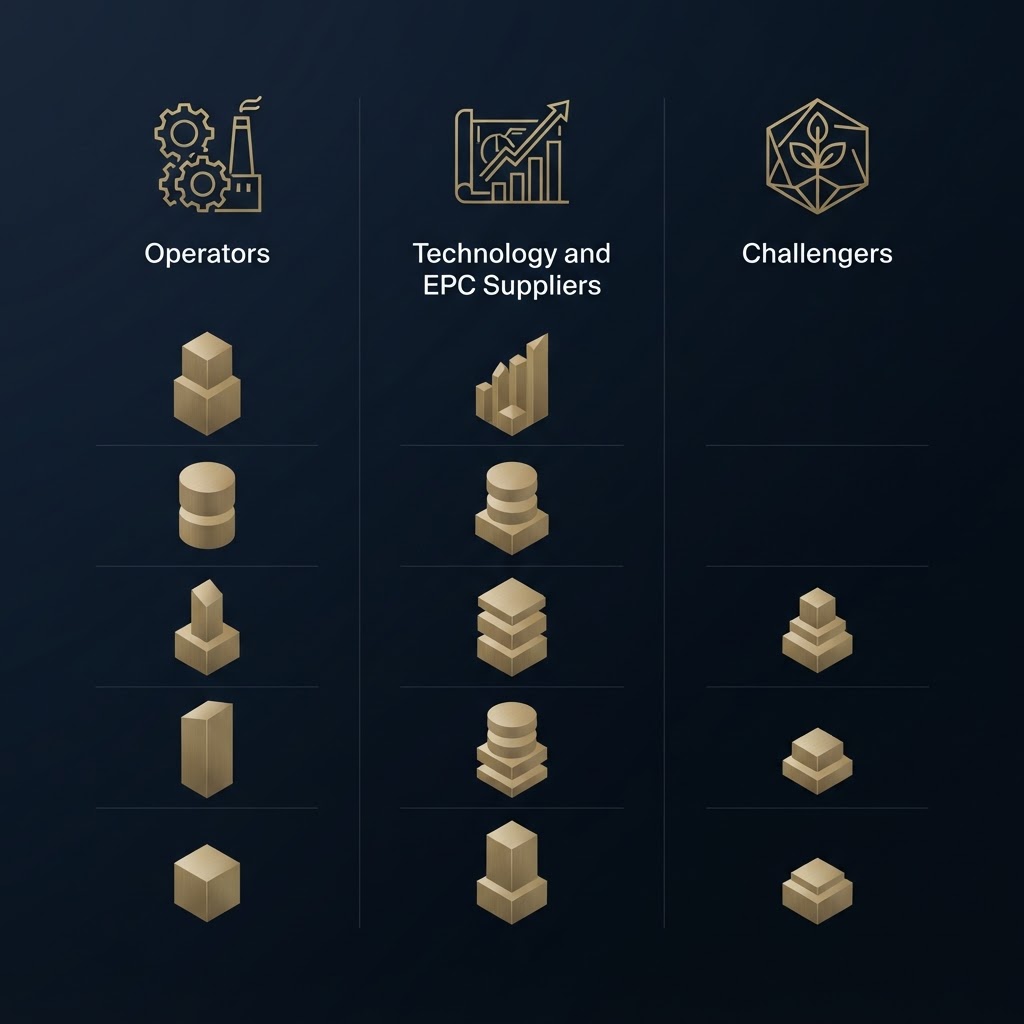
Three kinds of waste to energy company
The installed base is large and still growing. As of early 2025 there were more than 3,100 waste to energy plants worldwide with a disposal capacity of about 640 million tons per year, with about 3,300 plants and more than 770 million tons expected by 2034. Behind those plants sit three different business models.
- Operators and concessionaires. They own or run plants under long municipal contracts and earn gate fees plus energy sales. Their risk is contractual and political.
- Technology and EPC suppliers. They design and build the combustion lines, boilers and flue gas treatment, then sell service. Their risk is performance guarantees and warranty.
- Challengers. They bring a new conversion route, usually gasification, pyrolysis or fermentation, and are trying to prove it at commercial scale. Their risk is technology and the financing that depends on it.
The roles overlap at the largest groups, but the distinction tells you who carries the risk when something goes wrong, which is the question that matters.
The operators: who owns the plants
Veolia
Veolia is the reference operator. It runs more than 90 waste to energy facilities worldwide, including 60+ household waste incineration plants and over 50 non-hazardous landfills with biogas recovery, usually as part of integrated municipal waste contracts that also cover collection and recycling. On revenue it leads the field, with about 8.5 percent of market revenue in 2025.
Reworld (formerly Covanta)
Covanta now operates under the Reworld brand and is the closest thing to a pure-play operator in North America. Its fleet is 41 plants in North America and Europe processing roughly 21 to 22 million tons of waste a year, generating over 10 million MWh of electricity and recovering around 600,000 tons of metals, handling more than 5 percent of US municipal waste. Its share of global revenue was about 4.8 percent in 2025, built on merchant operations where tipping fee management decides the margin.
China Everbright Environment
By capacity, the largest single operator is Chinese. China Everbright Environment had invested in 284 environmental energy projects by end of 2025, with annual municipal solid waste processing capacity above 55 million tonnes and on-grid generation of about 19.3 TWh, and it has started building abroad in Uzbekistan and Vietnam.
That push abroad is not a coincidence. China's domestic build-out has peaked: in the record year of 2021, 190 plants with about 64 million tonnes per year of capacity were commissioned, and the major cities on the eastern seaboard now have sufficient or even oversized capacity, so many operators struggle to secure enough waste. Most Chinese majors are both builders and operators, so they face a double squeeze: no new projects to build at home, and not enough waste for the plants they already run.
The technology and EPC suppliers: who builds the lines
Kanadevia Inova (formerly Hitachi Zosen Inova)
If a list still says Hitachi Zosen Inova, it is out of date. The Zurich company became Kanadevia Inova on 1 October 2024, with 3,000 employees in 17 countries and roots going back to its founding in 1933 as L. von Roll. Ownership and management did not change. It is primarily an EPC contractor and technology provider, which means it usually builds the plant and supports it, while someone else owns and operates it. Its revenue share was about 3.5 percent in 2025.
Martin, Babcock & Wilcox and Mitsubishi Heavy Industries
The other grate and boiler names compete on engineering detail rather than fleet size.
- Martin GmbH in Munich is a grate specialist; its December 2024 award for a new combustion line at Switzerland's Linth facility includes a redesigned grate and planning for a future carbon capture unit, which is where European procurement is heading.
- Babcock & Wilcox supplies mass-burn boilers and emissions control in the US; its reference list includes the Palm Beach facility burning 3,000 tons per day for 95 MW, plus carbon capture retrofit products for existing plants.
- Mitsubishi Heavy Industries sells stoker furnaces, gasification and ash melting systems, with modular 120 ton per day units generating 4.6 MW and a large refurbishment business in Japan and Southeast Asia.
When you buy from this group you are buying a performance guarantee. The value of that guarantee depends on the balance sheet behind it and on how many plants at your scale already run on the same design.
A fragmented market, and where it is moving
No company dominates. The top five players held only about 21.7 percent of revenue in 2025, because municipal concessions, national permitting and the capital intensity of each plant keep the field local. A waste to energy company that is a household name in Germany may have no presence at all in Indonesia.
The growth has also moved. Outside China, momentum is building in Indonesia, Thailand and the Philippines and in Central Asia, especially Uzbekistan, while Europe has turned to replacement and modernisation: in 2025 it commissioned 1.2 million tonnes per year of new capacity and retired almost 900,000. For a deeper view of where those gaps are investable, see our analysis of the waste to energy market.
That shift matters for anyone choosing a partner. The incumbents built their reference lists on large plants in rich cities with high gate fees. The new demand is in emerging markets where gate fees are low, waste is wet and grid connections are weak. Being big in one does not prove fitness for the other, and the project mechanics differ enough that a project guide to waste to energy for emerging markets is worth reading before any shortlist.
The challengers, and the lesson of Fulcrum BioEnergy
The last group is where most of the investor attention and most of the losses sit. Challengers convert waste into something other than steam and power: Enerkem gasifies mixed waste into methanol and ethanol, LanzaTech ferments waste-derived gases toward sustainable aviation fuel, and Brightmark runs plastics pyrolysis. The promise is higher-value products. The exposure is first-of-a-kind scale.
Fulcrum BioEnergy is the case every investor in this space should read. It set out to turn municipal waste into jet fuel through gasification and Fischer-Tropsch synthesis. Its Sierra plant in Nevada was designed to take in 175,000 tons of municipal solid waste a year. The company raised more than USD 500 million from investors including United Airlines, Japan Airlines and SK Group, built the plant for nearly USD 200 million, then hit nitric acid build-up and sludge in the gasifier up to 10 feet high, and filed for Chapter 11 in September 2024.
The sequence is the lesson. The flagship opened in 2022, years behind schedule; Fulcrum began missing payments on USD 289 million in bonds in August 2023 and shut the plant in May 2024 because it lacked funding to restart. By the end of October 2024 the parent company recorded a net worth of minus USD 420.3 million, and the site was sold off to a waste company and a data centre operator.
Nothing about Fulcrum proves that waste gasification cannot work. It proves that a single large first plant, financed with debt before the process had operating hours, leaves no room to fix the engineering. We have set out the wider pattern in why waste to energy projects fail: the technology rarely fails alone, it fails inside a financing structure that cannot absorb a slow start.
How to choose a waste to energy company for your project
Use the role first, then the evidence.
- Match the role to the job. If you need someone to take waste for 25 years, you need an operator. If you own the concession and need a plant built, you need an EPC supplier. If you are backing a new process, you are underwriting a challenger and should price it like venture risk.
- Ask for references at your scale and feedstock. A grate proven on dry European waste at 300,000 tons a year says little about wet tropical waste at 50 tons a day.
- Find out who holds the performance risk. Which entity issues the guarantee, against what balance sheet, and for how long.
- Read the waste and offtake contracts before the brochure. Revenue in this sector is set by gate fees and power tariffs, which is the subject of who actually pays in a waste to energy business model.
- Check bankability. Lenders want operating history. If your chosen supplier has none, plan for equity and grants, as described in how the capital stack for a waste to energy plant is assembled.
Where EX EPIC fits
We are not a concession operator and we do not sell 1,000 ton per day grate lines. EX EPIC builds companies around technology that would otherwise stay in the lab, and in waste to energy that has meant small, distributed systems rather than one large plant per city. Through Zero-X, the ecosystem has designed, financed and installed waste-to-energy systems across 11 countries, with more than 200 units deployed, backed by a EUR 160M+ capital track record across four continents.
That record is the answer to the Fulcrum problem. Two hundred small units produce operating hours, failure data and fixes in parallel, rather than betting a company on one plant. It is the same discipline behind what a deep tech venture builder does in any capital-heavy sector: earn the operating record first, then scale into the markets the incumbents were not built for.
FAQ
Who is the largest waste to energy company in the world? It depends on the measure. By revenue, Veolia leads with roughly 8.5 percent of the global market. By installed processing capacity, China Everbright Environment is larger, with more than 55 million tonnes a year, almost all of it in China.
What happened to Covanta and Hitachi Zosen Inova? Both renamed rather than disappeared. Covanta now trades as Reworld, and Hitachi Zosen Inova became Kanadevia Inova on 1 October 2024 after its Japanese parent adopted the Kanadevia name. Ownership and management stayed the same, so older reference lists under the previous names still apply.
Are waste to energy companies a good investment? Operators with long municipal contracts behave like infrastructure: slow, contracted and exposed to regulation and gate fee levels. Challengers behave like venture bets, and Fulcrum BioEnergy lost its investors' capital despite backing from airlines and oil majors. Diligence the waste supply and offtake contracts and the operating history, not the technology pitch.
Which waste to energy companies work on small plants? Most incumbents optimise for large municipal plants. Small and distributed systems are a separate niche served by modular suppliers and builders such as Zero-X, where the evaluation should focus on how many units already run and on what feedstock.