A venture builder is an organisation that creates new companies from scratch using its own capital, its own team and usually its own ideas, rather than investing in or advising companies that already exist. The defining fact sits in the timing: when a venture builder starts work, the company does not exist yet. It builds the thing, tests it, and installs or recruits a founder to run it.
That is the definition. The harder question, and the one most people are actually asking, is which kind of venture builder is sitting across the table, because four structurally different organisations use the same two words.
What a venture builder actually is
The academic literature reaches for a factory metaphor, and it is a fair one. Venture builders churn out startups through systematic, repeatable processes, and they exert control over what they build through two mechanisms: equity stakes and active involvement in strategic decision making. Not a board observer seat. Not a mentor hour per month. Operating control.
The equity follows from that. A venture builder takes a founder-level equity position in what it creates, because it is doing founder-level work. It is not buying into a company. It is one of the reasons the company is there.
Three things a venture builder is not:
- Not an accelerator. An accelerator takes a startup that already has a team, an idea and often early users, and compresses its learning curve over a programme.
- Not a venture capital fund. A fund selects and finances existing companies. A builder creates the company before any investment round is a meaningful concept.
- Not a consultancy. A consultancy is accountable for a deliverable. A builder is accountable for whether the business works.
Venture builder or venture studio? The honest answer
Most pages answering this question either treat the two terms as identical or assert a crisp distinction without showing any evidence for it. The truthful position is between those.
Terms that mean the same thing
In practice the terms are used interchangeably. The reason a reader in Boston meets "venture studio" and a reader in Berlin meets "venture builder" is naming habit, not a difference in how the organisations work. German-speaking markets add a third label for the same activity, "company building", and "startup studio" and "company foundry" float around the same idea. If you are comparing a US organisation to a European one, do not read anything into which of these words they chose. It mostly tells you where they raised their first fund.
Where the two words genuinely differ
Where a distinction is claimed, it is a tendency rather than a definition. Studios lean towards product and design craft as the differentiator, and often co-build alongside a founder who is there from early on. Builders lean harder into running a systematic, high-volume process of testing many concepts and installing a founder only once the idea has been de-risked, frequently on behalf of a corporate or institutional sponsor.
Treat that as a description of typical behaviour, not a test you can apply. The academic survey of the field states outright that venture builders are subject to varying definitions and conceptualisations across both scholarly and professional literature. Nobody owns the term. If you want the studio side of this in full, we have written separately on what a venture studio is and on studio, accelerator or incubator.
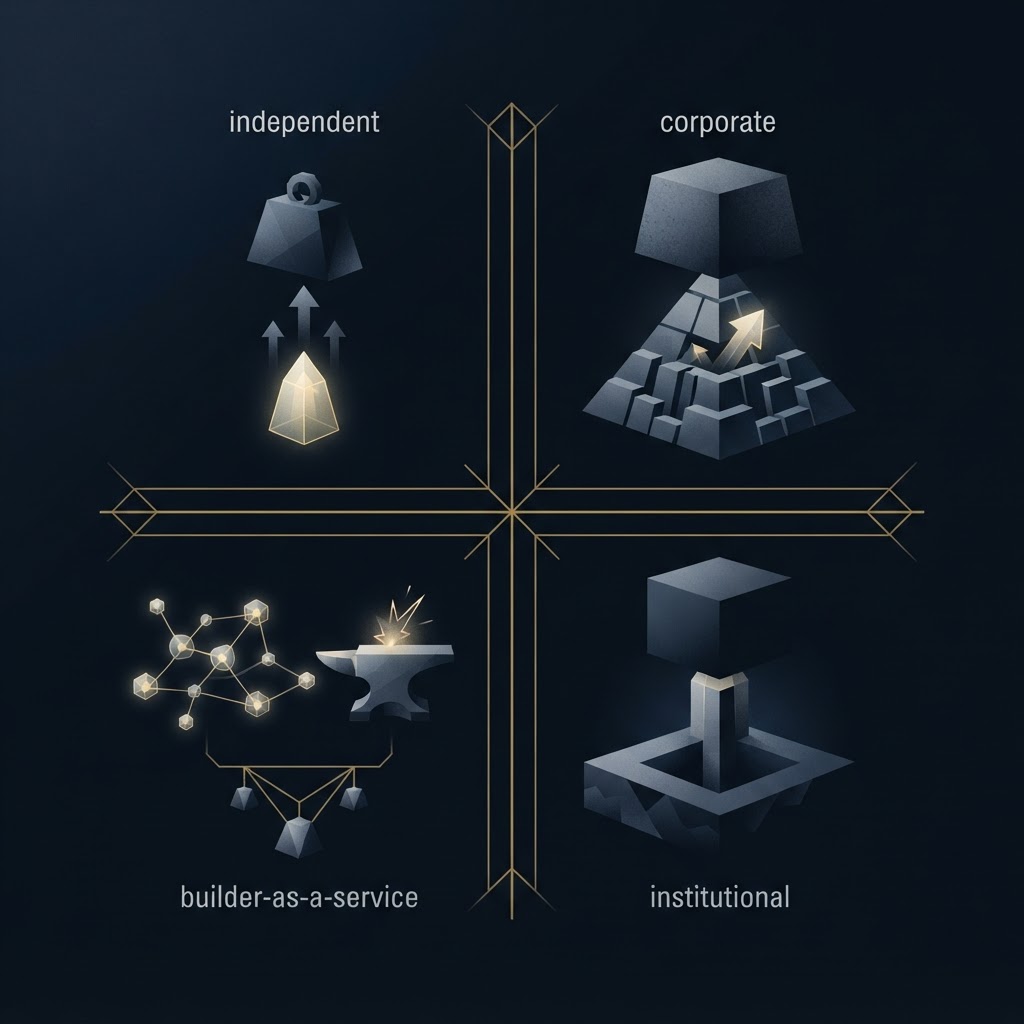
The four kinds of venture builder
This is the part that matters for a decision. The label is shared; the incentives are not.
Independent builders
Standalone organisations doing serial company creation with their own team, their own funding and a portfolio of ventures. Rocket Internet, Idealab and eFounders are the usual reference points. The idea is theirs, the risk is theirs, and the portfolio logic means any single venture can be killed without much ceremony.
Corporate builders
Units inside a large or mid-sized company that build new business lines as separate ventures. The strategic thesis comes from the parent's gap, not from an open market scan, and the parent contributes industry access, proprietary data or distribution in exchange for equity or strategic upside. This is also the type with the highest failure rate, for reasons covered further down.
Builder as a service
External partners who run the venture building process for a client company: part consulting, part operational execution. The consultancy-run version is well established, with BCG Digital Ventures the most visible example. Here the client supplies the problem and often the technology, and the builder supplies the method.
University and public builders
The category most glossaries omit, and the one growing fastest. MIT's Proto Ventures, Stanford's Venture Studio and Nanyang Technological University's GRIP programme in Singapore all run this model, alongside government-operated studios and public-private partnership builders. The driver is that institutions increasingly want a structured route from research to a commercially real company rather than hoping a professor files a spinout on their own. If that is your situation, start with commercialising university research.
The practical test: ask who generated the idea and who carries the downside. Those two answers identify the type faster than any brochure.
How the build sequence runs
The mechanics are more consistent than the labels. A full cycle from identified opportunity to investable venture typically runs 9 to 18 months, with the first 6 to 10 weeks spent on discovery. The academic frame splits it into five steps: ideate, validate, create, portfolio, scale, and the same survey records one builder spending 13 weeks purely evaluating an idea before deciding to pursue it.
Inside that, the kill rule is the engine. Concepts that fail to hit performance benchmarks within four to eight weeks are stopped and the resources redirected. Most ideas die in stage two. That is the design working, not the design failing. Knowing at week eight costs a fraction of knowing at month eighteen.
One thing to settle before you sign anything: where the idea came from. Ventures start by internal sourcing, where the builder had the idea and expands it with co-founders; by external sourcing, where an industry expert brings the idea and forms a partnership; or by hybrid sourcing, where internal and external people form the starting team around a shared concept. The route decides who owns what, and it is much cheaper to agree on it in week one than in month twelve.
What it costs: the equity question
Here the sources disagree, and the disagreement is the finding. One account puts the builder's stake at 20 to 50 percent in exchange for validation, centralised services, pre-seed capital and ongoing support. Another puts it at 30 to 80 percent. Anyone quoting you a single industry-standard number is guessing.
What moves the figure is how early the builder engaged and how much of its own capital and operating time went in before outside money arrived. A builder that wrote the thesis, funded the prototype and recruited you into it will hold more than one that joined a working concept. We cover the arithmetic in how much equity venture studios take and the revenue side in how venture studios make money.
The equity is not the only price. Deep involvement means less autonomy for the founder and a real dependency on the builder's resources and network, and if those turn out to be thinner than advertised, the venture's growth is capped by them. Diligence the builder as hard as the builder diligences you. If the comparison you are really making is against raising a round instead, that is venture builder against venture capital.
Where the model breaks
Two failure modes are documented well enough to plan around.
Corporate ventures die of organisational rejection, not market failure. The most common reason a corporate venture fails is not that customers said no. It is that large organisations have powerful immune systems: approval processes, reporting structures, risk committees and cultural antibodies that attack anything not fitting the existing operating model. The corporate ventures that survive are the ones given enough autonomy to move at startup speed while keeping access to the parent assets that made them defensible in the first place. If a corporate builder cannot show you that autonomy in writing, the venture is already fighting the wrong war.
The founder recruitment problem is structural. Strong entrepreneurs rarely want to be employees building someone else's vision. That tension pushes a lot of builders towards becoming traditional VCs, or towards becoming consultancies that happen to take equity. The same sceptical read adds the qualifier that matters most: the builders that genuinely work tend to concentrate in capital-intensive industries, where the model provides an advantage a founder cannot replicate alone.
That last point is not a footnote. It is the whole argument.
Deep tech is where the model stops being optional
In software, a capable founder can reach a testable product with a laptop and a few months. The builder's contribution is speed and overhead removal, which is real but optional. Change the asset to a reactor, a molecule or a patent family and the calculation inverts.
Deep-tech ventures carry four risks at once: technology risk, market risk, capital requirements and talent acquisition. The science is often early and needs substantial refinement before it can reach a market at all, the market validation is thin by definition because the product does not exist yet, the capital needed dwarfs a software raise, and the specialists who can do the work are scarce. Fund-then-step-back handles none of that.
Notice what this does to the standard validation instrument. The digital builder's playbook measures interest through landing pages, prototypes and targeted ad campaigns scored on conversion rate and cost per lead, then kills anything that misses the benchmark inside eight weeks. That is a good demand test. It is not a technology test. A gasifier that has not yet completed its validation runs will fail an ad campaign and a physics review for entirely unrelated reasons, and only one of those two verdicts should stop the project.
So the deep-tech builder's jobs are different in kind: finance the pre-company stage, convert the science into protected IP, assemble the operating team and then actually deploy hardware rather than launch a page. We break that down in what a deep tech venture builder actually does.
This is the model EX Venture runs, and the record is the evidence. The group has a EUR 160M+ capital track record and finances, patents and deploys deep tech across four continents. Its waste-to-energy line has 200+ units deployed across 11 countries. Its patent arm has 24 patent families filed with roughly 100 more validated in the pipeline. Its operator training programme has put 250+ people into portfolio companies, which is the unglamorous answer to the talent risk above. The ecosystem is built and led by Julien Uhlig.
One European mechanic is worth knowing if you are choosing between models. Venture building pairs unusually well with non-dilutive public funding: instruments such as the EIC Accelerator or Horizon Europe can carry the build-and-go-to-market phase, extending runway without diluting the cap table and signalling credibility to private investors afterwards. A builder that knows how to run a grant application in parallel with a build sprint is worth more equity than one that does not.
FAQ
Is a venture builder the same as an incubator?
No. An incubator supports external founders who arrive with their own idea, giving them infrastructure and advice. A venture builder founds the company itself, supplies the initial team and is operationally involved as a co-founder, which is why it holds a considerably larger stake and more influence over strategic direction.
Who owns the idea in a venture builder?
It depends on the sourcing route agreed at the start. With internal sourcing the idea is the builder's own and you are recruited into it. With external sourcing you brought the idea and formed a partnership around shared terms. With hybrid sourcing the starting team is mixed and so is the claim. Get it in writing before the build begins.
What happens to the builder once the company can stand on its own?
As the venture hires its own executives and builds out its own functions, the builder's operational role fades and it becomes a board member and major shareholder. Governance and capital, not daily operations.
Do universities use venture builders?
Increasingly, yes. MIT's Proto Ventures, Stanford's Venture Studio and NTU Singapore's GRIP programme are established examples, alongside government-run studios and public-private partnership builders created to move research and policy insight into commercially real companies.
Can venture building be combined with grant funding?
In Europe it commonly is, and it is one of the most capital-efficient routes available. Non-dilutive instruments fund the phase where a venture is spending hardest and is least attractive to equity investors, which is exactly when dilution is most expensive.