A deep tech venture builder in Europe is doing a job that, in the United States, the capital markets mostly do by themselves. That is the whole explanation for why the model is denser here, and it is the first thing a founder should understand before signing anything. Europe is not short of science. It is short of the financing chain that carries science from a lab bench to a factory floor, and the builder is the instrument that was assembled to substitute for the missing links.
The numbers are unambiguous. Europe accounts for 45 percent of the world's deep tech startups but captures only 17 percent of global deep tech funding, with 6.1 thousand European startups against the United States' 4.1 thousand and a Series A to Series B conversion rate of 10 percent against North America's 24 percent. Half the world's science, a sixth of the world's money, and less than half the odds of getting from one round to the next.
This article maps the builders that grew in that gap: the four operating models, where they cluster, what the public money changes, and the five questions worth asking before you hand over founding equity. If you want the mechanism itself rather than the European cut, we cover what a deep tech venture builder actually does separately.
Why Europe grew a builder layer the United States never needed
The gap is at scaling, not at founding
Europe starts companies perfectly well. It cannot finance them past the first serious round. The seed-stage funding gap between the United States and Europe is roughly 2x and widens to 16x by Series C and beyond, with seed to Series A conversion at 22 percent in European deep tech against 39 percent in the United States. The same analysis finds that 89 percent of European deep tech exit value leaves the continent, mostly to American acquirers.
The cause is structural rather than cyclical. Seventy percent of late-stage funding for European deep tech comes from non-European investors, and 87 percent of the continent's dedicated deep tech funds are under $300 million, which is too small to lead a Series B. A fund that cannot lead the round that matters is not a growth-stage market. It is a feeder into somebody else's.
What a builder is actually substituting for
Given that chain, the builder's proposition is narrow and concrete: it pays for the pre-company stage out of its own balance sheet, files the patents, and installs an operating team, because none of those three things reliably arrive on their own. It is not competing with venture capital at the same stage. It is occupying the years before there is anything for a fund to invest in. The instrument-level comparison is worth reading in full under venture studio versus venture capital.
None of this means the European ecosystem is weak. Deep tech now takes 32 percent of all European venture capital, up from 15 percent in 2015, on $20.3 billion invested in 2025. The asset class arrived. The plumbing between the lab and the growth round did not.
The four models of European deep tech venture builder
The word builder covers at least four different businesses. Directories list them together, which is exactly why a founder cannot use a directory to choose. Sort by where the technology comes from and who pays for the first two years.
University-embedded builders
These sit inside or beside a single institution and convert its research. Chalmers Ventures in Gothenburg is the clean example: a venture builder and fund for startups out of Chalmers University, providing pre-seed funding, business coaches and lab access, with spin-offs including Minesto and KomboSat. The advantage is proximity to the IP and to the technology transfer office. The limit is the same thing: the pipeline is one campus wide.
Research-institute sourcing builders
These take technology from large public research organisations rather than universities. HighTechXL at High Tech Campus Eindhoven runs a nine-month venture-building programme turning advanced technology from CERN, ESA and comparable institutes into startups. This model is the best fit for hard physics and instrumentation, where the underlying work was funded publicly, has no commercial owner, and needs a team assembled around it from scratch.
Thesis-driven venture creation
Here the builder decides what the world needs before it looks for a technology or a founder. Deep Science Ventures publishes the full sequence: identify underperforming outcome sectors, narrow to a specific opportunity area, find an entrepreneurially minded scientist, deconstruct the area from first principles, build out the team, then test the riskiest aspects and integrate IP before the company is even incorporated. Founders do not apply to this model so much as get recruited into it. If you already have a technology you are attached to, it is the wrong door.
Operator and portfolio builders
The fourth group builds companies across a sector portfolio and staffs them from its own bench. Paris carries two of the visible ones: Technofounders across healthcare, materials, energy and AI since 2014, and Marble on climate tech, carbon removal and emissions reduction since 2021, with FoolFarm in Milan covering AI, cybersecurity and quantum. EX EPIC belongs in this group. The distinguishing question inside it is not sector coverage, which is easy to claim, but whether the operators are real and whether anything has been deployed.
Where the European builders actually are
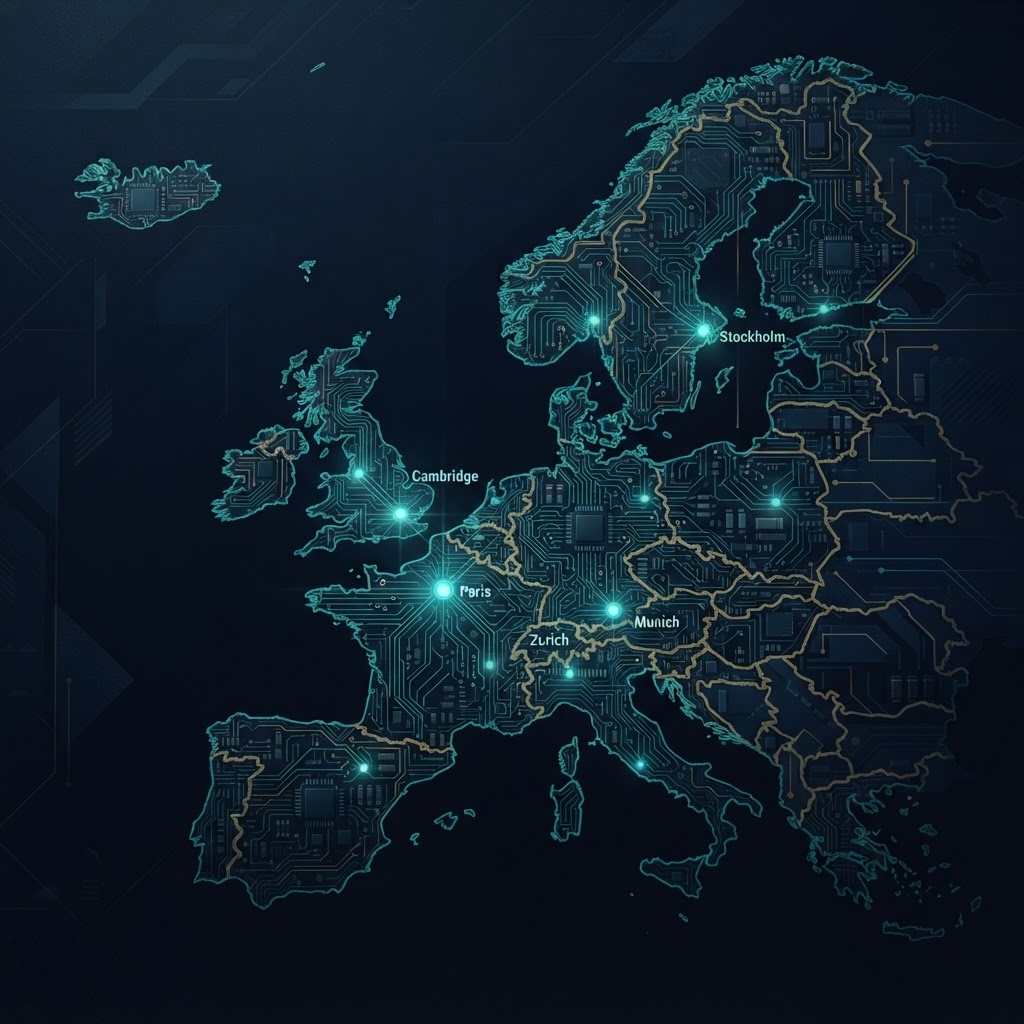
Builders cluster where the capital already is, which makes the funding geography a useful proxy. In 2025 the UK attracted the most European deep tech funding at $5.2 billion, ahead of France at $3.9 billion and Germany at $3.2 billion. At city level, Paris has emerged as Europe's leading deeptech hub, with Cambridge, London, Munich, Stockholm and Zurich also ranking among the world's top ecosystems. The same reporting notes Europe hosts 30 percent of the world's leading deeptech universities and produces twice as many science and engineering graduates as the United States.
Germany is the instructive anomaly. It ranks fifth globally with 0.5 thousand deep tech startups, behind the UK at 1.1 thousand and France at 0.8 thousand, despite being Europe's largest economy. German builders consequently skew away from volume company creation and toward industrial and energy deployment, where the country's engineering base is the asset rather than its startup formation rate. If your technology is a physical process that has to run inside a plant, that is a feature.
Southern and Central Europe are thinner but not empty, and the gap is being filled deliberately rather than organically. Venture Catalysts in Porto spins companies out of scientific and technical projects, having helped create SWORD Health and AddVolt, which is the kind of track record that takes a decade to accumulate outside a capital hub.
The public money is a European-specific builder skill
The competence that most separates a European builder from an American one is fluency in public funding. This is not a soft advantage. Public instruments now finance venture building directly: Ventures Thrive, an EIC-funded pan-European venture building studio, committed a cumulative EUR 1.5M equity-free across 32 deep-tech startups from Central and Eastern Europe and widening countries, targeting companies at TRL 6 and beyond. Equity-free capital at that stage does not exist in the American model.
The larger instruments are slower. The Scaleup Europe Fund is targeting EUR 5 billion against an annual funding gap estimated at $4 billion to $24 billion, and its first operational activities were only expected in mid-2026. A builder that can absorb grant money today is therefore worth more than one waiting for that fund to open, and grant absorption capacity belongs on your diligence list rather than in the nice-to-have column. The routes themselves we cover under EU funding for deep tech startups.
How to evaluate a European deep tech venture builder
Five questions, answerable in a first meeting, and each one separates a builder from a programme with better branding.
Where does the technology come from? A builder names its sourcing channel, whether that is one campus, a research institute network, or its own thesis. An accelerator waits for applications.
Whose balance sheet writes the pre-incorporation cheque? If the answer is a partner fund that invests after incorporation, you are talking to an investor with a workshop attached, not a builder.
Does IP work happen inside the process? The strongest models test the riskiest technical claims and integrate the IP before the company exists. Referral to a law firm after incorporation is a different and much weaker service.
Are operators placed or are mentors supplied? Mentors advise. Operators take a job. Ask for the names of people currently employed inside portfolio companies who came from the builder.
Has anything been deployed? This is the one the directories cannot answer and the one that matters most in Europe, because more than 80 percent of European deep tech exits are M&A with much of the value captured by US acquirers. A builder with a portfolio page and no operating assets is offering you that same path with extra steps. For the investor-side version of this test, see deep tech investing for family offices.
Where EX EPIC sits in that map
EX EPIC is an operator and portfolio builder with a deployment bias, and the record is the part worth checking rather than the positioning. EX EPIC finances, patents and deploys deep tech across four continents on a EUR 160M+ capital track record; Zero-X alone has designed, financed and installed 200+ waste-to-energy units across 11 countries; EX IX launched with 24 patent families filed and roughly 100 more validated in the pipeline; and EX EPIC Academy has deployed 250+ operators into the portfolio. The Academy exists because the operator shortage described above is real and could not be recruited around.
The trade is the same one every builder in this article asks for: founding equity, more than a fund would take at the same stage, plus real influence over the early direction of the company. Any builder unwilling to state that plainly in a first meeting is worth less than one that will. The upstream question, how research gets out of the institution at all, we cover in commercializing university research.
FAQ
How many deep tech venture builders are there in Europe? There is no reliable count, and you should distrust any article that gives you one. Public directories list anywhere from six entries for the whole continent to a few dozen, depending entirely on whether they filter for deep tech and whether they include corporate and university programmes. Most European builders are single-country, unlisted, and visible only inside their local ecosystem.
Is a European venture builder better than raising from a US fund? They solve different problems. The builder solves the pre-company problem: no capital, no patents, no team. A US fund solves the growth-stage problem Europe has not solved for itself. The cost of the second route is that the geographic centre of mass of the business tends to move with the money, which is one reason so much European deep tech exit value ends up on American balance sheets.
Which European country has the most deep tech funding? The UK, at $5.2 billion in 2025, ahead of France at $3.9 billion and Germany at $3.2 billion. Paris is the strongest single city hub, which is a different ranking from the country one and matters more if you are choosing where to incorporate.
Do European deep tech venture builders take equity? Most do, because somebody has to pay for the validation, patents and salaries before there is a company, and that money comes off the builder's balance sheet. Publicly funded programmes are the exception. Ventures Thrive deployed its EUR 1.5M equity-free. No cited source publishes a standard equity range, so treat any builder quoting one as a market rate with scepticism.
What sectors do European deep tech builders focus on? Climate and energy, quantum and photonics, computational biology, advanced materials, and increasingly defence, which took 43 percent of European deep tech VC in 2025. Marble in Paris is a carbon removal specialist, FoolFarm in Milan covers AI and quantum, and the research-institute builders skew toward instrumentation and hard physics.