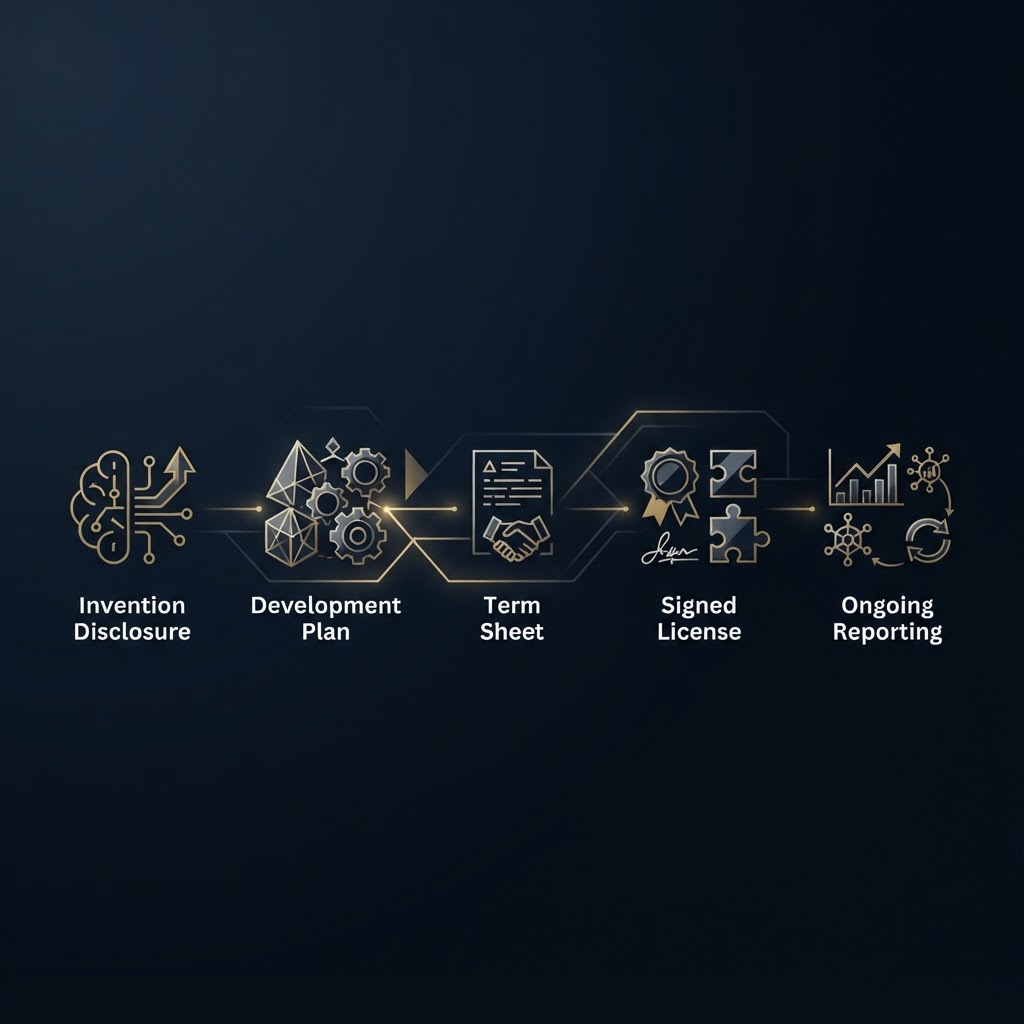
Technology transfer licensing is how most research leaves a university. The technology transfer office keeps ownership of the patent and grants a company permission to use it, in exchange for fees, royalties, equity and a promise to actually develop the thing. Every major US research university publishes its own version of the process. Read six of them side by side and the pattern is clear: the steps are nearly identical, the menu of terms is nearly identical, and the clauses that decide whether a startup survives are rarely the ones people argue about.
This guide merges those official sources into one map. The steps, every financial term, the non-financial terms that matter more, where the money ends up, and what a license will never give you.
What technology transfer licensing actually is
A license is a contract in which the owner of intellectual property grants some of its rights to another party that takes on obligations to commercialize it. Illinois' Office of Technology Management puts it in one line: the license gives the company permission to use the university's IP and sets out the business terms. The university keeps title. That is what separates a license from an assignment, and it is why licensing is the default route out of academia.
Licensing is one mechanism inside the wider field of technology transfer. If you are still deciding which route fits, start with our breakdown of technology transfer vs licensing. This piece assumes you have chosen a license and want to know how it works.
The volume is large and rising. AUTM's fiscal year 2025 survey of US institutions recorded more than 28,000 invention disclosures, with licenses up 7%, options up 10% and licenses or options that included equity up 16%. Equity deals growing fastest tells you who the licensees increasingly are: startups.
The licensing process, step by step
Stanford's Office of Technology Licensing describes six stages. UC Berkeley's IPIRA splits the same journey into eight. Merged, they look like this.
Find the technology
Universities market inventions through non-confidential abstracts, online technology catalogues and direct meetings. If you are interested, the office can share patent details and set up conversations with the inventors, sometimes under a confidentiality agreement. If you are the inventor founding the company, this step is reversed: you bring the disclosure and the plan.
Submit a development plan
Before any terms are offered, the office asks how you will bring the technology to market. Stanford wants the expected product, target market, development timeline and financial projections for the first years, and for startups the team and funding level. Berkeley calls it a commercialization plan and provides a template. Treat this document as the opening move of the negotiation. The office builds the financial structure from it, so the milestones you propose here become the diligence obligations you sign later.
Negotiate the term sheet
The term sheet sets the field of use, the type of exclusivity, the financial terms and the diligence milestones. Berkeley says plainly that this back and forth can take several iterations and "may be time consuming." Real timelines are covered in our guide to how long a university license takes. If you need time to raise money or run validation before you commit, a university license option agreement holds the technology for you first.
Draft and sign the agreement
The office drops agreed terms into its standard template and negotiates the rest. Two things run in parallel and catch first-time founders out. If an inventor is a co-founder, equity holder or consultant, Stanford runs a conflict of interest review that must be approved before signing. If the IP is jointly owned with another institution, Berkeley notes that the other owner may have to approve the terms too. For a startup, Berkeley also executes a share issuance agreement alongside the license.
Live with the license
Signing is the beginning, not the end. Stanford monitors licensees for the life of the agreement through periodic financial and development reports, and either party can ask to amend the deal as markets change. AUTM counted nearly 2,000 license amendments in FY25, so renegotiation is routine, not a failure.
The money: every financial term in a university license
MIT's Technology Licensing Office lists the common financial elements. Illinois and the University of Kansas define the same items in more detail. Not every license contains all of them.
| Term | What it is | When you pay |
|---|---|---|
| License issue fee | One-time fee for entering the license | At signing |
| Annual maintenance fee | Modest yearly payment to keep the license alive | Before product sales |
| Milestone payments | One-time payments triggered by development or commercial events | When the event happens |
| Running royalties | Percentage of net sales or a fee per unit | Quarterly, once you sell |
| Minimum royalties | A floor that applies if running royalties fall short | Annually, after first sale |
| Sublicense income share | Fixed percentage of what you earn by sublicensing | When you sublicense |
| Patent reimbursement | Past and ongoing patent filing and maintenance costs | On a payment plan, then as incurred |
| Equity | A minority stake, usually only for startups | At formation or signing |
Two patterns matter for founders. First, Stanford says an exclusive license to a startup raising funds will most likely include equity and a "more back-end-loaded" financial structure, while a multinational would get no equity and less back-loading. The university trades cash today for upside later. What that upside typically costs is covered in university spinout royalties.
Second, the startup terms are softer than they look. The University of Kansas exclusive license guide says it can be "quite flexible" on the timeline for reimbursing patent costs already incurred, and that its equity stake is usually small and often protected from dilution until early fundraising rounds close. KU may also accept a one-time success fee at exit instead of equity. How that anti-dilution protection behaves in a priced round is the subject of university spinout anti-dilution.
The terms that matter more than the money
Nucleate's 2026 founder playbook, built on more than fifteen interviews with tech transfer staff, founders, investors and attorneys, reports a consistent message: "headline economics are usually not the real battle." Field of use, sublicensing, diligence, prosecution control and ownership boundaries drive outcomes. Here is why each one bites.
Field of use. A license can be limited to one application or one territory. If your company pivots from diagnostics to therapeutics, or from one industrial sector to another, a narrow field can leave you without rights to your own product. Illinois says terms should anticipate potential pivots. Ask for the field you might need, not just the one you pitch.
Exclusivity. MIT offers nonexclusive, exclusive, or exclusive restricted by field or geography. Investors generally want exclusivity in the field the company is built on, because without it a competitor can license the same patents. The trade-offs are set out in exclusive vs non-exclusive patent license.
Sublicensing. Exclusive licenses usually allow sublicensing, and the university takes a share of the income. For any company whose exit path is a partnership with a larger player, the sublicense terms decide how much of that deal value you keep.
Diligence milestones. These protect the university against a technology being licensed and then shelved. They also give it a way out. Illinois and MIT both say unmet milestones can lead to termination, after which the technology is offered to someone else. Nucleate's advice is to tie milestones to fundraising events rather than purely technical ones, because they then land when you have cash to meet them.
The Net Sales definition. Running royalties are usually a percentage of Net Sales, and Nucleate calls the definition one of the most heavily negotiated parts of the agreement. Permitted deductions such as returns, rebates, distribution fees and taxes determine the base the royalty is charged on. A lower rate on a broad base can cost more than a higher rate on a narrow one.
Retained rights. Even an exclusive license is not total. MIT reserves rights for itself and other non-profits to continue research and teaching, and for federally funded inventions the US government keeps a license. KU calls the government right standard and says it "rarely interferes with commercialization." Know it is there so it does not surprise an acquirer in due diligence.
Where the royalties go
Licensing terms look different once you know who gets paid. Illinois discloses its formula: after expenses such as patent costs, inventors receive 40% of net licensing revenue, the inventor's department 20% and the university 40%, and equity proceeds are shared the same way when the university cashes in.
That split explains behaviour at the negotiating table. The inventor is often both a co-founder and a direct beneficiary of the university's economics, which is why the conflict of interest review exists. It also means a department has a financial interest in the deal closing, which makes faculty allies worth having.
What a license does not give you
A license is permission. It is not a working technology. WIPO's guidance on technology transfer agreements says a license "becomes an actual transfer when the licensor delivers the technology and knowledge to the licensee and the licensee learns how to effectively use, adapt and where possible improve the technology and knowledge." WIPO adds that there is no such thing as a standard contract. University templates are a starting point.
The practical gap is people. The patent describes the invention. The process parameters, the failed experiments, the supplier quirks live in the heads of the lab team. If the inventors are not joining the company, write knowledge transfer, training and a support period into the agreement, or plan to hire people who already know how. The mechanics of building that team alongside the license are in how to spin out a company from a university.
This is the part we know from the inside. EX EPIC finances, patents and deploys deep tech across four continents, with a EUR 160M+ capital track record. EX IX launched with 24 patent families filed and roughly 100 more validated in its pipeline. Zero-X has designed, financed and installed more than 200 waste-to-energy units across 11 countries, and the EX EPIC Academy has deployed more than 250 operators across the portfolio. The licenses and patents make that legal. The operators make it work. Sign the license for the rights. Budget for the transfer separately.
FAQ
What is an option agreement in technology transfer?
An option gives a company the exclusive right, for a limited period, to evaluate a technology and then negotiate a license. MIT notes that the option holder pays the patent costs during the option period. It suits teams that need to raise money or run validation before committing to full license terms.
Can a university license be terminated?
Yes. If a licensee misses diligence milestones or fails to meet reporting or payment obligations and does not fix the problem, the university can terminate. The technology then typically becomes available to another company.
Does the university keep any rights under an exclusive license?
Usually yes. Universities reserve the right to keep using the technology for research and teaching, and for inventions developed with federal funding the US government keeps a limited license. Both are standard and rarely block commercialization.
Can a license be changed after it is signed?
Yes. Either party can request an amendment, for example to change exclusivity, add or remove IP, or adjust the field of use as the business evolves. Amendments are common in practice.