Technology transfer vs licensing sounds like a choice between two options. It is not. Technology transfer is the outcome: a technology that worked in one place starts working somewhere else. Licensing is one legal tool for getting there. Every license is a form of technology transfer. Plenty of technology transfer involves no license at all.
The distinction matters because founders sign licenses expecting a working technology and receive a permission. A license says you may use the invention. It does not say anyone will show you how. That gap, between the right to use and the ability to use, is where most deep tech deals stall.
This piece defines both terms with primary sources, lays out every route that counts as transfer, shows what a bare license leaves out, and ends with a frame for deciding which one you need.
The short answer
The World Intellectual Property Organization puts it plainly in its licensing training manual: technology licenses "fall within the broad concept of technology transfer." The same manual says transfer can happen through something as simple as teaching, through hiring skilled workers, or through formal contracts including licensing contracts.
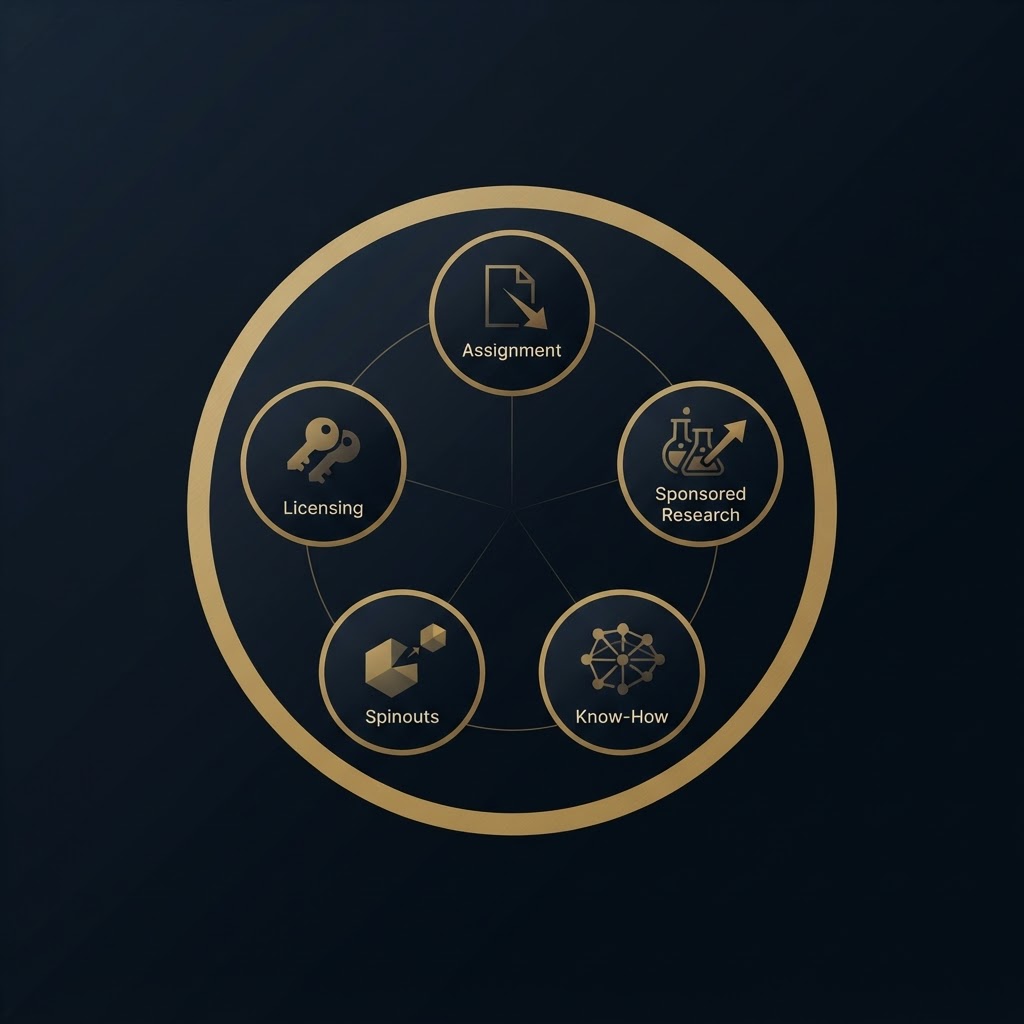
So the relationship is a set and a member. Technology transfer is the set. Licensing is the most common member, especially in universities, but it sits alongside assignment, sponsored research, spinouts and know-how agreements.
WIPO's page on technology transfer agreements adds the sentence every founder should read twice. A license is a consent to use IP. It "becomes an actual transfer when the licensor delivers the technology and knowledge to the licensee and the licensee learns how to effectively use, adapt and where possible improve the technology and knowledge." In other words, signing the license is the start of a transfer, not proof that one happened.
Why the two words get mixed up
The confusion is institutional. University technology transfer offices do most of their work through licenses, so their own guides collapse the terms. Columbia's inventors' guide defines technology transfer broadly, as the movement of knowledge and discoveries from research to the public, then says that "for the purposes of this guide, tech transfer refers to the formal licensing" of university IP to companies and startups.
That is a reasonable shortcut for a university office. The license is its legal output. It is a poor shortcut for a founder, who needs the technology to actually run.
The scale explains why the shortcut stuck. In fiscal year 2025, AUTM's survey of US institutions recorded more than 28,000 invention disclosures on research spending above $112 billion, with total licenses up 7%, options up 10% and nearly 2,000 license amendments. Startups formed from academic discoveries rose from 951 in 2024 to 1,095 in 2025, according to AUTM's release. Licensing is the measurable unit of academic tech transfer, so it became the name for the whole thing.
Technology transfer: the whole set of routes
IEEE's technology transfer overview describes the field as the structured movement of inventions, technical knowledge and engineering capability from one organization to another. It lists several distinct mechanisms. Here is how they differ.
Licensing
The owner grants a right to use patented or protected technology in exchange for royalties or a lump sum, and keeps ownership. This is the default route when an established company can absorb the invention into an existing product line. For the decision between licensing out and building yourself, see our breakdown of when to license the patent or build the company.
Assignment
Ownership itself moves. The WIPO manual describes assignment as a sale: title passes from seller to buyer, for an agreed price, as a one-time event with few continuing obligations. A license, by contrast, is a relationship that usually runs for years. What an assignment document actually conveys is covered in this guide to the assignment of patent rights agreement.
Sponsored and cooperative research
A company funds continued development at a university or lab, with negotiated rights to what results. IEEE notes that cooperative research agreements and joint ventures are common between government research agencies and industry for pre-competitive work. The transfer here happens through shared work, not just a document.
Spinouts
IEEE describes spinout formation as the route when the technology needs significant development before it can be sold and no established firm is positioned to take it on. A review in the medical literature on academic tech transfer adds the commercial detail: universities usually keep title and license exclusively to the startup, and often take equity in lieu of upfront license fees to preserve the startup's cash. So a spinout still contains a license, but the license is the smallest part of it. The process is covered step by step in how to spin out a company from a university.
Know-how and show-how
This is the route most people forget. WIPO's licensing guide for developing countries names the supply of know-how and the provision of technical services and assistance as main methods of commercial technology transfer, alongside licensing of industrial property. The know-how can sit in documentation or be delivered orally, through demonstration and training by engineers and specialists.
A Canadian government guide to supplying or acquiring technology draws the useful line. Know-how is technical knowledge and experience not protected by statute. Show-how is training, technical assistance, supervision and ongoing support that helps the recipient use the technology efficiently and profitably.
Licensing: what the permission does and does not include
A license is a narrow instrument by design. WIPO defines it as permission granted by the owner to use IP "on agreed terms and conditions, for a defined purpose, in a defined territory and for an agreed period of time." The licensor keeps ownership.
Three consequences follow, and all three surprise first-time licensees.
A bare patent license does not include help. The Canadian guide is explicit: a simple patent licence means the owner agrees not to stop you making, using or selling the invention. It does not oblige the owner to provide any technical information beyond the patent claim, or any technical assistance. If you need the process parameters, the failed experiments, the supplier list, you have to write that into the deal.
An exclusive license is still not ownership. The same guide notes that an exclusive licence does not transfer property. It is permission plus a promise not to let anyone else use the same right. A licensee's rights run against the licensor, not against the world. How exclusivity changes the economics is set out in exclusive vs non-exclusive patent license. Our piece on university spinout royalties covers what that permission typically costs.
Know-how changes the term and the royalty. Kilpatrick Townsend's note on licensing know-how with patents points out that a patent license ends with the patent, while a know-how license can run indefinitely. That allows a longer royalty structure, provided the royalty after patent expiry is clearly tied to the know-how. It also means the know-how needs confidentiality, security and equitable relief clauses that a patent license does not.
WIPO's manual calls the combined form a "patent and know-how license agreement," and notes that agreements can add further research, development or technical assistance. That combined agreement is the closest a license gets to being a full technology transfer.
Technology transfer vs licensing, side by side
| Technology transfer | Licensing | |
|---|---|---|
| What it is | The outcome: technology working in a new place | One legal mechanism to get there |
| Scope | Licenses, assignments, research deals, spinouts, know-how, hiring, training | Permission to use defined IP |
| Needs IP? | No. Know-how and teaching count | Yes. Without IP there is nothing to license |
| Ownership | May move (assignment) or stay | Stays with the licensor |
| Term | Anything from a single training to a permanent sale | Defined period, usually tied to the patent |
| Payment | Price, royalty, equity, research funding or none | Royalty, upfront fee, equity or cross license |
| Who does the work | People on both sides | Mostly the licensee |
| Done when | The recipient can run, adapt and improve it | The agreement is signed |
The last row is the whole argument. A license is complete on signature. A transfer is complete when the receiving team can operate the technology without calling the inventor.
Which one does a founder actually need?
Start from the question, not the paperwork. Ask what is missing on your side.
You need only a license when you already have the capability. An established manufacturer that can read a patent and build the product needs permission, not training. A bare license, possibly non-exclusive, is efficient here.
You need a license plus know-how when the patent describes the invention but not how to make it reliably. This is the normal case in hardware, materials, energy and biotech. Write the know-how definition, the delivery method, the support period and the confidentiality terms into the agreement, and price them separately. Expect it to take time; see how long a university license takes.
You need a full transfer when nobody on the receiving side can run the technology yet and no incumbent wants it. That is a company to be built, with people who learn the technology from the inventors. The institutional side of that handoff is covered in venture studio vs technology transfer office, and the mechanics of the license inside it in our guide to technology transfer licensing.
That third case is where we work, and our numbers show why licensing alone does not get a technology deployed. EX EPIC finances, patents and deploys deep tech across four continents with a EUR 160M+ capital track record. Zero-X has designed, financed and installed more than 200 waste-to-energy units across 11 countries. EX IX launched with 24 patent families filed and roughly 100 more validated in its pipeline. The EX EPIC Academy has deployed more than 250 operators across the portfolio. The patents are the permission. The units in the field exist because of the operators, which is the part of technology transfer no license can grant.
FAQ
Is a technology transfer agreement the same as a license agreement?
Not always. A technology transfer agreement can be a purchase of technology, a licence of rights, or a combination of both, often with delivery of know-how, training and documentation. The title of the document does not reliably tell you which one you are signing, so read the operative clauses.
What is the difference between licensing and assignment of IP?
In licensing, the right to use the IP is granted for a period while the owner keeps title and can often exploit it elsewhere. In an assignment, ownership passes to the buyer for an agreed price as a one-time transaction.
Can know-how be licensed without a patent?
Yes. Know-how supply is a recognised technology transfer mechanism in its own right. Because it is protected by contract and confidentiality rather than a patent, a know-how license can run beyond any patent term, but it needs strong confidentiality and security terms.
Why do universities take equity instead of license fees?
Startups are short of cash, so universities often accept equity in place of upfront fees and share in the upside instead. AUTM reported a 16% rise in FY25 in licenses and options that included equity.