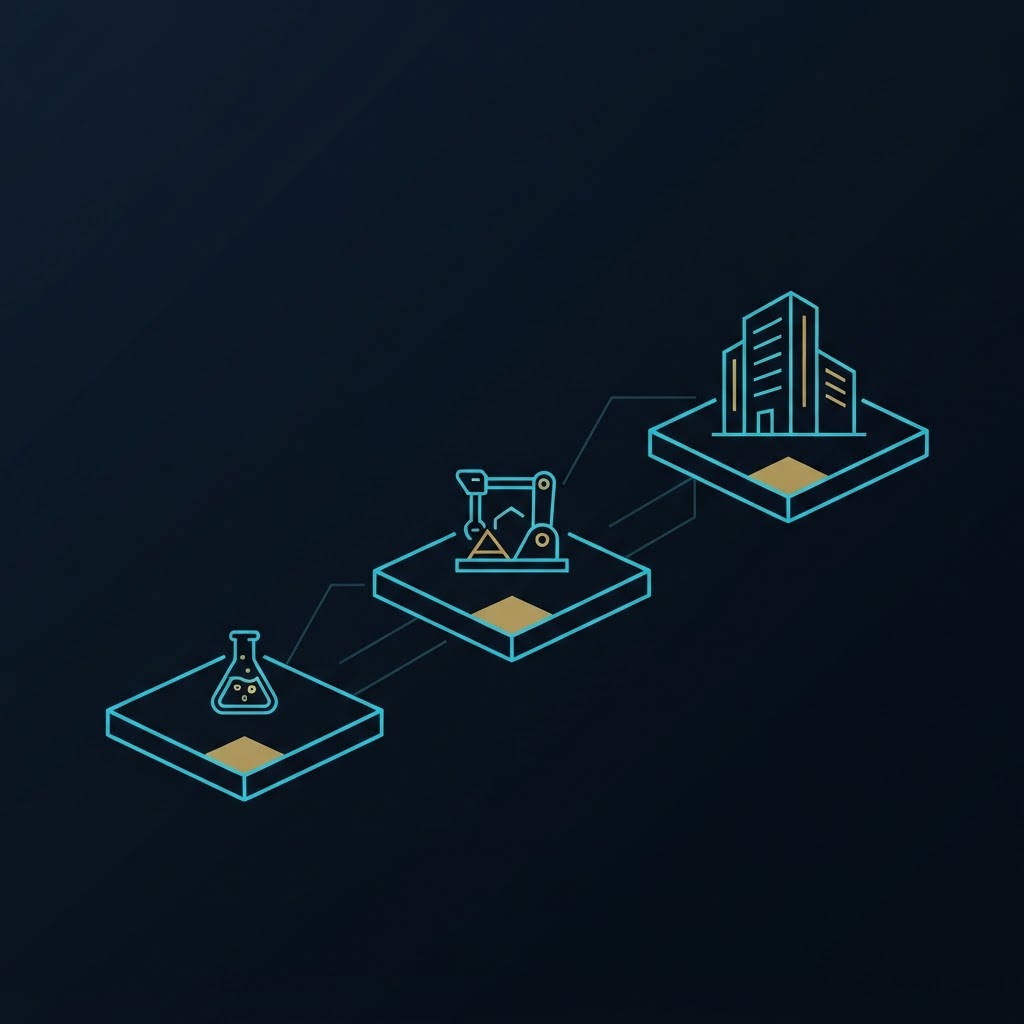
EIC Pathfinder vs Accelerator is not a choice between a small pot and a big one. It is a choice between funding science and funding a company. Pathfinder pays research teams, usually a consortium, to prove that a radically new technology can work, at TRL 1 to 4, with grants of up to EUR 4 million according to the official EIC Pathfinder page. The Accelerator pays one start-up or SME to take a validated technology to market, with a grant and optional equity on top. Between them sits EIC Transition, which most founders overlook and many cannot use.
Pick the instrument that matches where you actually are, not the one with the largest number. The rest of this page shows how to tell.
The short answer
| EIC Pathfinder | EIC Transition | EIC Accelerator | |
|---|---|---|---|
| What it funds | The science behind a new technology | Validation and a business case | A company bringing an innovation to market |
| Stage | TRL 1 to 4 | TRL 3 completed or 4, towards TRL 5 or 6 | TRL 6 to 8 for the grant |
| Who applies | 3+ entities from 3 countries; single applicants in Challenges only | One SME, start-up or research organisation, or 2 to 5 partners | One start-up or SME |
| Entry ticket | A radically new technology vision | Results from an eligible EU-funded project | TRL 5 completed |
| Money | Grant up to EUR 4 million | Grant up to EUR 2.5 million | Grant below EUR 2.5 million plus EUR 1 to 10 million equity |
| 2026 budget | EUR 262 million | EUR 100 million | EUR 634 million |
The budgets and the Accelerator equity range come from BeFunded's 2026 comparison, which checked them against the 2026 work programme. Pathfinder and Transition pay grants only. The Accelerator alone can pay grant only, equity only or blended finance, as the Alien Technology Transfer breakdown sets out.
If you are still mapping the whole landscape first, start with our overview of EU funding for deep tech startups.
EIC Pathfinder: funding the science
Pathfinder is for the earliest stage of deep-tech R&D: building the scientific basis for a breakthrough technology up to proof of concept. The question it funds is "can this work at all?", not "will anyone buy it?".
Pathfinder Open vs Pathfinder Challenges
There are two doors, and they have different rules.
- Pathfinder Open takes projects from any field. Its 2026 budget is EUR 166 million and the 2026 deadline was 12 May. You need a consortium of at least three independent legal entities: one in an EU Member State and at least two more, each in a different Member State or associated country.
- Pathfinder Challenges funds predefined themes run with EIC programme managers. Its 2026 budget is EUR 96 million and the 2026 deadline was 28 October. Challenges are the only Pathfinder route open to single applicants and two-partner consortia.
That consortium rule is the first hard filter. A start-up alone cannot enter Pathfinder Open, however good the science. Funded projects can add booster grants of up to EUR 50,000 to test the commercial potential of their results, and the main grant can go above EUR 4 million if duly justified.
What evaluators want to see
The EIC lists three essential characteristics: a convincing long-term vision of a radically new technology, a concrete and ambitious science-towards-technology breakthrough, and a high-risk, high-gain method with plausible objectives. A product roadmap does not meet that bar. If your pitch is about customers and margins, you are in the wrong instrument.
Competition is stiff. BeFunded counts 30 funded projects from 647 eligible proposals in the 2025 Pathfinder Challenges call, roughly 1 in 22. Companies do win places: 29 percent of participants were private for-profit organisations.
EIC Accelerator: funding the company
The Accelerator is the opposite end. It funds one company, never a consortium, whose technology is already validated and which needs patient capital to finish development and scale. Its innovation activities must sit at TRL 6 or above, and the grant covers TRL 6 to 8 work.
In 2026 it pairs a grant below EUR 2.5 million, paid as a fixed lump sum for work completed within 24 months, with an optional EIC Fund equity investment. A company can receive grant-only support once under Horizon Europe. Whether to take the equity is its own decision, covered in our guide to grant only or blended finance.
The Accelerator also has the tightest entry rules on entity, country and size. Our checklist for EIC Accelerator eligibility walks through them, and our breakdown of the EIC Accelerator success rate shows how narrow each stage is. When you are ready, our guide on how to apply for the EIC Accelerator covers the short proposal, full proposal and jury.
EIC Transition: the bridge most founders miss
People searching "EIC Pathfinder vs Accelerator" are often asking the wrong question, because their technology sits in the gap between the two. That gap is what EIC Transition is for.
According to the official EIC Transition page, Transition pays grants of up to EUR 2.5 million to validate a technology in an application-relevant environment, starting at TRL 4 and aiming for TRL 5 or 6, and to build business and market readiness. Its 2026 budget is EUR 100 million.
The catch is the entry ticket. Your proposal must build on results from an eligible EU-funded project, and those results must be at TRL 3 completed or TRL 4. Any other starting level is ineligible. Eligible precursor projects include:
- EIC Pathfinder projects, including the older FET-Open and FET-Proactive projects
- ERC Proof of Concept projects
- Research and Innovation Actions under Horizon 2020 and Horizon Europe Pillar II, at an eligible TRL
- European Defence Fund research, for civil and dual-use applications only
- Horizon Europe and Horizon 2020 Research Infrastructures actions
So "EIC Transition vs Accelerator" has a simple first answer. If your technology came out of one of those projects and sits at TRL 4, Transition fits. If it did not, Transition is closed to you, whatever your TRL.
Transition is also more flexible on who applies. A single start-up, SME or research organisation can apply alone, including university teams who intend to form a spin-off. Two partners from two countries, or a consortium of three to five, also work. A large company cannot apply on its own. The proposal is capped at 22 pages, and selection runs in three steps: submission, evaluation by individual evaluators, then an online interview with an EIC jury.
Pre-Accelerator: the fourth option
The EIC programme finder lists a fourth instrument that comparison pages rarely mention. The EIC Pre-Accelerator targets TRL 4 to 5, technology validated in the lab but not yet market-tested, for founders in emerging EU innovation ecosystems who need early validation before a full Accelerator application. It pays individual grants of EUR 300,000 to 500,000 in the 2025 call and EUR 500,000 to 1 million in the 2027 call, for up to two years. If your company is based in an eligible country and you are one step short of the Accelerator, check it before forcing an early Accelerator bid.
The real difference: who holds the grant
The tables above compare TRLs and euros. The decision that actually costs founders time is structural.
From consortium to company
Pathfinder money usually flows to a consortium, and in practice that often means universities and research organisations. The Accelerator only funds a company. Moving from one to the other is a spin-out decision, not a form choice. Somebody has to:
- Move the IP. The results belong to the consortium partners under their grant and consortium agreements. The company that applies to the Accelerator needs the rights to commercialise them, which means an assignment or licence agreed with every partner who owns a piece.
- Build a cap table that survives the SME test. A university that takes a large stake in exchange for the IP counts toward your company size. Our university spinout funding guide covers how those deals are usually structured.
- Hire the operators. The Accelerator jury funds a team that can sell, not only a team that can publish.
This is the work we do at EX EPIC. We finance, patent and deploy deep tech that would otherwise stay in the lab, with a EUR 160M+ capital track record across 4 continents, according to exventure.co. Through EX IX we have filed 24 patent families, and Zero-X has installed 200+ waste-to-energy units across 11 countries. The pattern we see: strong science rarely fails at the Accelerator for scientific reasons. It fails because nobody sorted out who owns the patents, who holds the shares and who runs the company before the proposal was written.
Fast Track: the shortcut from Pathfinder to Accelerator
There is a built-in shortcut. The Fast Track scheme lets proposals that result from existing Horizon Europe projects, including EIC Pathfinder, submit directly to the full application stage of the EIC Accelerator, skipping the short proposal. There is no formal requirement to pass through Pathfinder or Transition first, but if you already hold one of those grants, the Fast Track is the cheapest route in. Plan the spin-out during the Pathfinder project, not after it ends.
How to choose: four questions
Accelopment notes that misalignment between a proposal and its instrument is one of the most common reasons for rejection: market-ready solutions sent to Pathfinder, exploratory research sent to the Accelerator. Four questions put you in the right one.
- What is your TRL today, honestly? Below TRL 4: Pathfinder. TRL 3 completed or 4: Transition, if you qualify. TRL 5 completed and above: Accelerator.
- Who is applying? A consortium across three countries points to Pathfinder Open. One company points to the Accelerator. A lone lab team or start-up with an EU-funded result can use Transition or Pathfinder Challenges.
- Did the technology come out of an eligible EU-funded project? If not, cross Transition off the list.
- Do you need equity, or only a grant? Only the Accelerator offers EIC Fund equity. If you will need investors anyway, that matters.
If your answers point to two different instruments, the usual reason is that the science and the company are at different stages. Fix the structure first. Then write the proposal for the instrument that fits.
FAQ
Can a startup apply to EIC Pathfinder?
Yes, but usually not alone. A start-up can join a Pathfinder Open consortium as one of the three required entities, or apply as a single applicant to Pathfinder Challenges where the topic fits.
Can a university apply to the EIC Accelerator?
No. The Accelerator only funds companies. A university team can apply to EIC Transition alone, but to reach the Accelerator it needs to form a spin-out that holds the rights to the technology.
Do I need EIC Pathfinder before applying to the EIC Accelerator?
No. There is no formal prerequisite. If you do hold a Pathfinder grant, the Fast Track lets you skip the short proposal and go straight to the full application.
Is EIC Pathfinder funding a grant or equity?
Grant only. Pathfinder and Transition never take equity. The EIC Fund equity investment exists only in the Accelerator, and even there it is optional.