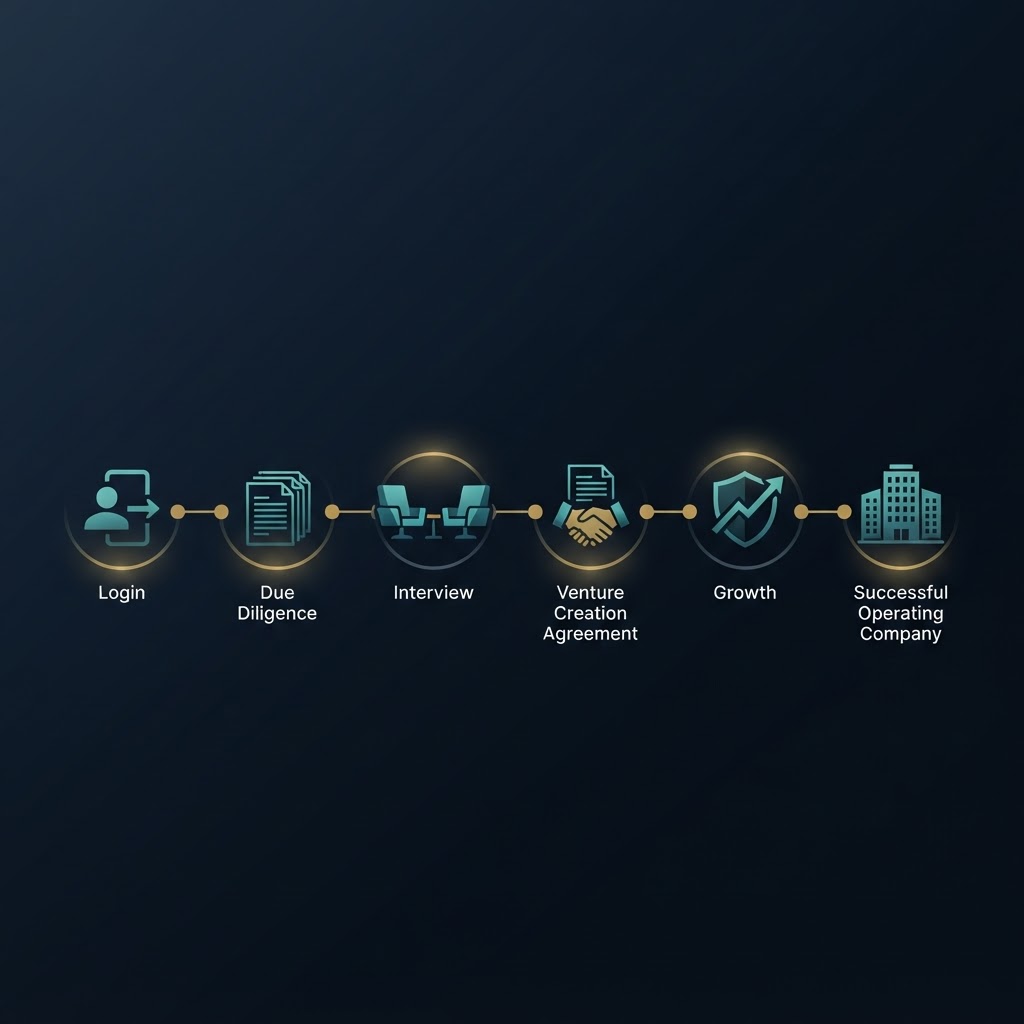
Here is how to apply for the EIC Accelerator, in the order you will actually do it. Register on the EU Funding and Tenders portal. Submit a short proposal. If it gets a GO, submit a full proposal to a batching date, defend it in an online interview with a technology expert, then pitch to a jury in Brussels. Win there and you sign a grant agreement while the EIC Fund runs due diligence on any equity. The official EIC Accelerator page calls it four steps. In practice it is closer to six, and most founders only prepare for the first.
This is the founder runbook for the whole route. If you first need the basics, read what the EIC Accelerator is.
The application route in one table
| Step | What happens | Who decides | Typical timing |
|---|---|---|---|
| 0. Register | Portal account and a 9-digit PIC | You | Days |
| 1. Short proposal | 12-page form, 10-slide deck, 3-minute video | 4 remote evaluators, GO or NO GO | Result in about 4 to 6 weeks |
| 2. Full proposal | 20-page form, new deck, video, annexes | Technology expert plus a panel of 3 or more | Result about 8 to 9 weeks after batching |
| 3. Jury interview | 10-minute pitch, 35 minutes of questions | Jury of up to 6 | Result about 2 to 3 weeks after the session |
| 4. Contracting | Grant agreement, EIC Fund due diligence | Commission and EIC Fund | After the award |
The timings for Steps 2 and 3 come from the EIC Accelerator guide for applicants (WP26), which is the document evaluators work from. Read it before any template.
Before you apply: three decisions
Most failed applications were decided before anyone wrote a page. Settle these three first.
Check you are eligible
The Accelerator funds single startups and SMEs, not consortia, with an innovation that has completed all aspects of TRL 5. Entity, location and ownership all matter. Our guide to EIC Accelerator eligibility covers who can apply and from where, including founders based outside the EU.
Know your attempt budget
You do not get unlimited tries. The EIC Accelerator FAQ caps a company at three unsuccessful submissions of the same or an improved proposal, at any stage, for the rest of Horizon Europe. A NO GO at Step 1 counts the same as a NO GO from the jury. Treat every submission as one third of your lifetime allowance.
Pick grant only, blended or equity only
You choose the funding type at the full proposal. Ipernovation's evaluator guide summarises the envelope: a grant of up to EUR 2.5 million plus equity of up to EUR 10 million through the EIC Fund, with the grant covering 70 percent of eligible costs, so your company funds the other 30 percent. The WP26 guide caps a grant only request at EUR 2,499,999. Decide early, because it changes your annexes and your cap table. See grant only versus blended finance and what the EIC Accelerator investment component means for dilution.
Step 0: register on the portal and get a PIC
Before you can start any application, you register on the Funding and Tenders portal and obtain a 9-digit Participant Identification Code (PIC). If your company already has a validated PIC, use it. A natural person who has not set up a company yet also needs a PIC to submit.
Two small choices here pay off later. The short proposal ends with self-declaration questions and an option to give your National Contact Point (NCP) access to your proposal and results. Say yes: if you are not selected, the NCP can point you to national funding instead. And if you spot a mistake after submitting, ask the portal helpdesk to withdraw the proposal at once, then fix and resubmit. The guide is explicit that a withdrawal before you receive a result does not count toward the resubmission limit.
Step 1: the short proposal
The short proposal is open all year. It is batched for evaluation on the first Tuesday of each month at 5pm Brussels time, and four remote experts each vote GO or NO GO. You need three GOs.
It is a real filter now. Segler Consulting reports a Step 1 pass rate of 21.7 percent in 2025, down from around 60 percent before the threshold rose to three of four, and an evaluation time of 51 days. Plan for seven weeks, not four.
We cover the form section by section, the deck and the video in our EIC Accelerator Step 1 guide, so here is only the one rule that matters for the rest of the route: every number you put in the short proposal will be read again by people checking whether it changed. Write it as if you will have to defend it in a room, because you will.
Step 2: the full proposal
A GO buys you the right to submit a full proposal. It also buys three days of free remote coaching from the EIC Business Acceleration Services, offered once. Book the coach before you write, not after.
What you submit
Per the official page, the full proposal holds:
- A form of up to 20 pages, aligned with the short proposal questions, which you can reuse or revise using the evaluators' feedback.
- A pitch deck in PDF and a video of up to three minutes, new or reused.
- Annexes on financial data and company structure, including the cap table.
- An IP strategy, with a freedom to operate analysis if available.
- An implementation plan with milestones, and a lump sum budget table, if you request any grant.
The guide adds letters of intent and links to the CVs of key personnel. The deck matters more than it looks: there is no slide limit at this stage, but it is the deck you will present in the jury interview, in ten minutes. Build it for that room. For the budget table, know first what the EIC Accelerator eligible costs are; activities above TRL 8 cannot be funded by the grant.
Full proposals go through the Submission and Evaluation Platform (SEP) on the portal, as the application platform FAQ confirms. Budget real time for this. Ipernovation puts a competitive full proposal at 8 to 16 weeks of work, against 2 to 4 for Step 1.
The 2027 batching dates
Full proposals are batched at 5pm Brussels time on four dates:
- 20 January 2027
- 17 March 2027
- 1 September 2027
- 4 November 2027
Work backwards from these. A short proposal batched on 1 December 2026 returns, on Segler's 51 days, around 21 January 2027: one day after the January date. Add 8 to 16 weeks of writing and your realistic first window is March or September.
The technology expert interview
This is the interview most founders do not know exists. About three to four weeks after the batching date, a technology expert meets you online for roughly an hour. You may bring up to three people and show prototypes or a demo. Consultants are not allowed. The expert fact-checks your claims against third-party sources and reports to the panel.
If someone else wrote your proposal, this is where it shows. Every TRL claim, benchmark and market number has to be owned by the team.
How the panel scores and ranks
A panel of at least three experts reviews the batch alongside the expert's report and scores Excellence, Impact and Implementation. Ipernovation reports the bar as at least 4 out of 5 on every criterion and 13 out of 15 overall. The panel then ranks the batch, and the top proposals, up to 2.5 times the available grant budget, are invited to interview. You hear about 8 to 9 weeks after batching. Proposals above 13/15 that are not invited still receive a Seal of Excellence.
For how these filters stack into the overall odds, see our breakdown of the EIC Accelerator success rate.
Step 3: the jury interview in Brussels
Jury sessions run twice a year, after every second batch. You get the invitation at least two weeks ahead, and the interview time cannot be moved. It is in person in Brussels, in English, and travel is not reimbursed.
The format is fixed:
- Up to three company representatives.
- A jury of up to six members. Ipernovation describes them as mostly investors and entrepreneurs. EIC Programme Managers and EIC Fund staff may ask questions but do not vote.
- At most 45 minutes: a 10-minute pitch using the deck you submitted, then up to 35 minutes of questions with no pre-set list.
The jury sees your full proposal and its remote evaluation, but not your short proposal or any earlier attempt. It decides GO or NO GO by consensus after you leave. Expect questions aimed at whatever the panel flagged as weakest.
Prepare for the questions, not the pitch. Ten minutes is easy to rehearse. Thirty five minutes of investors probing your financing gap, your team gaps and why private money will not do this alone is not. Run mock sessions with people who will be unkind.
Step 4: grant agreement and EIC Fund due diligence
You hear about two to three weeks after the session. With a GO, you are invited to prepare the grant agreement, which includes a first pre-financing payment. If you asked for equity, a single Commission award decision covers both parts, your project is passed to the EIC Fund, and its investment need is assessed through due diligence, in parallel with the grant.
With a NO GO you receive a rejection letter and, if you earned them, a Seal of Excellence and a STEP Seal. If you gave your NCP access at Step 1, this is when it pays: the NCP can steer you to national funding schemes.
A realistic timeline
Add up only the published durations and the route from first submission to a jury decision is long:
- Step 1 evaluation: about 7 weeks on current data.
- Full proposal preparation: 8 to 16 weeks.
- Waiting for your batching date: up to several months, depending on timing.
- Remote evaluation and ranking: 8 to 9 weeks.
- Jury session, which happens after every second batch, then 2 to 3 weeks to a result.
On those numbers, nine to twelve months from first submission to award is a reasonable planning case, and longer if you miss a window. If your runway does not survive that, the EIC is your second round, not your bridge.
The operator view: apply as a company, not a proposal
At EX EPIC we finance, patent and deploy deep tech that would otherwise stay in the lab: a EUR 160M+ capital track record, 24 patent families filed through EX IX, and Zero-X waste-to-energy systems deployed as 200+ units across 11 countries, according to exventure.co. From that side of the table, the EIC Accelerator does not reward writing. It rewards a company that is already structured to receive money.
So we sequence it the other way round. Clean entity and cap table first. IP filed and a TRL you can demonstrate to a technology expert in an hour. A named round with investors already talking, so the financing gap is a fact rather than a paragraph. A team of three who can each answer any question on the numbers. Then write. Teams that do this find Step 1 short. Teams that skip it spend their three attempts finding out.
FAQ
Can I use a consultant to apply for the EIC Accelerator?
Yes, for writing and review. But consultants cannot take part in the technology expert interview, and the jury meets only up to three company representatives. The team has to own the proposal.
How long is a short proposal GO valid?
A GO under the 2025 or 2026 Work Programme lets you submit a full proposal, and the full proposal batching dates now published are in 2027. Check your remaining submission count before you use it.
Can I fix a mistake after submitting?
Yes. Ask the Funding and Tenders helpdesk to withdraw the proposal, correct it and submit again. A withdrawal before you receive the result does not count toward the three-submission limit.
What happens if I score well but do not reach the jury?
Proposals scoring above 13 out of 15 that are not invited, or that the jury does not select, can receive a Seal of Excellence and a STEP Seal, which your National Contact Point can use to point you to national funding.