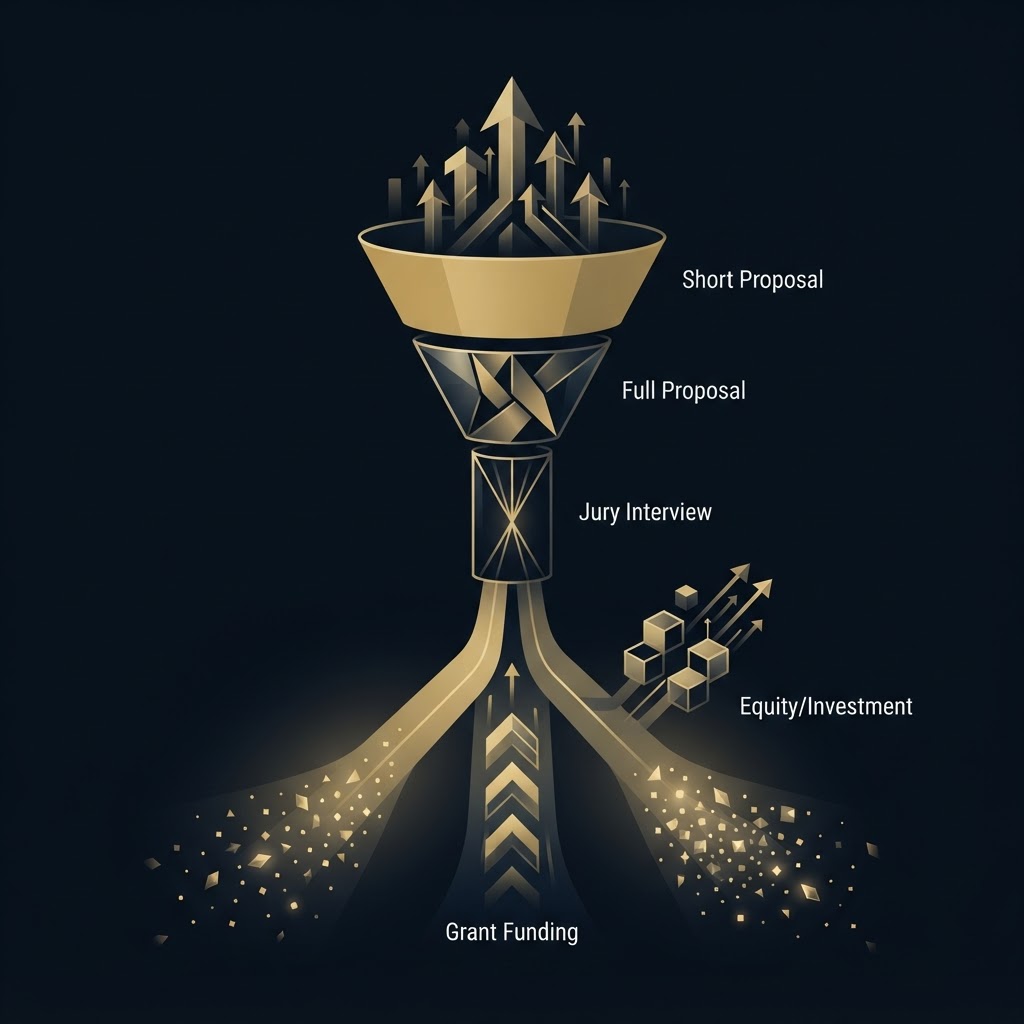
What is the EIC Accelerator? It is the European Union's main funding programme for start-ups and SMEs building breakthrough technology that is too risky for private investors to fund alone. It pays a grant of up to EUR 2.5 million for development work and can add an equity investment of EUR 1 million to 10 million for scale-up, according to the official EIC Accelerator page. It sits inside Horizon Europe and is run by the European Innovation Council.
That is the definition. The rest of this page explains what it means for a founder: what you get, what you give up, how selection works and how often it says yes. For the wider map of grants, equity and debt, start with our guide to EU funding for deep tech startups.
The EIC Accelerator in one paragraph
The official page describes the target company in three conditions. You have an innovative, game-changing product, service or business model that could create new markets or disrupt existing ones. You have the ambition and commitment to scale. And you need substantial funding where the risk is too high for private investors alone. Read the third condition twice. The EIC is not looking for the best company in Europe. It is looking for the best company that the market will not yet fund on its own.
What it is not
Not a cohort accelerator
The name misleads people. There is no batch, no demo day and no three-month programme in a shared office. It is a funding instrument with coaching attached. Winners get access to Business Acceleration Services: global partners, coaches and mentors, and an ecosystem of peers. The money is the product.
Not free money
The grant is free of equity, but the investment component is not. Under the EIC applicant guide for WP2026, the investment is usually direct equity or quasi-equity such as a convertible loan, capped at 25 percent of voting shares, on a patient-capital horizon of about 7 to 10 years. The grant also covers at most 70 percent of eligible costs, so you fund the rest.
Not fast
Three evaluation steps, a written proposal, a video and a jury interview. Then due diligence and contracting. Plan in quarters.
The money: grant, equity, or both
You choose one of three funding types when you submit the full proposal:
| Funding type | What it pays for | Amount | Who can take it |
|---|---|---|---|
| Grant only | Innovation activity, TRL 6 to 8 | Below EUR 2.5M, max 70% of eligible costs | SMEs with proof they can fund scale-up themselves; UK firms (only option) |
| Blended finance | Grant for TRL 6 to 8 plus investment for TRL 9 scale-up | Grant as above plus EUR 1M to 10M investment | SMEs in the EU or associated countries |
| Investment only | Market deployment and scale-up, TRL 9 | EUR 1M to 10M | Non-bankable SMEs and small mid-caps |
Three details from the guide matter more than the headline numbers. The grant is paid as a lump sum and the innovation activities should be finished within 24 months. A single work package cannot be split between grant and investment. And larger tickets of EUR 10 million to 30 million sit in a separate call, STEP Scale Up.
Each of these has its own trade-off. We cover them in depth in grant only or blended finance, the EIC Accelerator investment component and the EIC Accelerator eligible costs.
Who it is for
The short version: a single start-up or SME, including university spin-outs, established in an EU Member State or a country associated to Horizon Europe. Founders without a company can apply if they incorporate before signing. Small mid-caps with up to 499 employees can apply for investment only. UK companies can apply for grant only. Companies from the US, Singapore or other third countries can submit a short proposal but must be established in Europe by the full proposal.
Two conditions filter harder than geography. The technology must be at TRL 6 or above, meaning demonstrated in a relevant environment. And you must show a real need for EU support: evidence that your company is not yet investment-ready at current market risk appetite. The full checklist is in our guide to EIC Accelerator eligibility. If you are still in the lab, compare EIC Pathfinder vs Accelerator first.
How the selection works
Step 1: short proposal
Short proposals can be submitted at any time. You send a pitch deck of up to 10 slides, a video of up to three minutes with up to three core team members, and written answers of up to 12 pages. Proposals are batched on the first Tuesday of every month and you hear back in about four to six weeks. Four experts each vote GO or NO GO. You need at least three GOs. Our guide to EIC Accelerator Step 1 goes section by section.
Step 2: full proposal
With a GO you write the full proposal for a cut-off date. The 2026 work programme cut the full application forms from 50 to 20 pages and moved to evaluations every two months instead of every six. Each of three criteria (excellence, impact, and risk and implementation) is scored out of 5. You need at least 4 on each and 13 out of 15 overall. Proposals requesting about 2.5 times the available grant budget are invited to interview.
Step 3: jury interview
You pitch to a jury, with 10 minutes for your deck, followed by questions. Winners move to grant preparation and, for the investment component, investor due diligence. For a full walk-through, see how to apply for the EIC Accelerator.
The odds
Germany's National Contact Point for the EIC Accelerator publishes counts for every cut-off. Since 2021, 840 of 12,202 full proposals were funded: 6.9 percent. In the January and March 2026 round, 38 of 442 were funded, 8.6 percent.
That is from full proposal onward. Step 1 got much harder: Segler Consulting's breakdown of Commission data shows the short proposal pass rate falling from 60.6 percent in 2023 to 21.7 percent in 2025. Multiply the two and roughly 2 in 100 companies that start at Step 1 end up funded. Our page on the EIC Accelerator success rate has the full series and why it moved.
Quality alone is not enough either. In that same round, 95 more applications cleared the bar but received a Seal of Excellence instead of money because the budget ran out.
Open, Challenges and the budget
There are two doors. Accelerator Open takes any technology. Accelerator Challenges takes projects that match predefined strategic topics. The 2026 challenges include advanced materials for renewable energy and storage, fusion power plant technologies, biotech for regenerating agricultural soils, critical raw materials, and deep tech for climate adaptation.
The whole Accelerator had EUR 634 million in 2026 and has been open to dual-use innovation since 17 June 2026, per the work programme page. For 2027, the programme page lists EUR 428 million for Open and EUR 150 million for Challenges.
Should you apply? The operator view
At EX EPIC we finance, patent and deploy deep tech that would otherwise stay in the lab. We have a EUR 160M+ capital track record and Zero-X waste-to-energy systems installed in 11 countries with 200+ units deployed, according to exventure.co. We look at the EIC Accelerator the way we look at any capital: by what it does to the company, not by its headline size.
It fits when three things are true:
- Your technology is past the lab but not yet bankable. TRL 6 to 8, with a clear path to TRL 9.
- Your need is bigger than your market can fund. If a seed round would cover it, the EIC will say so.
- You can live with the EU as a long-term shareholder. For blended finance, that is a 7 to 10 year partner on your cap table.
It does not fit when you need money in the next six months, when your story is incremental rather than a breakthrough, or when the proposal is half ready. The last one is expensive. The EIC Accelerator FAQ sets a three-strikes rule: after three unsuccessful submissions of the same or an improved proposal, you cannot apply again under Horizon Europe. Every attempt counts.
The pattern we see is that founders treat the EIC Accelerator as a grant application. It is closer to a fundraise with an unusually patient investor. Prepare it like one.
FAQ
Is the EIC Accelerator a grant or a loan?
Neither alone. It is a grant, an equity or quasi-equity investment, or both. Quasi-equity can mean a convertible loan, but there is no bank-style debt.
How long does the EIC Accelerator process take?
Step 1 alone takes four to six weeks after the monthly batching date. The full proposal, interview, due diligence and contract add months, so most companies should plan for a process measured in quarters.
Does the EIC take equity in my company?
Only if you choose blended finance or investment only. The stake is capped at 25 percent of voting shares and is held as patient capital for about 7 to 10 years.
Can dual-use or defence-adjacent startups apply?
Yes. The EIC Accelerator has been open to dual-use innovation since 17 June 2026.
What is a Seal of Excellence?
A label for proposals that pass every quality threshold but cannot be funded because the budget is spent. It confirms the project was judged fundable, which is useful evidence when you approach other funders.