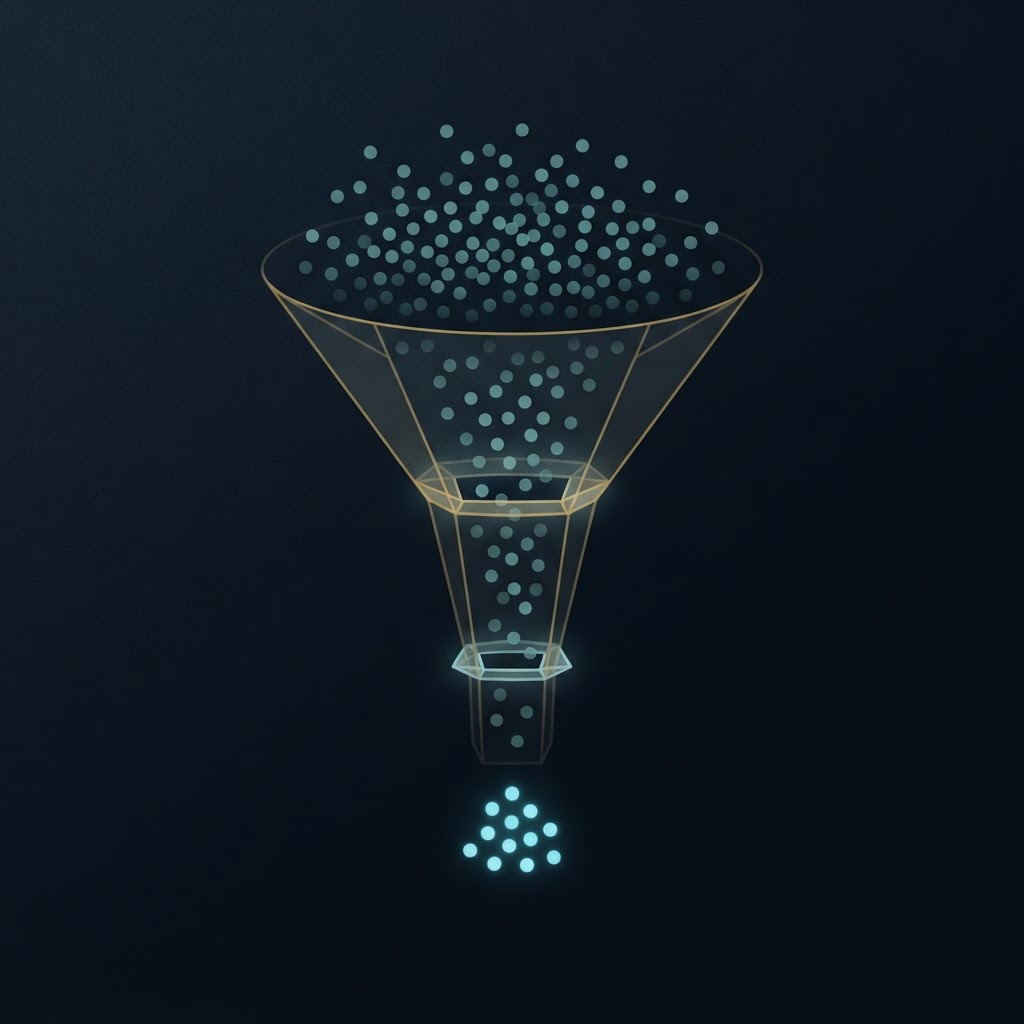
The EIC Accelerator success rate is 43.7 percent, 8.6 percent or about 2 percent. All three describe the same round. They start counting at different gates.
- 43.7 percent is the odds once you are in the interview room.
- 8.6 percent is the odds from a submitted full proposal to funding.
- About 2 percent is our estimate of the odds from a Step 1 short proposal to funding.
The last number answers the question most founders are asking. This page gives the full series behind all three, explains why they moved, and shows how to plan around them. For the wider map of instruments, start with our guide to EU funding for deep tech startups.
Every cut-off since 2021
The most complete public series comes from Germany's National Contact Point for the EIC Accelerator, which publishes counts per cut-off. The percentages are our arithmetic on its counts.
| Cut-off | Full proposals | Interviewed | Funded | To interview | Interview win | Overall |
|---|---|---|---|---|---|---|
| Jun 2021 | 801 | 132 | 65 | 16.5% | 49.2% | 8.1% |
| Oct 2021 | 1,109 | 211 | 99 | 19.0% | 46.9% | 8.9% |
| Mar 2022 | 1,102 | 266 | 74 | 24.1% | 27.8% | 6.7% |
| Jun 2022 | 1,006 | 231 | 75 | 23.0% | 32.5% | 7.5% |
| Oct 2022 | 1,005 | 240 | 78 | 23.9% | 32.5% | 7.8% |
| Jan 2023 | 476 | 159 | 32 | 33.4% | 20.1% | 6.7% |
| Mar 2023 | 555 | 139 | 51 | 25.0% | 36.7% | 9.2% |
| Jun 2023 | 641 | 138 | 47 | 21.5% | 34.1% | 7.3% |
| Nov 2023 | 1,076 | 242 | 42 | 22.5% | 17.4% | 3.9% |
| Mar 2024 | 969 | 341 | 68 | 35.2% | 19.9% | 7.0% |
| Oct 2024 | 1,139 | 431 | 71 | 37.8% | 16.5% | 6.2% |
| Mar 2025 | 965 | 149 | 39 | 15.4% | 26.2% | 4.0% |
| Oct 2025 | 916 | 121 | 61 | 13.2% | 50.4% | 6.7% |
| Jan + Mar 2026 | 442 | 87 | 38 | 19.7% | 43.7% | 8.6% |
Across all rounds, 840 of 12,202 full proposals were funded: 6.9 percent. That matches the 7 percent cumulative figure from Lira, which counted 803 companies to the end of 2025.
Two reading notes. Counts differ slightly by publisher: the EIC announced 1,211 proposals for October 2024 and 923 for October 2025, where this table shows 1,139 and 916. The overall rate moves by 0.3 points or less, so we keep one consistent series. And the overall column is far steadier than the middle two. The total has stayed between 3.9 and 9.2 percent while the route to it changed completely.
Step 1 stopped being a formality
Step 1 is missing from the table because the EIC does not routinely announce it. The numbers surfaced through an information request to the Commission, and Segler Consulting published the yearly breakdown:
| Year | Short proposals | GO | Pass rate |
|---|---|---|---|
| 2021 | 5,161 | 3,033 | 58.8% |
| 2022 | 2,778 | 1,761 | 63.4% |
| 2023 | 3,015 | 1,827 | 60.6% |
| 2024 | 2,637 | 879 | 33.3% |
| 2025 | 3,378 | 732 | 21.7% |
| 2026 (partial) | 621 | 132 | 21.3% |
Older advice that calls Step 1 a light screen describes a programme that no longer exists. Under the WP26 guide for applicants, at least three of four evaluators must say GO. Two NO GO votes end the application. Segler attributes the drop to this higher threshold. Our guide to EIC Accelerator Step 1 covers the stage itself.
Multiply the current rates and you get the end-to-end figure: 21.7 percent at Step 1 times 8.6 percent from full proposal gives about 1.9 percent. The same sum on 2023 numbers gives about 3.8 percent. Treat both as orders of magnitude. They mix cohorts, because a GO stays valid across later cut-offs, and others estimate roughly 3 percent. The direction is the useful part: entry got harder, and the entry gate now removes about four of every five applicants.
Why the interview rate jumped
A budget rule, not a better jury
Interview odds went from 16.5 percent in October 2024 to 43.7 percent in the latest round. Applicants did not suddenly pitch twice as well. The design changed.
The official EIC Accelerator page states the rule for 2026: the top-ranked proposals corresponding to 2.5 times the available grant budget are invited to interview. One divided by 2.5 is 40 percent. Lira reads it the same way: budget for around 40 percent of invited companies. The 43.7 percent is close to what the rule produces.
So when a consultant quotes the interview rate, remember it is now a design parameter. The filtering moved upstream. A year-by-year analysis of the Commission data puts the full-proposal pass rate at about 35 percent in 2024 and 14 percent in 2025.
That analysis shows about 10 percent for partial 2026 data. The German contact point's table shows 87 of 442, or 20 percent, and its 87 matches the interview count the EIC announced, so we use that. The January and March total of 442 is hard to find: at least one widely read tracker lists it as unpublished.
In 2026 a technology expert also joins the assessment, with an online interview about three to four weeks after batching. Your first live conversation with the EIC now happens before the jury.
Above the bar is not the same as funded
The latest round also shows what budget does at the end of the funnel. Beyond the 38 winners, 95 applications were assessed above the threshold but received a Seal of Excellence because funding ran out.
By our arithmetic, 133 of 442 proposals, 30 percent, cleared the quality bar. Only 8.6 percent got money. Roughly five in seven of the applications judged good enough went unfunded. Do not read rejection in that group as a verdict on the technology.
How the rate changes by country and sector
The series lets you compare one market. German applicants won 125 of 1,401 full proposals, or 8.9 percent, against 6.9 percent overall. Across the same Commission data, the full-proposal pass rate was about 30 percent for the Netherlands, 29 percent for Sweden and France, 25 percent for Germany, and 16 percent for Italy.
By sector, the same dataset shows wider gaps. These are pass rates at the full-proposal stage across 2021 to 2026, not funding rates:
- Space: 26.4 percent
- Engineering and technology: 26.1 percent
- Health: 25.6 percent
- Biotechnology: 25.0 percent
- Energy: 23.4 percent
- ICT: 17.6 percent
- Transport and mobility: 14.8 percent
These are averages across several rule sets, so use them as context. A software company is not locked out, but it starts with a harder job explaining why the technology is difficult to copy.
US and Singapore founders should read the rules before the rates. Under the EIC Accelerator FAQ, a company in a non-associated country may file a short proposal but must prove effective establishment in a Member State or Associated Country by the full proposal. Check the current list in our EIC Accelerator eligibility guide.
How to plan around a 9 percent event
We read these numbers as a venture builder. EX EPIC has a EUR 160M+ capital track record, and its company Zero-X has deployed 200+ units across 11 countries. The operator's question is never "what are the odds?" It is "what happens to the company in each outcome?"
Count your attempts
The FAQ caps you at three rejections at any stage, for any funding type, until Horizon Europe ends in 2027. A rejection at Step 1 counts. A GO does not. Rejections before 2024 do not count.
This is what makes single-round odds misleading. If each full proposal had an independent 8.6 percent chance, three tries would give about one in four. That is illustrative: attempts are not independent, and a strong company is not an average one. Remote evaluators do not see earlier submissions, so each attempt is judged afresh. The point stands. You are managing a small, fixed budget of attempts, and a rushed first filing spends one.
Keep it out of the base case
From the March 2026 batch to the mid-June result took about three and a half months. Add around seven weeks for Step 1, where Segler reports a current evaluation time of 51 days. Add up to three months for most grant agreements, with equity following later. That is about eight months before writing time, on a clean first pass.
The prize justifies the effort. The round set aside EUR 292 million across 38 companies, about EUR 7.7 million each on our arithmetic, split into EUR 90 million of grants and EUR 202 million provisioned for equity. Equally, more than nine in ten full proposals get nothing. Build the plan so the company survives that outcome, then treat an award as upside.
That means your runway cannot depend on it. Keep a parallel route running: our guide to equity-free funding shows what stacks alongside it, and the lab to market timeline shows how long the rest of the journey takes.
Spend effort where the cut happens
In the latest round about four in five full proposals ended before the jury. Most founders still think of the pitch as the hard part. The data says the hard part is the document and the technology expert conversation. Decide early whether you want grant only or blended finance, since 84 percent of the latest cohort was eligible for blended finance. Then work through how to apply with the written stage as the main project.
What comes next
The last 2026 full-proposal batch is dated 4 November. Myriad Associates expects a further 70 to 75 funded companies this year, with May and July applicants interviewing in October and September and November applicants in February 2027. We found no published May or July results as of this writing, so the 8.6 percent rests on a single 2026 round.
The pool is also changing. The June 2026 amendment opened the call to dual-use innovation, with no scoring advantage and no separate budget. A new category of applicant can shift these rates in either direction.
FAQ
Does the EIC publish the Step 1 success rate?
Not routinely in its results announcements. The yearly figures above come from an information request to the Commission, published by independent analysts.
Does a Seal of Excellence let you skip Step 1?
No. The EIC FAQ says a Seal does not in itself give the right to apply directly to the full proposal. You still need a valid GO under the 2025 or 2026 work programme.
Do EIC evaluators see my previous rejected application?
Remote evaluators do not. Proposals are assessed on their own merits, and the EIC encourages you to describe improvements in the narrative.
Does using a consultant raise your odds?
The evidence is thin. In a 2021 survey by the European Association of Innovation Consultants, members reported a 15 percent aggregated success rate against a 5 percent average. That data is self-reported, by consultants, under rules that have since changed.