The patent licensing business model is the only structure in technology where a company can collect revenue on products it never designs, builds or sells. Qualcomm collects a royalty on handsets that contain no Qualcomm chip. ARM collects on every processor its licensees ship. Dolby collects on every player that decodes its codecs. The pages that rank for this phrase describe those three companies with admiration and stop there.
This article takes the model apart instead. It uses Qualcomm's own audited segment figures to show where the margin comes from, isolates the four contract decisions that set the economics, and then answers the question investors and founders actually bring to us: can a portfolio smaller than Qualcomm's run this model at all? We file and sell patent families for a living through EX IX, so the last section is first-hand.
What the patent licensing business model actually is
A licensor owns the patents. A licensee builds and sells the product. The licensor is paid for the right, not the unit. The structural fact that makes this a business rather than a legal arrangement is that intellectual property has near-zero marginal cost of replication: once a design or claim exists, licensing it to the hundredth company costs essentially nothing, so research and development is fixed and front-loaded while revenue scales with every licensee. The same source reduces the whole model to one line: revenue equals units shipped by licensees times the per-unit royalty, plus fixed licence fees, and profit is that revenue minus R&D, enforcement and overhead.
The contracts behind that formula are plainer than the litigation around them suggests. Qualcomm's handset licences, the SULAs, grant a worldwide, non-exclusive licence to make, import, use and sell finished handsets, in return for an up-front licensing fee plus a running royalty, paid quarterly, set as a percentage of the net selling price of the handsets sold. Upfront fee, running royalty, a defined base, a defined layer of the value chain. Every licensing business is a set of answers to those four variables.
The numbers that make it worth doing
Qualcomm: 13 percent of revenue, a quarter of the profit
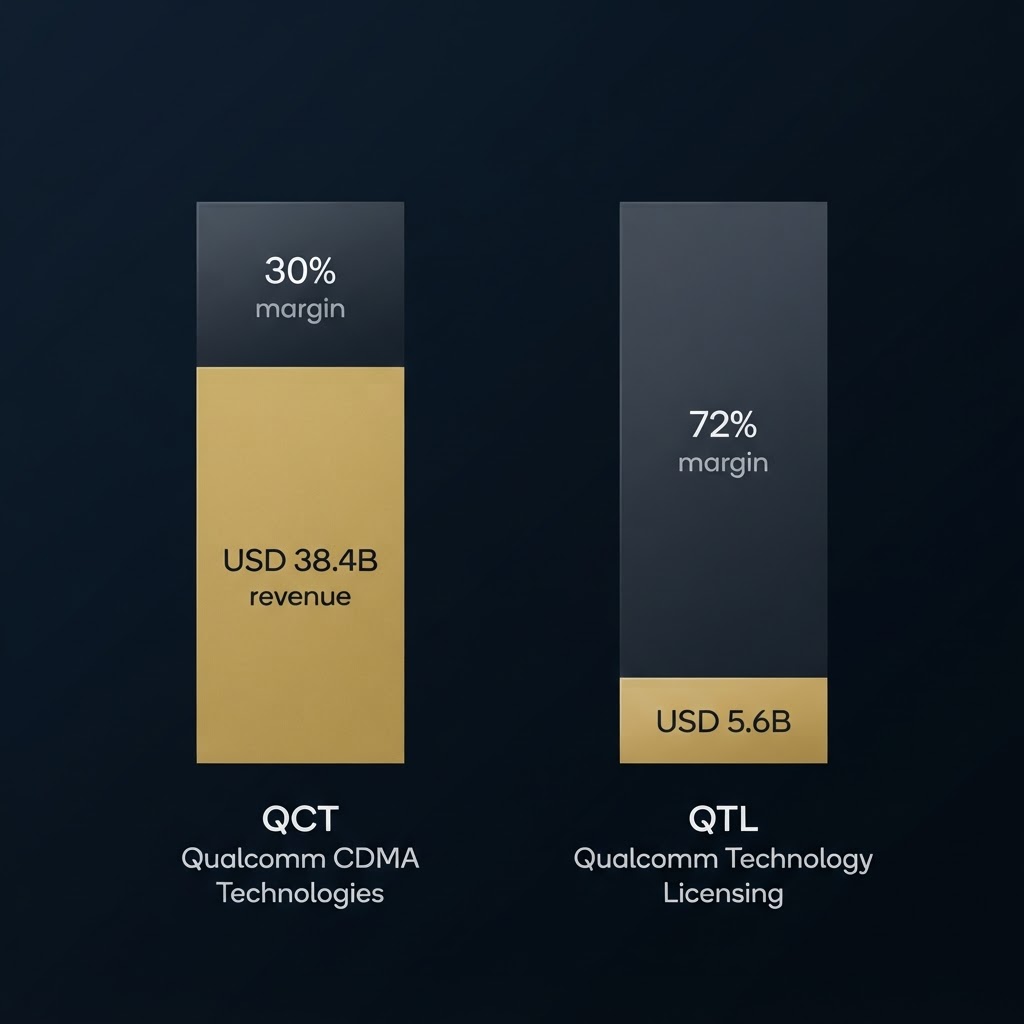
Qualcomm reports its licensing arm, QTL, as a separate segment, so the economics are audited rather than estimated. In fiscal 2025 QTL generated USD 5,582 million of revenue against USD 1,539 million of total costs and expenses, for pre-tax profit of USD 4,043 million, a 72 percent margin that has not moved for three years. The chip business, QCT, turned USD 38,367 million of revenue into USD 11,670 million of profit at 30 percent. Thirteen percent of Qualcomm's revenue produces about a quarter of its pre-tax profit, with no factories, no inventory and, in the ordinary course, no sales cycle.
The reason the margin sits where it does is that QTL's costs are almost entirely fixed: patent prosecution, legal defence and licensing staff. Revenue is a function of the global handset base of roughly 1.2 billion smartphones a year, the royalty rate and the compliance level achieved across several hundred OEM licensees, so incremental revenue drops to the bottom line. Behind that sits a portfolio of more than 140,000 patents and patent applications worldwide.
ARM: a low rate on seven billion chips a quarter
The lesson for anyone designing a licensing programme is the sequencing. ARM bought ubiquity with a low rate for two decades, then raised the rate once the installed base could not leave.
Dolby: 85 percent licensing
Dolby is the cleanest pure-play of the three. Its codecs sit inside Blu-ray, HDMI and streaming standards, so licensing is effectively mandatory for device makers. The same business-model survey that gives ARM about USD 2.7 billion of fiscal 2023 revenue on 250 billion cumulative chips reports that Dolby earned about USD 1.3 billion in fiscal 2023 with licensing around 85 percent of that figure, while spending about 15 percent of revenue on R&D to stay ahead of open-source alternatives.
Four design decisions that set the economics
Royalty base: the part or the product
The most consequential clause in any patent licence is what the percentage is applied to. Qualcomm historically demanded royalties calculated as a percentage of the final selling price of the entire mobile device rather than the modem chip. On a USD 1,000 phone with a 3 percent rate that is USD 30, even if the modem cost USD 30. Apple's position in its 2017 suit was that the base should be the smallest salable patent-practicing unit. The licensor wants the product as the base because the product gets more expensive every year while the licensed component gets cheaper. The licensee wants the part. Whoever wins this clause wins most of the economics.
Royalty rate: standard-essential versus proprietary
Rates are set by what the licensee can do instead. Where a patent is declared essential to a standard, the owner has usually committed to FRAND terms, fair, reasonable and non-discriminatory, which caps the rate but guarantees the market. Rates range from about 1 to 3 percent for standard-essential patents to 5 to 15 percent for proprietary technology; higher rates signal stronger IP but increase the licensee's incentive to vertically integrate. Qualcomm's published multimode rate is 3.25 percent of net selling price for 3G and 4G, rising to 5 percent for 5G. A proprietary claim nobody must use can carry a higher rate on paper and a lower one in practice, because the licensee can walk. Our IP company EX IX keeps a sector-by-sector benchmark of average patent licensing royalty rates for pricing a first licence.
Upfront fee versus running royalty
The upfront fee monetises access and derisks the licensor against a licensee that never ships. The running royalty monetises success. ARM's split shows the two streams behave differently: licensing revenue is lumpy and tied to new design starts, royalty revenue is annuity-like and tied to shipments. A small licensor that cannot audit shipments should weight the upfront fee. A licensor confident in volume and in its ability to verify it should weight the royalty.
Which layer of the value chain pays
Qualcomm licenses handset makers, not competing chipmakers, and its chipmaker licences restrict sales to handset makers that hold their own licence. That value-chain structure is why the same patents can be paid for at the device layer regardless of whose modem is inside. The choice of layer decides who you negotiate with, how many counterparties you have, and whether patent exhaustion cuts off the downstream royalty once an authorised sale occurs. It is also the decision most often made by accident in a first licence.
Why the same model fails below scale
The fixed-cost structure that produces a 72 percent margin at Qualcomm is the reason most patent portfolios earn nothing from licensing. Prosecution, maintenance and enforcement do not shrink because revenue is small. A licensing model only works if the owner can simultaneously stop competitors designing around the IP, stop licensees vertically integrating to replace it, and stop regulators forcing unfavourable terms. ARM, Qualcomm and Dolby have each spent decades and billions on those three defensive battles, and ARM reinvests roughly 35 to 40 percent of revenue in R&D, Qualcomm about 25 percent.
The litigation bill is part of the model, not an exception to it. Apple sued Qualcomm for USD 1 billion in 2017 and the two settled only in April 2019 after injunctions in several jurisdictions, with Apple signing a multi-year licence and paying an undisclosed sum. ARM cancelled Qualcomm's design licence over the Nuvia acquisition and took the dispute to trial in late 2024. A licensor without the balance sheet to see a case like that through is holding a right it cannot price.
The second failure mode is the absence of a standard. If the IP is one option among many, licensees have leverage and royalty rates compress over time; if the IP is woven into an industry's infrastructure so deeply that switching costs are prohibitive, the owner has a toll booth on an entire market. A single family that covers an elegant improvement nobody is required to adopt is a product idea or an acquisition target. It is rarely a licensing business.
Can a startup run a patent licensing business model?
Epirus frames the fork for patent-first companies as product, licensing or acquisition, and its examples show why the first and third dominate. Commonwealth Fusion Systems spent three years developing a high-temperature superconducting magnet that reached a record 20-tesla field in 2021, and investors committed roughly USD 1.8 billion in Series B funding later that year because the patented magnet de-risked the fusion thesis. In 2021 alone, 996 new university IP-based startups were formed in the United States. CFS did not license the magnet. It built the reactor around it, because the licensee market did not exist yet.
Three conditions have to hold before licensing is the right fork for a small portfolio.
- The claim sits on a bottleneck an existing industry must pass. Not a better way, a required way. If a manufacturer can ship without you, the rate converges on zero.
- The licensee base already ships volume. A royalty is a percentage of someone else's revenue. If that revenue is still a forecast, the model has no base.
- Enforcement can be financed. Either the owner has the balance sheet, or a licensing company or litigation funder carries the cost for a share.
If those hold, the family can be run as a licensing programme or placed with a licensing company. If they do not, the honest choices are to build the product or to sell the family, and we have set out the trade-offs in whether to license it or build around it and in what a startup built around a patent needs before it raises. The contract mechanics of base, rate and layer are covered in our guide to the patent licensing agreement.
How EX EPIC runs licensing inside a venture builder
Our answer to the scale problem is to run the licensing model at portfolio level rather than at single-company level. EX IX is a patent liquidity marketplace with 24 patent families filed and around 100 more validated in the pipeline, focused on clean energy, inside a group that finances, patents and deploys deep tech across four continents on a EUR 160 million plus capital track record.
The operating pattern is different from Qualcomm's in one respect and the same in another. Different: a patent family is created for a portfolio company, and licensing to a deployment partner, sale through the marketplace, or building the product inside the portfolio are all live exits for the same asset. Licensing is one route among several, so a family that fails the three conditions above is not stranded. The same: the fixed costs of prosecution, validation and enforcement are shared across the whole pipeline, which is the only way a family that would never justify its own legal budget becomes a licensable asset. That is also what makes patents legible to the investors we work with, which is the subject of our note on IP as an asset class. For founders deciding how to structure a programme before the first licence, the sequencing questions live in our patent licensing strategy guide.
The practical test we apply to each family is the one this article has been building toward. Would a licensee pay the device-price base or only the component base? Is the claim standard-essential, de facto standard, or merely useful? Can we verify shipments, and can we afford to be sued? A family that passes three of four is run as a licensing programme. One that passes fewer is built or sold.
FAQ
What is the difference between a licensing fee and a royalty?
A licensing fee is paid once, or per term, for access to the intellectual property regardless of how much the licensee ships. A royalty is paid on use, either a fixed amount per unit or a percentage of sales, and is usually settled quarterly. Most patent licences combine both: an upfront fee that compensates the licensor for access and a running royalty that scales with the licensee's success. ARM reports the two as separate revenue streams.
Why are patent licensing margins so high?
Because the costs are fixed and the revenue is not. A licensor pays for prosecution, maintenance, legal defence and a licensing team whether it has one licensee or three hundred, and the cost of adding another licensee is close to zero. Qualcomm's licensing segment turned USD 5,582 million of revenue into USD 4,043 million of pre-tax profit in fiscal 2025 for exactly that reason. The same structure means margins collapse when the licensee base shrinks.
What royalty rate does a patent licensing business charge?
It depends on whether the licensee has an alternative. Standard-essential patents under FRAND commitments typically earn about 1 to 3 percent of the product price, and proprietary technology that a licensee could choose not to use earns about 5 to 15 percent on paper. Qualcomm's standard multimode rate is 3.25 percent of a handset's net selling price, up to 5 percent for 5G devices. ARM charges one to two percent of the chip price and relies on volume.
Is a patent licensing business model a good fit for a university spinout?
Usually not on its own. A spinout's claim typically covers a technology whose market does not yet exist, so there is no shipment base to take a royalty on and no licensee that must use it. Licensing becomes viable once an industry has adopted the approach and the claim sits on a step it cannot avoid. Until then, building the product or selling the family to a buyer who can absorb the enforcement cost is the more common path.